The Poetry of Soft Light in Pastoral Art
There are landscapes that describe a place, and there are landscapes that describe a feeling. Pastoral art often belongs to the second kind. A field may be ordinary, a hill almost anonymous, a path hardly more than a pale break in the grass—yet light can make each of them feel remembered.
When the sun is low or the air is veiled, the countryside stops presenting facts. Edges loosen. Distance grows. A cottage becomes a small sign of shelter; a flock becomes a rhythm; a horizon holds more time than geography.
Soft light is one of painting’s quietest instruments. It does not need spectacle to change the story. It only needs to make certainty porous enough for the viewer to enter.
In This Article
Why Soft Light Changes a Landscape
Hard light defines; soft light suggests. In direct sun, we notice individual leaves, fence posts, roof tiles, and the exact edge of a shadow. When mist, cloud, or the low angle of morning diffuses that light, forms begin to belong to one another.
A tree becomes less an object than a silhouette against a field. Grass becomes a shared wash of olive and gold. The sky enters the ground through haze. Nothing disappears completely, but the painting stops explaining every distance with equal confidence.
That reduction is not a loss of information. It creates hierarchy. A dark foreground gives way to a quieter middle distance, then to a horizon that seems to dissolve rather than end. The eye understands where to begin, but it is allowed to wander before arriving anywhere.
Claude Lorrain understood this with unusual clarity. In the National Gallery’s Seaport with the Embarkation of the Queen of Sheba, warm sunrise light catches water, cloud, foliage, and the silhouettes of boats. The scene contains activity, yet the light gathers it into one atmosphere.

The Emotional Language of Pastoral Art
Pastoral art has long carried the idea of life beyond the city: cultivated land, shepherds, animals, villages, and human figures held within a larger natural order. It is not a documentary category. Its countryside is often shaped by longing.
The Metropolitan Museum of Art describes François Boucher’s reinvention of the pastoral as an idealized landscape populated by shepherds and shepherdesses. That theatrical world is different from a solitary modern meadow, yet both rely on the same imaginative distance between daily life and the country as it is dreamed.
A field can suggest freedom because nothing seems to prevent movement. A path can suggest return because its destination remains out of sight. A cottage beneath a wide sky can suggest shelter precisely because the surrounding landscape feels so large.
Even a tiny figure changes the emotional scale. Without a person, the land may feel timeless. With one person, it becomes a place in which time is being experienced. A herdsman resting under a tree can introduce solitude without loneliness.
The National Gallery notes that the shepherd or goatherd in classical art could represent a lost age of innocence or retreat from worldly concerns. That history still echoes in vintage pastoral wall art, even when viewers no longer know the original symbols. We recognize the desire before we name it.
Soft light makes that desire tender rather than declarative. It removes some certainty from the image and lets the landscape become a container for private memory.
Morning Light, Evening Light, and Memory
Early morning and late afternoon are powerful in painting because both belong to transition. They are hours in which the world appears to be becoming something else.
Morning light carries possibility. It may arrive cool and pearl-colored, allowing a meadow to emerge slowly from mist. Shadows are present but not yet heavy. The scene feels private, as though the viewer has entered before the day has learned to perform.
Evening light is more reflective. It lowers, warms, and lengthens. Gold settles into olive and brown; trees darken against the sky; a distant roof may catch the final brightness while the foreground has already begun to leave.
Both kinds of light are temporary, and perhaps that is why they resemble memory. We are moved not only by what is beautiful, but by what is already changing while we look at it.
A painting interrupts that disappearance. It holds a specific instability—the sun before it clears the mist, or the field before it becomes shadow—and allows us to return without asking the hour to repeat itself.
Pastoral light does not freeze time. It lets us feel time passing without losing the moment completely.

Why Distance Feels So Powerful
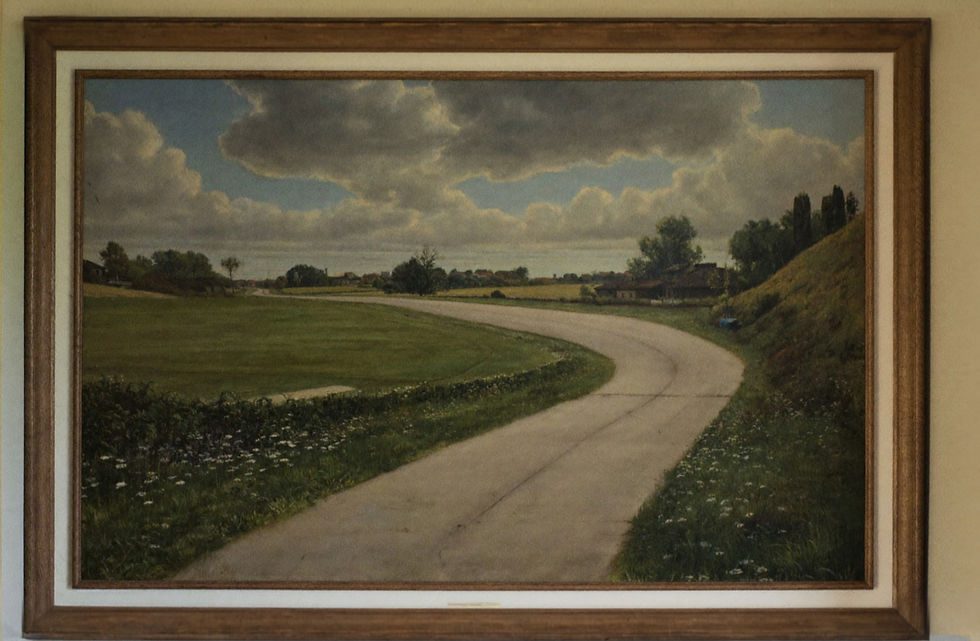
Many pastoral paintings are built in stages. Grasses, stones, or a fence establish the foreground. A path or stream leads into the middle distance. Beyond it, trees become smaller, hills become paler, and the sky begins to share its color with the land.
This creates perspective, but it also creates longing. The eye travels toward what cannot be fully reached. A distant horizon is compelling because it offers an elsewhere while withholding its details.
Atmospheric perspective deepens that effect. Cooler, lighter, and less distinct forms appear farther away; darker contrast brings the foreground nearer. The technique is visual, yet its emotional consequence is spaciousness.
Inside a room, a deep landscape can make a flat wall behave almost like an opening. It does not imitate a window literally. It gives the mind a second distance to inhabit, which is why even a small pastoral print can alter a narrow hallway or reading corner.
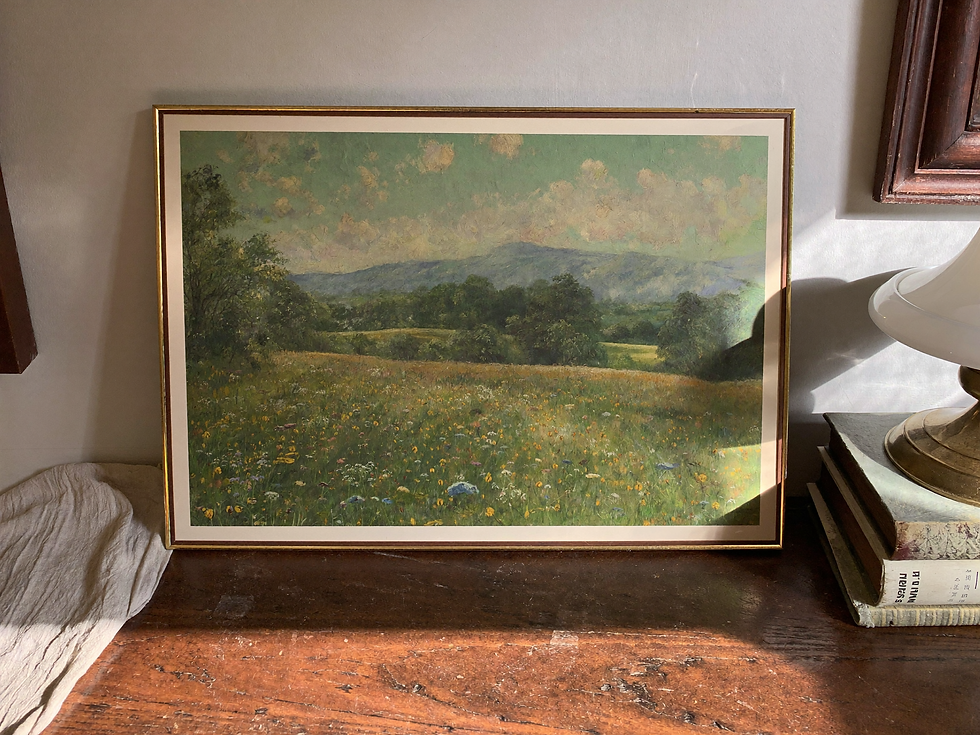
This quiet use of recession is especially clear in misty meadow art, where the softened horizon slows the gaze and gives busy interiors somewhere to settle.
Bringing Pastoral Light into an Interior
Pastoral art enters a home easily because its colors already belong to natural materials. Soft green sits beside oak; muted gold belongs near aged brass; warm cream meets linen and plaster; mist gray feels at home with stone.
But easy color is not the same as passive art. A strong pastoral painting should keep some independence from the room. If every olive in the field becomes a cushion and every cream in the sky becomes upholstery, the image is reduced to a palette reference.
Instead, repeat one or two quieter notes and let the artwork retain its weather. A walnut frame can give a pale meadow structure. Antique gold can bring warmth to an evening field. Pale oak can keep a darker scene from becoming solemn.
Scale changes the reading. Above a sofa, a broad horizon can become the room’s emotional center. In a bedroom, a misted field sits closer to the daily rhythm of sleep and waking. In an entryway, a path can make arrival feel like the beginning of movement rather than its end.
The key is breathing room. Keep accessories below the frame low and selective. One lamp, a ceramic vessel, or a small stack of books is enough. If branches cross the important horizon or several objects repeat the same silhouette, the room begins narrating over the painting.
For a closer look at how restrained materials support rather than smother art, see our guide to a warm neutral living room. For a more intimate application, bedroom wall art ideas considers what it means to live with an image at the first and last hours of the day.

What to Look for in a Pastoral Print
Begin with atmosphere rather than subject. Two paintings may both contain a field, a cottage, and distant hills, yet one invites the eye inward while the other remains merely descriptive.
Light: Does it reveal every detail, or does it leave some of the scene suspended?
Distance: Can the eye travel from foreground to horizon without encountering visual clutter?
Temperature: Is there a quiet relationship between warm ground and cooler sky, or between golden light and olive shadow?
Structure: Does one tree, path, figure, or dark edge prevent the softness from becoming vague?
Imagination: Does the painting finish the story for you, or leave enough room to enter?
Return: After looking away, is there a particular light, shape, or unresolved distance that draws you back?
For printing, matte paper preserves subtle transitions without adding window glare. Canvas can deepen the painterly presence, while textured fine-art paper gives weathered color a tactile surface. The reproduction should hold separation in the pale areas; if sky, mist, and distant hill collapse into one flat tone, the atmosphere is lost.
Frame according to the image’s need for structure. Pale scenes often welcome walnut or aged brown wood. A restrained antique-gold frame suits romantic landscape art, especially when warm light is part of the subject. Black can make a pastoral image feel contemporary, though it should not sever a very delicate scene from the room.
Our curated look at Havenest vintage landscape prints explores how horizon, scale, and narrative vary across a broader landscape collection.
The Landscape We Return To
Soft light is not only a visual effect in pastoral art. It is part of the story. It can make a familiar place feel remembered, an empty field feel inhabited by emotion, and a simple horizon seem to hold time.
Perhaps that is why these paintings remain easy to return to. They do not insist that we understand them at once. They allow recognition to arrive slowly: a road we may have taken, a weather we once waited through, a quiet we have not yet found.
A little light on a field. A path becoming pale in the distance. A sky holding the final warmth at its edge. Nothing in the scene needs to happen, and still the scene is not empty.
The poetry lies in that restraint. The land is present, but not fully explained. The light is fading, but not gone. The viewer is invited, but never hurried.
Words and visual direction by Havenest.


Comments