
Misty Meadow Art: How to Style Its Quiet Beauty at Home
A misty meadow does not behave like a decorative accent. Give it enough space and it changes the pace of a room. The horizon draws the eye outward, the softened distance makes the wall feel deeper, and the absence of sharp detail gives busy furniture a place to settle.
That effect is easy to lose. A print hung too high becomes background noise. A frame with too much ornament can turn a pale landscape into something stiff. Even the familiar advice to “match the green” often works against the painting, producing a room that feels coordinated rather than lived in.
This guide looks at misty meadow art as both an image and an interior decision: how to choose the scale, build a palette around it, print it well, and place it where its quietness can actually be felt.

In This Article
Why Mist Changes the Feeling of a Landscape
Mist edits a view before the painter ever touches it. It removes the fence posts, softens the tree line, and lets several shades of green collapse into one uncertain field. What remains is not emptiness but hierarchy: a darker foreground, a quieter middle distance, and a horizon that seems to recede rather than stop.
That is why atmospheric landscape art can calm a room without looking bland. The eye still has somewhere to travel. It simply travels slowly.
In Claude Monet’s Morning Haze, trees emerge from pale color rather than being neatly outlined. The National Gallery of Art’s image is a useful reminder that softness depends on small tonal shifts, not on making everything gray.
Quiet art is sometimes described as neutral, but that misses the point. A convincing misty meadow has tension inside it: a cool sky against warmer ground, one dark trunk against a blurred field, or a path that vanishes before we know where it leads. The room benefits from that uncertainty. It gives the gaze something to return to.
Choose the Scale Before the Frame
Start with the wall, not the file size. A three-seat sofa needs a piece with enough visual weight to belong above it. A small print floating in the center of a wide wall nearly always looks accidental, no matter how beautiful the image is. Either scale the artwork up, build a considered grouping, or move it to a narrower wall where intimacy is an advantage.
For a large living-room placement, aim for an artwork that occupies a clear share of the furniture width beneath it. The exact number matters less than the relationship: the art should feel connected to the sofa or console, not suspended in another composition. Leave breathing room at the sides and keep the center of the image near a comfortable standing eye level.
Small misty landscapes work differently. Place one beside a reading chair, above a bedside table, or on a short hallway return. At that scale, the viewer can approach the image and notice brush texture, a pale break in the clouds, or the edge of a distant path. The piece becomes almost private.
If the rest of the room already follows a restrained palette, see our guide to quiet luxury home decor. It explains how natural materials and negative space can support art without turning the room into a beige showroom.

Build the Room Palette from the Sky, Not the Grass
The obvious move is to pull green from the meadow and repeat it around the room. A sage cushion appears, then an olive vase, then a green throw. Soon the painting looks less like a view and more like a color swatch. One echo is enough.
Look upward instead. Misty skies often contain warmer and more useful interior colors: chalky white, mushroom, blue-gray, faded lilac, or a thin wash of cream near the horizon. These tones are easy to carry into plaster walls, linen curtains, a wool rug, or an upholstered chair. They support the image while allowing the field to remain the field.
Wood keeps a pale landscape from washing out. Light oak feels airy; walnut gives the picture a firmer edge; aged brown wood introduces a little history. Stone and ceramic work for the same reason. Their irregular surfaces make digital or printed art feel less flat.
Do not make every finish equally quiet. A dark lamp, a blackened metal detail, or one deep brown frame can give the room the contrast it needs. Restraint is more convincing when something in the composition has the courage to be dark.
Print and Frame Without Losing the Atmosphere
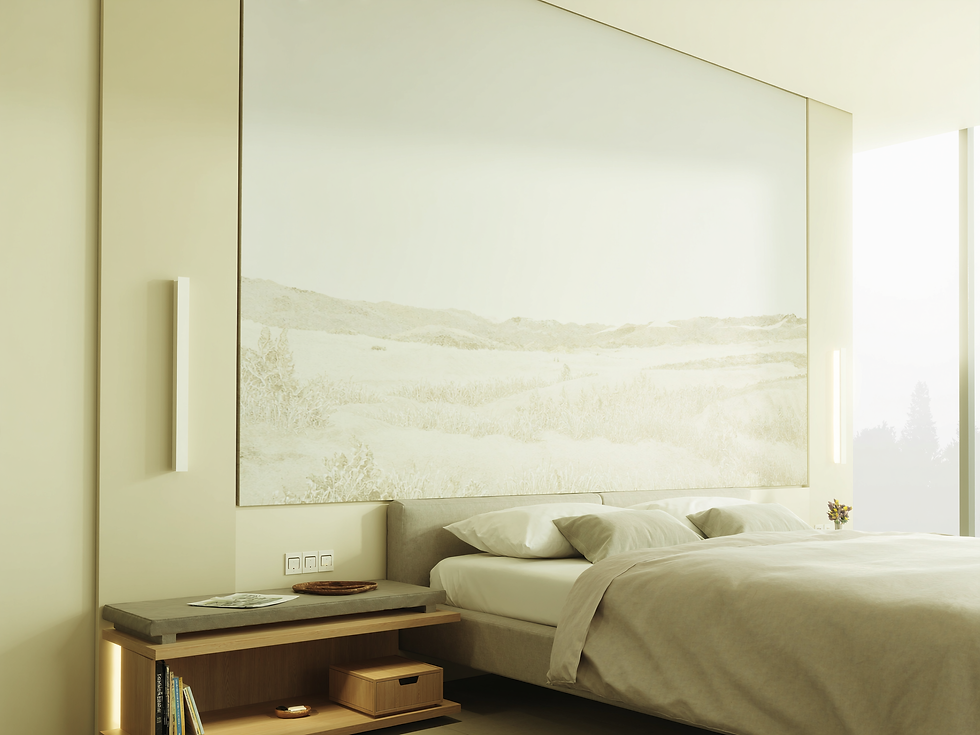
For misty meadow wall art, matte surfaces are usually the safer choice. Glossy paper sharpens reflections and can make the palest areas disappear whenever a lamp or window catches the print. Heavy matte paper preserves subtle color while still looking crisp. Canvas softens the image further and suits rooms where you want the piece to read more like a painting than a poster.
Choose the frame after deciding how much structure the image needs. A narrow walnut or dark wood frame gives a foggy view a clear boundary. Pale oak keeps the overall effect light. An ornate gold frame can work with a more traditional landscape, but it should not become the first thing you notice. If your eye lands on the frame before the horizon, the frame is probably doing too much.
A mat changes the mood as much as the frame. Wide warm-white matting makes a small print feel considered and gives it architectural presence. For a large canvas, skip the mat and let the image occupy the surface. In either case, avoid a bright optical white beside a warm, muted painting; it can make the art look unexpectedly dull.
For another study in how fog creates distance, compare the muted tree line in Pines in a Morning Fog. The foreground remains legible while the background nearly dissolves — exactly the balance a good print needs to retain.

The Havenest Edit: Landscapes with Room to Breathe
At Havenest, we are drawn to landscapes that leave part of the story unfinished. A disappearing path, a low horizon, or a field with no obvious landmark can hold attention longer than a scene that explains itself immediately. The print does not need to dominate the room. It needs to give the room somewhere to look.
Digital wall art is useful here because the final mood is not fixed at purchase. The same file can become a small matted print for a bedside wall, a wide statement piece above a sofa, or a canvas that brings a softer painterly surface into the room. The choice belongs to the space rather than to a warehouse size.
If floral fields appeal more than fog, continue with our nature-inspired wall decor guide. It takes a brighter, more botanical approach while using the same principles of scale, material, and restraint.
A Room-by-Room Placement Checklist
Before hanging the print, stand in the doorway and notice what the wall is already doing. Is it the first surface you see, a background to conversation, or a quiet edge of the room? The answer matters more than any universal hanging rule.
Living room: Use one confident scale above the sofa or console. Keep small accessories below it low enough that they do not interrupt the horizon.
Bedroom: Choose the palest version of the palette and hang it where you can see the image from the bed, not only from the doorway.
Hallway: A medium or small framed print works well on a narrow wall. Give it one lamp or a simple console, not a parade of tiny objects.
Reading corner: Let the art sit slightly lower and closer to the chair. This is one place where intimacy matters more than symmetry.
Home office: Place the meadow beside the desk rather than directly behind the screen. It should offer the eye a different distance during a pause.
Finally, live with a temporary paper outline for a day before drilling. Morning light, seated sightlines, and nearby door frames often reveal proportion problems that a tape measure misses.
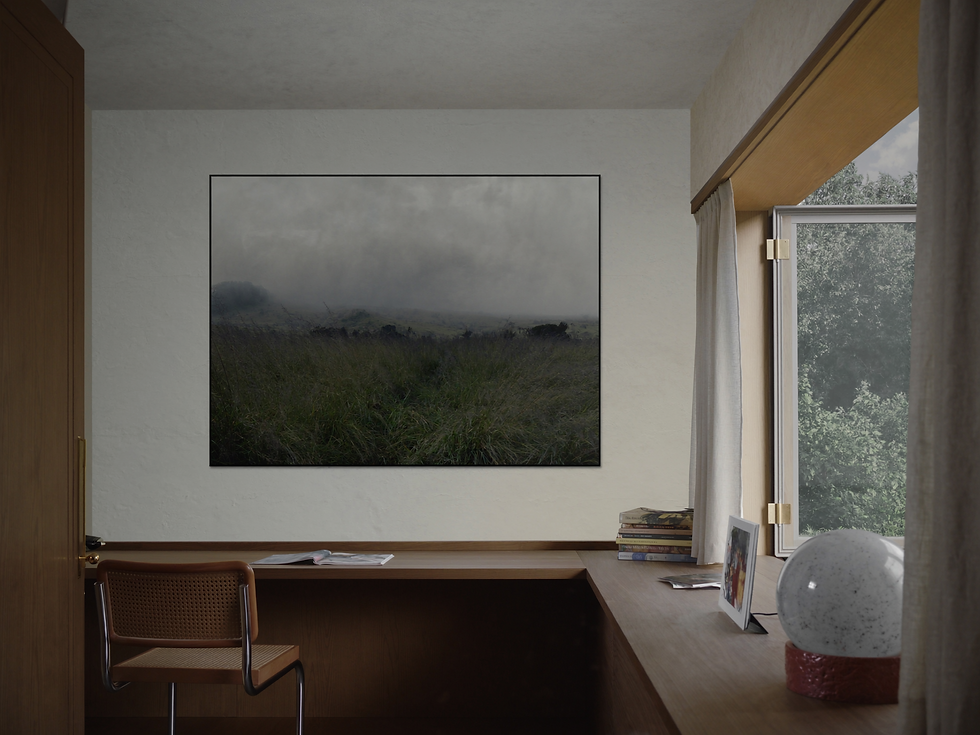
A misty meadow earns its place slowly. It may not be the first object a guest comments on, and that is part of its strength. Over time, the softened horizon becomes a familiar pause in the room — somewhere the eye goes when conversation stops, the kettle is boiling, or the afternoon light changes.
Choose the scale with confidence, keep the materials honest, and allow one or two imperfect contrasts. The landscape will do the rest. It does not need to shout across the room. It only needs enough space to remain quiet.
Find a landscape that feels calm, spacious, and already at home in the Havenest Etsy shop.


Comments