Romanticism Vintage Art: When a Painting Reads You Back
Updated: Aug 30
Sometimes we choose a painting because it works with a room. And sometimes the opposite happens: the painting arrests us first, before we have considered the wall, the frame, or even whether we can explain why we want to keep looking.
Romanticism vintage art belongs to that second category. Its landscapes are rarely just landscapes. Its lovers are rarely only lovers. A figure at a window may be waiting, leaving, remembering, or finally choosing not to return. The story remains open long enough for the viewer to enter it—and once we do, the picture begins to borrow something from our own inner life.
This is the idea behind the Havenest Romanticism collection. The pieces were gathered less as decorative answers than as visual stories: scenes with enough atmosphere, tension, and silence to keep unfolding. What draws you to one may not diagnose you in any literal sense. But it can reflect the feeling you are ready to recognize. In that way, a painting does not simply hang in front of you. It quietly reads you back.
In This Article
Romanticism Was Never Interested in Polite Feelings
The Romantic movement gathered force in Europe around the beginning of the nineteenth century. As The Metropolitan Museum of Art’s overview of Romanticism explains, imagination and emotion became central at a moment when confidence in reason and order had begun to fracture. Nature appeared not as a tidy background but as something immense, unpredictable, and sometimes terrifying. Literature, memory, distant histories, private longing, spiritual doubt, and the sublime all entered the painter’s field.
That is why the word romantic here means far more than courtship. A Romantic picture can hold tenderness, certainly, but also dread, exile, devotion, rebellion, grief, awe, and the loneliness of standing before something larger than oneself. Its drama may be obvious—a storm, a farewell, a ruined coast—or compressed into one suspended gesture: a hand that has not yet reached another hand; a letter that may never be opened.
A Painting Begins Where the Written Story Stops
A novel can tell us who left, who lied, who returned, and what the weather meant. A painting offers one frame and withholds the rest. We receive a room, a landscape, two figures, a certain quality of light. We are asked to become the missing pages.
Consider a couple paused at a threshold. One viewer sees a farewell; another sees the moment before reconciliation. Someone who has recently chosen freedom may notice the open door. Someone who is still waiting may notice the distance between the bodies. The painted facts stay the same. The emotional plot changes with the person looking.
This openness is not a flaw to be solved by reading the label. It is the source of the work’s longevity. Narrative vintage art continues to feel alive because it refuses to finish itself without us. A familiar piece can even change as our own lives change. The scene we once read as abandonment may later look like courage.
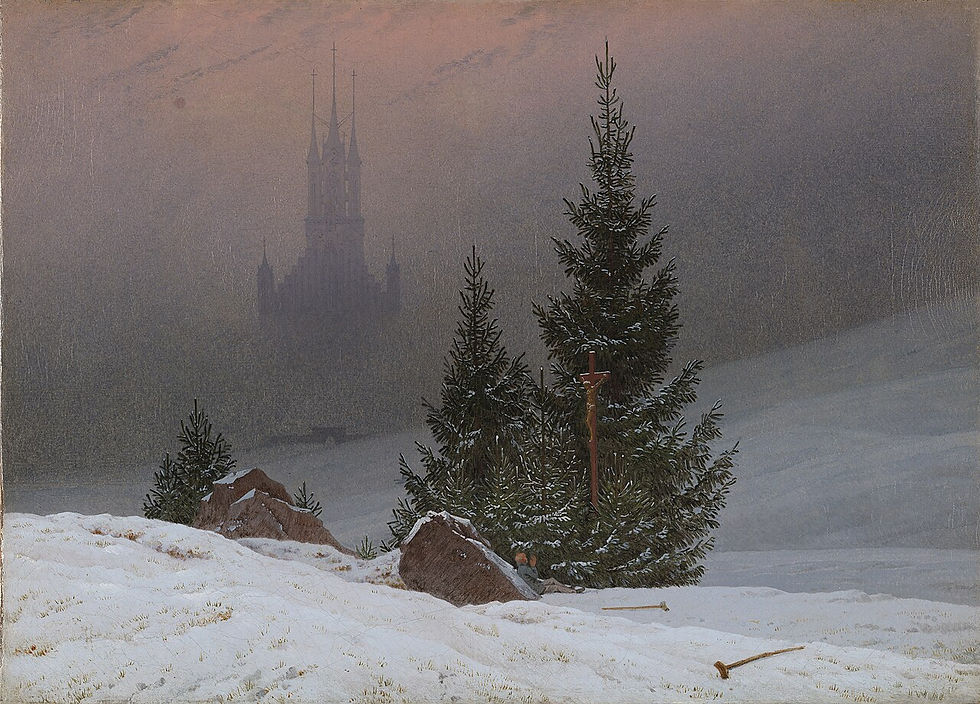
Caspar David Friedrich’s Winter Landscape is a useful example. The National Gallery describes a tiny figure, discarded crutches, snow, a cross, and a cathedral emerging through mist. Those elements can be read as despair, faith, endurance, or renewal. The landscape carries the feeling, yet leaves room for the viewer to decide where hope begins.
The Image That Attracts You May Be Reading You Back
There is a particular intimacy in being stopped by an image you did not expect to like. Perhaps it is darker than the work you normally choose. Perhaps the figure’s face is turned away, or the landscape feels too empty, or the scene contains a sadness you would not knowingly invite into a room. Still, you return.
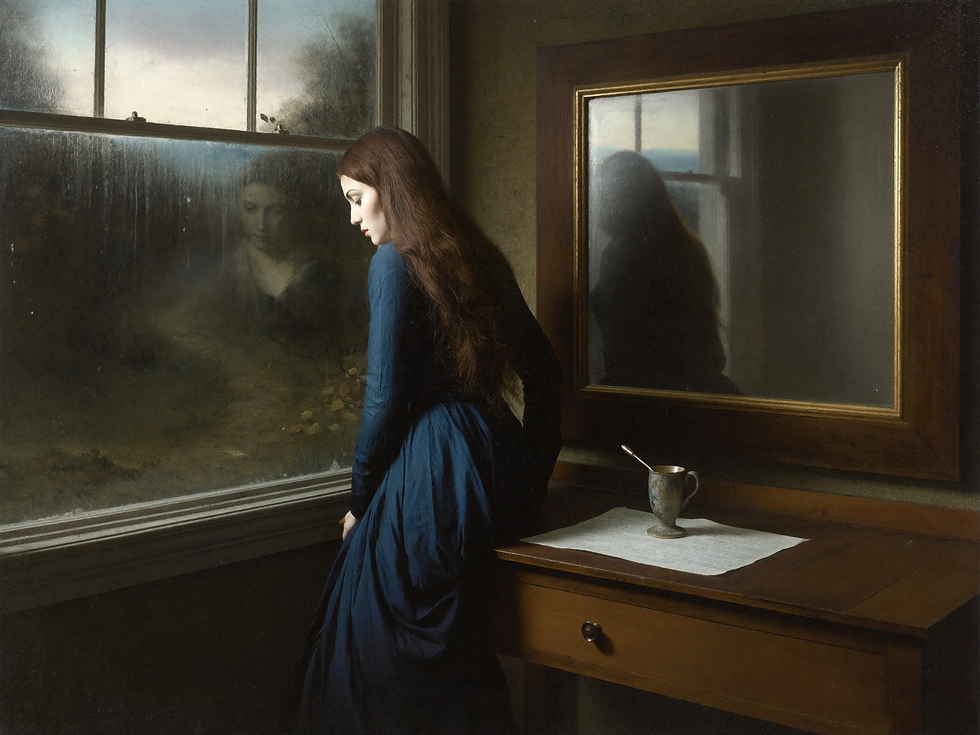
This is where looking becomes reflection. Not a personality test, and not a claim that a picture can expose some fixed truth about you. The process is quieter than that. Attention is selective. We notice the details that have somewhere to land: the unread letter, the path disappearing into fog, the person who stands apart from the gathering.
The painting gives those feelings a shape outside the self. Longing becomes a horizon. Uncertainty becomes weather. Solitude becomes a figure held within a vast composition rather than a private failure. Sometimes that distance is exactly what makes a difficult emotion bearable enough to contemplate.
You do not always choose a painting because it matches the sofa. Sometimes you choose it because it has already named a feeling you have avoided. Living with it does not mean remaining inside that feeling. It means allowing the feeling to become visible, beautiful, and capable of change.
What Different Scenes May Reveal
Lovers at a threshold may speak to the tension between closeness and freedom. Are they meeting, parting, or unable to decide? Your answer often depends on which possibility feels most charged.
A solitary figure at a window can suggest waiting, but also privacy, self-possession, or the courage to remain still while the world expects movement.
A reader, poet, or small salon gathering may attract those who long for intellectual companionship—the feeling of being understood through ideas, not merely admired.
A lone traveler before mountains or sea can hold ambition and humility at once. The landscape does not flatter the figure; it gives scale to a private struggle.
A storm, ship, or dark horizon may appeal during periods of uncertainty. Turbulence becomes composed inside a frame: still powerful, but finally possible to look at.
A moonlit garden, distant path, or turned-away figure often belongs to memory. The scene may feel less like something happening now than something the viewer has not fully finished remembering.

The most revealing question is often not “What does this painting mean?” but “What story did I immediately give it?” The answer belongs partly to the art and partly to the life you brought into the room.
The Havenest Romanticism Edit
The Havenest edit of Romanticism vintage art was assembled around that moment of recognition. The collection favors pictures with narrative pressure: images that appear to have a before and an after, even when neither is shown. They invite a slower kind of looking than trend-led wall decor and reward the person who wants art to remain slightly unresolved.
Some pieces may meet you through atmosphere—a storm, a forest, a strange clearing of light. Others work through human distance: two people nearly touching, one person waiting, a gathering in which someone seems emotionally elsewhere. The right work is not necessarily the easiest or the most immediately harmonious. It is the one whose silence feels specific.
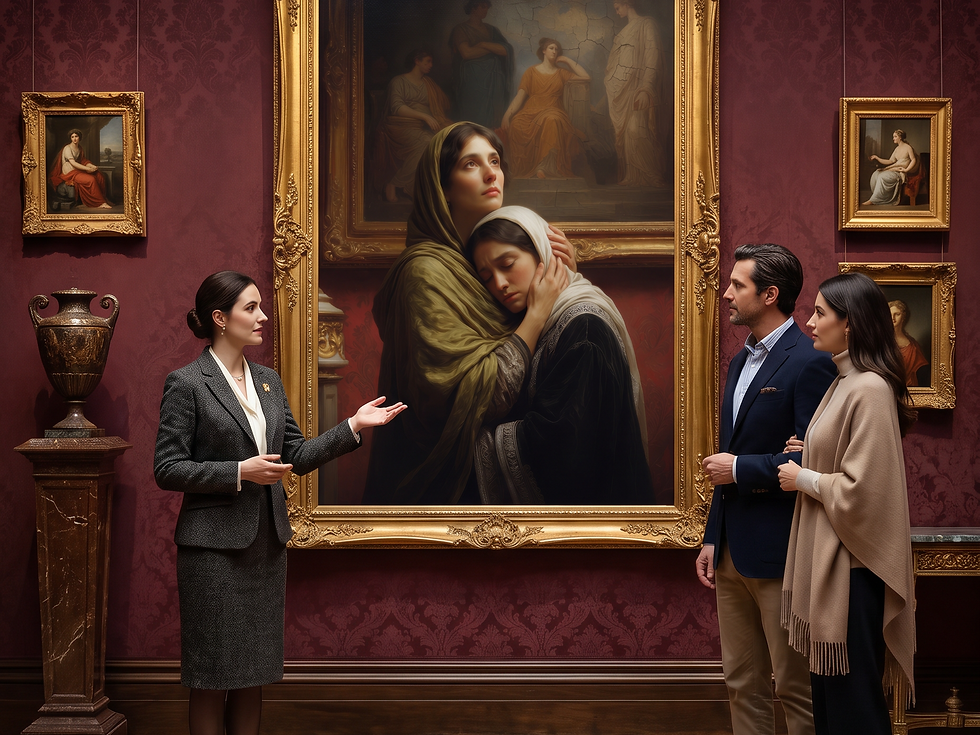
This is also why the collection is offered as printable art. The digital format makes room for a private act of interpretation after the selection: choosing the paper, scale, and frame through which the story enters your life. The result can feel less like acquiring a finished object and more like completing the last stage of its arrival.
Explore the Havenest Romanticism vintage art collection on Etsy—and begin with the piece you cannot quite explain.
How to Live With Art That Keeps Telling a Story
Narrative art benefits from a little space around it. It does not need an elaborate gallery wall or a room built around a theme. In fact, one emotionally charged work often becomes more articulate when it is allowed to stand alone.
Place it where looking can be unhurried: beside a reading chair, across from the bed, at the end of a hallway, or above a desk where the eye naturally lifts. The approach is close to the softer, more personal idea of interiors explored in Quiet Luxury Home Decor—fewer objects, chosen with more attention.
Scale changes the voice of the story. A large print makes the scene environmental; you feel drawn into its weather and architecture. A smaller print becomes intimate, almost like an illustration found inside an old book. Neither is more important. Choose according to the distance from which you want the work to speak.

Frames can add period feeling without turning the room into a costume. A narrow antique-gold profile, dark wood, or warm off-black frame will often hold the mood while allowing the image to remain central. Matte or softly textured fine-art paper suits vintage oil painting prints particularly well because it keeps the surface quiet and reduces the slickness of modern reproduction.
Most of all, resist the urge to explain the painting to every visitor. Let it keep some privacy. The same principle gives misty meadow art its pull: atmosphere is not empty space but a place where the viewer’s own memory can gather.
A meaningful collection grows through these encounters. One picture may hold the part of you that waits; another, the part that leaves. Over time the walls become less a display of taste than an archive of attention—a record of the stories, tensions, and forms of beauty you were willing to recognize.
Romanticism vintage art endures because it does not reduce emotion to a slogan. It gives feeling a landscape, a body, a season, and a silence. The viewer is not asked to admire from a safe distance. We are asked to enter, complete the story, and notice what we brought with us.
The picture you choose may not reveal who you are forever. It may reveal who you are today: what you miss, what you fear, what you are ready to forgive, or what kind of beauty still makes you stop. Tomorrow, the same scene may tell you something new. That is not inconsistency. It is the privilege of living with art that remains alive.
Browse the Havenest Romanticism collection on Etsy and follow the image that feels less like decoration—and more like recognition.


Comments