Why Monet Painted the Same Scene Again and Again
The first painting of a place gives us recognition. The second makes recognition less secure.
By the third, we may realise that Monet was never trying to settle the scene. He was asking how many different lives could exist inside the same view.
This is why the repeated subjects in his paintings do not feel like copies. A haystack, a row of poplars, a cathedral façade, or a bridge becomes a small instrument for measuring change. The motif stays in place while the world around it keeps moving.
So why did Monet paint the same scene again and again?

Claude Monet, The Houses of Parliament, Sunset, 1903. National Gallery of Art. Open Access image.
Repetition was a way of seeing
The simplest answer is that Monet wanted to study light. The more revealing answer is that light gave him a reason to return.
A single glance tends to turn a place into an object. We see a cathedral and name it. We see a field and move on. Repetition interrupts that speed. It keeps the eye near the subject long enough for details that seemed secondary—the colour of a shadow, the softness of an edge, the reflection beneath a tree—to become structural.
The repeated motif functioned like a fixed question.
What changes when the sun moves? What happens when mist enters the view? How does snow alter the relationship between colour and weight? When does a building stop looking like stone and begin to look like light?
Monet did not need the answer to be permanent. He needed the question to remain alive across several canvases.
This makes the series a discipline of attention. The painting is not finished when the artist has identified the thing. It becomes interesting when identification begins to fail.
He was painting time, not only place
The series format allowed Monet to make something usually invisible—duration—appear on a wall.
A place does not have one appearance. It has a morning appearance, a winter appearance, a rainy appearance, a version seen through smoke, and another seen after the eye has adjusted to brightness. We usually carry these versions in memory without separating them.
Monet separated them.
The National Gallery describes his famous series as images of a single subject under different lighting conditions. The Metropolitan Museum of Art places the Haystacks, Poplars, and Rouen Cathedral among the works through which Monet pursued the changing processes of perception.
Each canvas becomes a temporary agreement between the world and the eye.
That agreement can be warm or cool, dense or transparent, sharp or nearly dissolving. None of the paintings cancels the others. Together, they suggest that the truth of a place may be plural.

Claude Monet, Morning on the Seine near Giverny, 1897. The Metropolitan Museum of Art. Open Access image.
Haystacks made the ordinary inexhaustible
Haystacks were not grand subjects. That was part of their usefulness.
Around Giverny, Monet could observe the stacks repeatedly without the interruptions that came with a changing human scene. Their shape was stable enough to return to, but their surface was open to snow, dusk, frost, and the low gold of the sun.
The National Gallery in London records that Monet painted twenty-five grainstack compositions between late summer or early autumn 1890 and February 1891. The series turned a familiar agricultural form into a sustained investigation of atmosphere.
This was also a quiet argument against the hierarchy of subjects.
A haystack did not need a mythological story or a historical event to deserve prolonged attention. Its significance could emerge through the act of looking. The longer Monet stayed with it, the less ordinary it became.
The paintings suggest that attention itself can enlarge a life.
A stack is first a stack. Then it becomes a surface of orange and violet. Then it becomes a record of weather, season, distance, and the body's changing response to cold or light.
Repetition did not make the object smaller. It made the world around it visible.
Poplars gave change a rhythm
The Poplars series introduces a stronger sense of movement. The trees rise in vertical intervals, like a visual pulse along the River Epte. Their reflections repeat the trunks below, then break the order into wavering colour.
The National Galleries of Scotland describes Poplars on the Epte as part of the series Monet made in 1891, using a boat as a floating studio. The museum also records that he helped delay the felling of the trees so he could complete his work.
The story is practical, but it reveals something important about the paintings. Repetition was not a purely intellectual programme. It depended on logistics, weather, physical endurance, and the unstable availability of a living landscape.
The poplars could be seen again because Monet made the conditions for returning possible.
Across the series, their vertical structure remains recognisable. Yet the colours alter the tempo. A clear day gives the scene a crisp, almost architectural beat. A cooler atmosphere softens the intervals. Reflections pull the rhythm downward, making the trees feel less like objects and more like vibrations.
The same view becomes a sequence rather than a location.

Claude Monet, Waterloo Bridge, London, at Dusk, 1903. National Gallery of Art. Open Access image.
Rouen Cathedral tested permanence
If the haystacks made the ordinary inexhaustible, Rouen Cathedral made the permanent uncertain.
Monet painted more than thirty views of the cathedral in Normandy between 1892 and 1893, moving between canvases to capture the changing effects of light and atmosphere. The National Gallery of Art notes that he later finished the works in his studio at Giverny.
The building's historical and architectural weight creates a productive tension. A cathedral seems designed to survive individual weather, individual bodies, even individual generations. Monet's canvases insist that its visible identity is still dependent on an hour of the day.
In one painting, the façade seems heavy with shadow. In another, the stone glows as though colour has risen from within it. The structure remains, but its certainty has been softened.
This may be why the series feels more radical than a simple exercise in colour. Monet placed a symbol of endurance inside a medium of change.
The cathedral does not lose its history. It becomes newly vulnerable to perception.
To look at the series is to discover that permanence and instability are not opposites. The building can remain physically present while its appearance, emotional temperature, and relationship to the viewer keep shifting.

Claude Monet, The Water-Lily Pond, 1899. National Gallery, London.
Waterloo Bridge brought the method into modern life
The Waterloo Bridge paintings show that Monet's interest in repetition was not limited to rural or historic subjects.
London offered smoke, traffic, river reflections, industrial haze, and a modern city whose outlines could disappear into the atmosphere. The bridge gave him a strong horizontal structure, but the Thames and the fog kept changing the conditions of visibility.
The National Gallery of Art's Waterloo Bridge, Gray Day remains legible as a bridge while its edges soften into muted blue, pink, and brown. The image is recognisable, but recognition arrives through uncertainty.
This matters because modern life was increasingly shaped by unstable visual experience. Railways, urban expansion, pollution, and photography altered how people encountered distance and speed. Monet's series does not illustrate these changes directly. It makes them perceptible.
The bridge becomes a threshold between solid and dissolved, engineered and atmospheric, public and private.
A viewer may know the London landmark, yet the painting refuses to make knowledge sufficient. You have to keep looking for the bridge inside the fog.
That effort is part of the subject.
The series protected the fleeting moment
Monet's repeated paintings are often praised for their spontaneity, but the evidence shows a more complicated process.
The canvases began outdoors, in front of the motif, yet many were substantially reworked in the studio. The National Gallery of Art describes this movement between campaigns before the subject and later studio work in its account of the Rouen Cathedral series. The Met's discussion of late Monet similarly emphasises observation and revision as connected parts of his practice.
This means that Monet was not simply chasing a moment before it disappeared. He was trying to preserve the sensation of having seen it.
That is a different task.
Memory enters the studio. A colour has to be recalled after the light has moved. One canvas must be held beside another. The artist has to decide which changes belong to the world and which belong to the painting.
The series therefore becomes a conversation between presence and absence. The original light is gone, but its pressure remains in the decisions made afterward.
What looks spontaneous may contain a long act of remembering.
Giverny turned repetition into a world
At Giverny, the subject eventually became an environment Monet had helped shape himself. He developed the water garden, built the Japanese bridge, and later devoted enormous attention to the pond, lilies, reflections, and surrounding vegetation.
The National Gallery notes that the culmination of the water-lily project included twenty-two monumental canvases donated to the French state. The National Gallery's account of The Water-Lily Pond also describes the bridge, reflections, and changing light as central to the work's experience.
Here, repetition moves toward immersion.
The pond no longer functions only as a view from outside. It becomes a surface without a stable horizon, a place where water, sky, flower, and reflection exchange identities. The more Monet returns, the less the garden behaves like a conventional landscape.
It becomes a world with its own weather of attention.
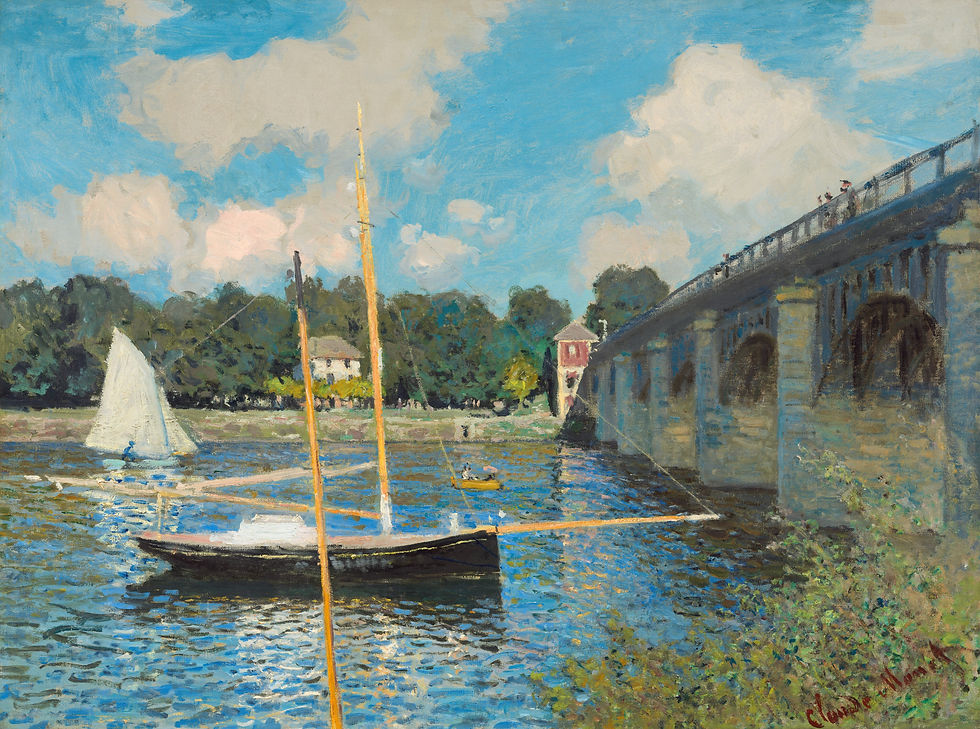
Claude Monet, The Bridge at Argenteuil, 1874. National Gallery of Art. Open Access image.
The reason was never only light
Light was the visible subject of Monet's series, but the deeper subject was the instability of experience.
He painted the same scene again and again because a place is never encountered only once. The observer changes. The hour changes. The body changes. Memory changes the colour of what seemed familiar.
Each return therefore carries a small risk. The scene may no longer give back the certainty we brought to it.
This is what makes the series emotionally compelling. Monet's repeated paintings do not promise that looking harder will reveal one final, correct image. They suggest that a closer look may multiply the world.
That idea connects his work to the emotional landscape of Romanticism, the poetic attention to ordinary nature in Qi Baishi, and the first essay in this series, Monet and the Art of Changing Light. The companion essay The Same View, Never the Same Painting continues the comparison between constancy and change.
If you are drawn to art that lets a room hold more atmosphere, you can spend time with the Havenest Wall Art collection or browse the Havenest Etsy shop.
Research sources
Alex from Havenest Studio
Comments