
Monet and the Art of Changing Light
The scene is familiar: a field, a cathedral, a bridge, a pond. Monet painted all of them again and again, until repetition became a form of attention.
To look at one of his series is to watch the world refuse to hold still. The subject remains recognisable, but the air around it keeps changing. A haystack turns rose, gold, violet, or blue. Stone dissolves into mist. Water becomes a surface for the sky rather than a boundary between elements.
This is why Monet's paintings still feel strangely immediate. They are not only records of places. They are records of looking.

Claude Monet, Haystacks, End of Summer, 1891. Art Institute of Chicago.
A painting that named a movement
When Claude Monet exhibited Impression, Sunrise in 1874, the painting's brief, atmospheric brushwork seemed to some critics unfinished. The title gave the emerging movement a name: Impressionism.
Yet Monet's most important idea was not simply to paint quickly or outdoors. It was to treat perception as an event. A painting could hold a passing sensation without pretending that the sensation was permanent.
That shift changed the role of the artist. Instead of presenting nature as a stable arrangement of objects, Monet asked what it felt like to stand before nature while light was moving across it.
His paintings are built from that question.
Light was never background
In older academic traditions, light often helped reveal the subject. In Monet, light becomes the subject's condition of existence.
A cathedral is not one cathedral in his series. It is a sequence of encounters: morning, afternoon, haze, frost, glare, shadow. The façade does not disappear, but our certainty about it does. Colour begins to carry the weight that line and architectural detail once carried.
This is also why Monet's brushwork can feel both deliberate and unstable. Small touches of colour remain visible, but they are not isolated marks. They gather optically, asking the eye to complete the image at a distance.
The painting does not hand us a fixed answer. It gives us a field of changing possibilities.

Claude Monet, Rouen Cathedral, West Façade, Sunlight, 1894. National Gallery of Art.
Haystacks: time made visible
Monet's haystack paintings are among the clearest examples of his belief that the same motif could produce endless visual experiences.
The stacks were near his home in Giverny, close enough to observe repeatedly. Their modest scale made them ideal instruments. There was no grand narrative to distract from the movement of light. The subject could remain quiet while time became visible around it.
In one canvas, the stack appears solid and sunlit. In another, it is almost violet, surrounded by a cool field. Snow, dusk, and low winter light flatten the forms into something more mysterious.
The point was never that Monet had discovered five different haystacks. He had discovered five different ways of seeing one.
Repetition, here, is not redundancy. It is a method for noticing what a first glance misses.
Rouen Cathedral: when stone becomes atmosphere
The Rouen Cathedral series makes the tension between permanence and change especially powerful. The building is one of Europe's great monuments, designed to suggest duration, faith, and structural order. Monet looked at it until those qualities began to tremble.
At close range, the surface is made from separate touches. At a distance, those touches merge into a luminous façade. The cathedral remains present, but it seems to be made of weather.
That transformation is not a rejection of reality. It is a different account of reality—one in which the appearance of a thing is inseparable from the conditions under which it is seen.
Monet's cathedral is architecture experienced through atmosphere. It asks us to notice how quickly certainty depends on light.
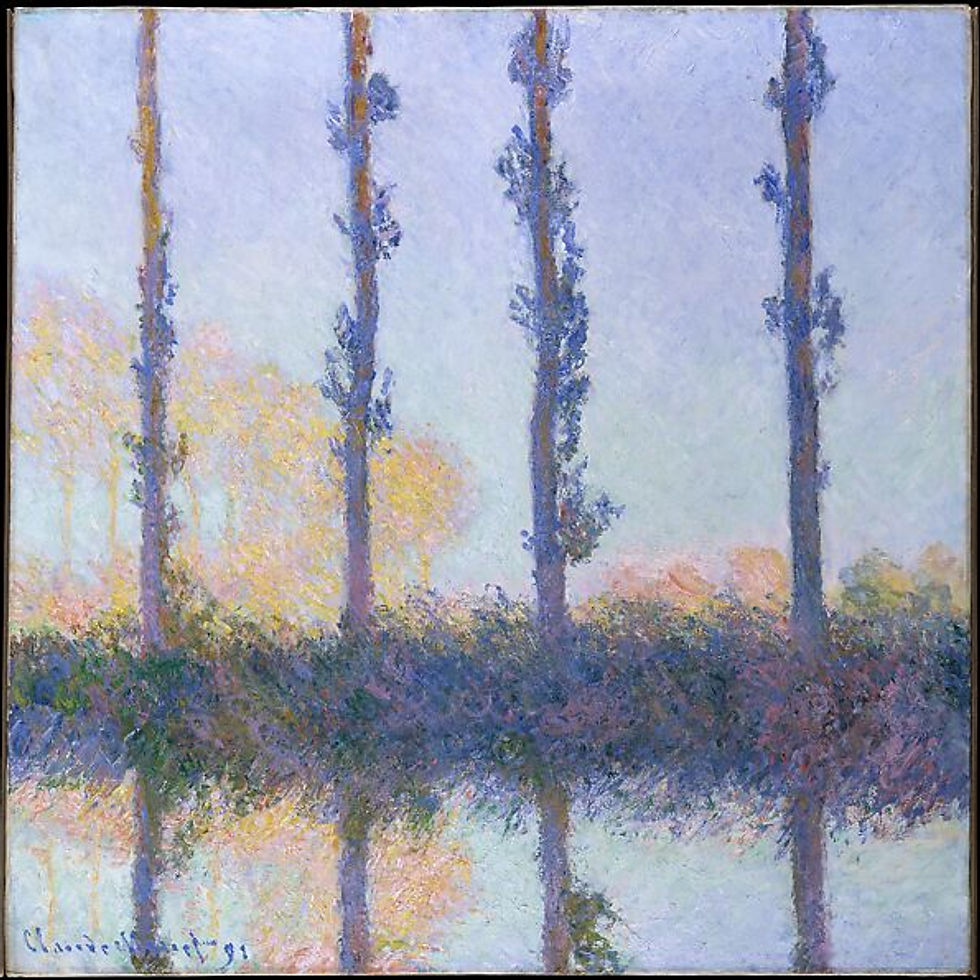
Claude Monet, The Four Trees, 1891. The Metropolitan Museum of Art. Open Access image.
Poplars and the rhythm of the landscape
In the Poplars series, vertical trunks organise the view like a rhythm in music. They repeat across the riverbank, but they are never mechanically identical. Their spacing guides the eye into the distance, while reflections and colour interrupt the sense of stable geometry.
The motif feels almost like a score. Each painting keeps the underlying structure but changes the tempo: one may be crisp and green, another silvery, another heavy with late-season colour.
This is one of Monet's quiet achievements. He could make a landscape feel both composed and contingent. The trees seem arranged, yet the atmosphere keeps undoing the arrangement.
The result is not a picture of a place so much as a picture of duration passing through a place.
London: the city dissolving in fog
Monet's London paintings push this idea into an urban setting. The Houses of Parliament and Waterloo Bridge are recognisable, but fog makes recognition provisional.
He was fascinated by the city's smoke, river light, and enveloping haze. London offered a landscape where atmosphere did not merely soften forms; it actively remade them. Buildings became coloured silhouettes. The Thames reflected a world that seemed to be forming and vanishing at once.
The city in these paintings is not primarily social or architectural. It is psychological. London becomes a state of suspension, a place where vision is delayed and the familiar becomes dreamlike.

Claude Monet, Waterloo Bridge, Gray Day, 1903. National Gallery of Art. Open Access image.
Giverny: the garden becomes a painting
At Giverny, Monet gradually built a living environment that could become both subject and studio. The water garden, the Japanese bridge, the reflections, and the water lilies gave him a world where surface and depth were constantly exchanging roles.
In the late Water Lilies paintings, the horizon often disappears. There is no reliable edge between sky, water, reflection, and flower. The viewer is invited into a field of looking rather than placed before a clearly framed scene.
This is where Monet's interest in changing light becomes almost meditative. The garden is not represented as a stable place. It becomes an experience of attention—slow, immersive, and slightly disorienting.
The paintings reward lingering because they are about lingering. Their subject is not simply the pond. It is the mind remaining with what it sees.

Claude Monet, Water Lilies, c. 1914–1917. Musée de l'Orangerie.
Why the series still matters
Monet's series paintings feel contemporary because they understand something about attention that is easy to forget: seeing is never neutral, and no view arrives unchanged.
The same landscape can feel tender in one hour and severe in another. A familiar room can become strange when the weather changes. Even our own memories alter the colours of places we thought we knew.
Monet gives these fluctuations a visual language. He does not ask us to choose between accuracy and emotion. He shows that the two are connected. The more closely we look, the less fixed the world becomes.
This may be why his repetitions do not feel like exercises. They feel like returns—to a place, to a question, and to the possibility that looking again might reveal a different life inside the same scene.
A way to look at Monet
When you stand before a Monet, begin with the motif. Name what you recognise: a tree, a bridge, a façade, a pond.
Then let the name loosen.
Notice which colours are carrying the image. Look at the spaces between forms. Ask what the atmosphere is doing, and how your eye completes the painting from a distance. If you compare two works from the same series, resist the temptation to decide which is more accurate.
Instead, ask what kind of time each painting contains.
That question leads beyond Impressionism. It leads toward a broader understanding of art as a record of attention—an idea that also appears in very different traditions, from the emotional weather of Romanticism to the poetic restraint of Qi Baishi.
If you enjoy living with art that makes a room feel more observant, you can explore the Havenest Wall Art collection or browse the Havenest Etsy shop.
Research sources
Alex from Havenest Studio
Comments