What Makes a Painting Feel Timeless?
Some paintings seem to belong completely to their moment. Others move through time with unusual ease. We may recognize the old canvas, the traditional subject, or the trace of another century, yet the image still meets us in the present tense. It feels less like a historical object than an encounter.
Timelessness is often confused with neutrality. In fact, enduring paintings are rarely vague or polite. They may contain strong weather, deep shadow, an unfamiliar face, or a single figure at the edge of a field. What lasts is not a safe style but a structure of feeling—something particular enough to be remembered and open enough to be entered again.
There is no formula that can guarantee this quality. Still, certain elements return: composition that steadies the eye, light that carries emotion, materials that reveal the hand, and a degree of mystery that leaves the viewer active. A timeless painting does not finish speaking when we have identified its subject.
In This Article
It Creates a World Beyond the Frame
A compelling painting implies more than it shows. A road continues behind the trees. A figure has arrived from somewhere and may soon leave. The edge of a room suggests another room beyond it. Even a still life can make us imagine the table before the objects were placed and the hand that will eventually move them.
This sense of continuation gives the image inner life. The frame contains the composition, but it does not seal the story. Viewers bring memory and anticipation into the unseen space, which allows the same work to hold different meanings across generations.
That is why narrative need not be literal. A wide sky, a dark doorway, or a field after rain can be enough. The painting creates a condition for wondering, and wonder ages more slowly than explanation.
The best test is simple: after looking away, do you feel that the scene is still continuing? When an image leaves a residue of weather, movement, or unanswered intention, it has begun to exist beyond its physical surface.

Composition Gives the Eye a Place to Return
Timeless paintings often feel discovered rather than arranged, yet their structure is precise. A horizon may sit low enough to give the sky emotional weight. A tree may balance a distant figure. A curve of river or light may carry the eye inward, then return it quietly to the foreground.
Good composition does not announce its geometry. It creates inevitability. We can look for a long time because every area participates: an active edge, a restful passage, a dark form that gives the light greater force. Nothing needs to be symmetrical, but the visual tensions feel held.
This order matters in a home as well as a gallery. A painting with a strong internal composition can command a quiet wall without elaborate styling. The room becomes a place from which to enter the image, rather than another layer competing for attention.
Compositional strength is felt at different distances. From across the room, the major masses should hold. Up close, smaller rhythms—the direction of brushwork, a repeated color, a pause between forms—reward the eye for returning.

Light Holds More Than Illumination
In memorable paintings, light is rarely just a description of weather. It may arrive after difficulty, gather before a storm, or touch one ordinary object with unexpected tenderness. We read it emotionally before we analyze where it comes from.
Soft light can blur the boundary between what is present and what is remembered. Harder light can clarify a moment until it feels almost irreversible. Painters use brightness, shadow, and reflected color to control not only what we see, but how long we remain with it.
Painted light can also make time perceptible. A long shadow implies an hour; a pale opening in clouds suggests change; a lamp glowing against a dark room marks the boundary between public day and private evening. Light gives the still image a temporal pulse.

Restraint Leaves Room for the Viewer
A painting becomes generous when it leaves something unresolved. An expression may resist a single name. The weather may be moving toward brightness or away from it. The story may pause at a point where the viewer must decide what has happened.
Restraint is different from emptiness. It is the careful withholding of one final answer. The artist provides enough detail to create belief, then allows silence to remain around it. That silence becomes a space in which personal memory can attach.
This is especially powerful in landscape. A solitary house, faint path, or distant horizon can call forward places we have never visited yet somehow recognize. The image becomes intimate without being biographical.
Too much explanation can close that space. Titles, wall labels, and historical context may enrich our knowledge, but the first encounter remains visual. A timeless work can survive the moment before we know what we are supposed to think about it.
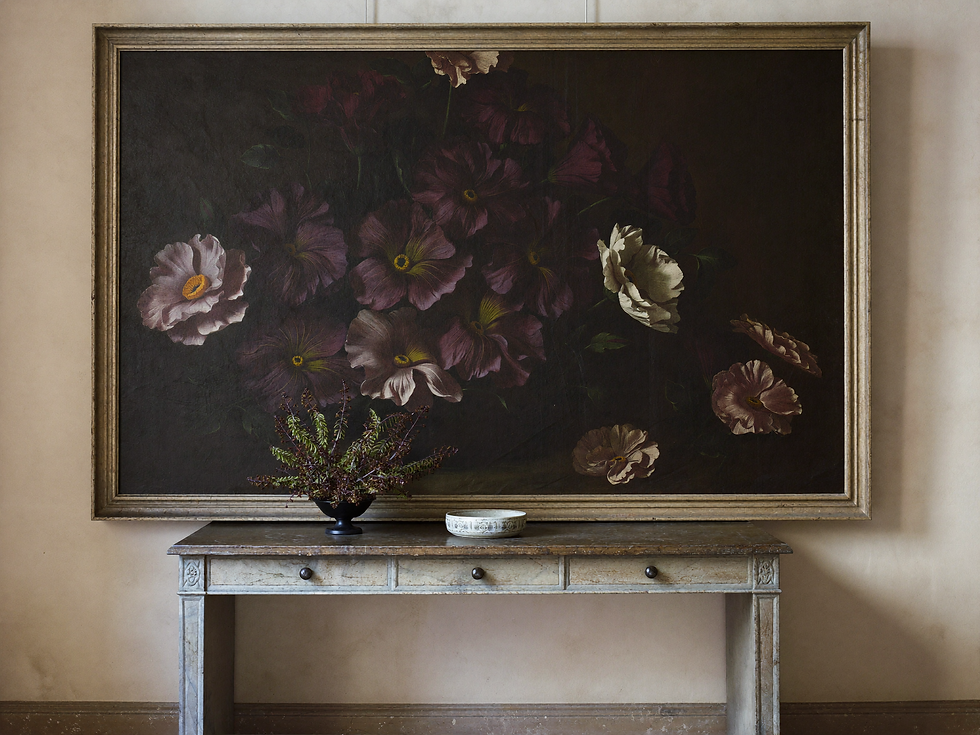
Material Presence Makes Time Visible
A screen can display an image, but a painting possesses a physical presence. In one area, the pigment is applied thickly, while in another, it thins to a stain. The ground is visible in places. Edges exhibit signs of wear. Glaze, canvas, wood, and varnish each interact with light uniquely.
These traces make looking physical. We sense the decisions and revisions held in the surface: where a brush slowed, where color was dragged across color, where a shape was softened rather than erased. The work records time spent making it.
Age can enhance that presence. The fine craquelure, softened colors, or a worn frame don't inherently make a painting beautiful, but they can unveil the object's journey. The past becomes tangible through the material rather than as nostalgia.
Reproduction alters this experience but does not eliminate it. A well-crafted print can maintain the composition, color relationships, and ambiance, while the selected paper and frame create a new material presence. The image embarks on a different existence instead of imitating the original object.

Emotional Ambiguity Keeps the Work Alive
The longest-lived paintings rarely dictate a single feeling. A meadow may be peaceful and lonely at once. A storm-lit sea may hold danger, release, and exhilaration. A portrait may appear guarded one day and vulnerable the next. The work changes because the viewer changes.
Ambiguity invites repeated looking. We return to test a new mood against the same image and discover that it can accommodate us. This does not make the painting passive. Its own atmosphere remains distinct; it simply has enough depth to meet more than one version of our attention.
This elasticity is not vagueness. The painting must first have its own weather and emotional pressure. Only then can viewers meet it from different lives. A blank surface asks little; an ambiguous one asks us to stay.
Timelessness Is a Relationship, Not a Formula
History decides some forms of endurance through institutions, preservation, and repeated attention. Personal timelessness is more immediate. It begins when a painting continues to matter after novelty has passed—when we notice it differently in morning light, after an absence, or during a season of change.
This is why technical mastery alone cannot explain the feeling. Craft gives the work coherence, but relationship gives it duration. A modest painting may remain with one person for decades because its weather, gesture, or silence keeps opening a path back to something essential.
Perhaps a timeless painting is one that allows time to enter it. The artist’s moment, the age of the object, and the viewer’s present life overlap inside a single frame. Nothing is frozen. The image endures because it continues to happen.
Our responsibility as viewers is simply to give that happening enough attention. Look past the quick recognition of subject and style. Notice where the eye slows, what remains unresolved, and which detail returns later in memory. Timelessness often reveals itself after the first impression.


Comments