The Same View, Never the Same Painting
A haystack at the edge of a field should be easy to paint once. Monet discovered the opposite.
He returned to the same group of stacks through autumn, winter, snow, frost, and late afternoon. The objects barely moved. Everything around them did.
The light shifted. The air thickened or cleared. Colours that seemed impossible in one hour became inevitable in the next. Each canvas kept the motif, then quietly changed the world that held it.
This is the strange promise of Monet's series paintings: the view stays familiar, but the act of seeing never does.

Claude Monet, Haystacks, End of Summer, 1891. Art Institute of Chicago.
Why one subject becomes many
Monet's series are often described as studies of changing light. That is true, but it is only the beginning.
He was not making a collection of identical pictures so that viewers could compare technical accuracy. He was testing what happens when a stable subject is placed under unstable conditions. The haystack, poplar, cathedral, bridge, or pond becomes a kind of measuring instrument.
The subject gives the eye something to recognise. Light gives the eye something to reconsider.
This balance matters. Without the repeated structure, the changes might feel arbitrary. Without the changes, repetition would become merely descriptive. Monet needed both constancy and disturbance.
The result is less like a single image copied several times than a sequence of encounters. Each painting records a particular relationship between the motif, the atmosphere, the hour, and the observer.
Haystacks: the first great experiment
Between 1890 and 1891, Monet painted a group of grainstack pictures around Giverny. The National Gallery in London describes these works as an important step in his sustained attention to atmospheric effects, while the National Galleries of Scotland notes that the series was conceived as a group rather than as isolated pictures.
That distinction changes how we look at them.
A single haystack can seem like a rural object: practical, heavy, and tied to agricultural labour. Across the series, it becomes more elusive. Its mass is still there, but its colour seems to belong to the hour more than to the straw itself.
One stack glows with warm oranges and rose. Another cools into lavender and blue. Snow can simplify the forms; sunset can make them appear almost lit from within.
The paintings do not ask which colour is the haystack's true colour. They ask how much of what we call an object is actually the atmosphere passing over it.
Monet's repeated motif therefore produces a subtle reversal. We think we are watching the haystacks change, but we are also watching our own certainty change.

Claude Monet, Rouen Cathedral, West Façade, Sunlight, 1894. National Gallery of Art.
Poplars: a landscape with a pulse
The poplar paintings made along the River Epte in 1891 introduce a different kind of repetition. Here the vertical trees create a rhythm across the picture, while their reflections disturb that rhythm below.
The National Galleries of Scotland records that Monet worked from the river and used a boat as a floating studio. The trees were threatened with being felled, and Monet helped delay that outcome long enough to complete the series. These details matter because they remind us that the paintings were not made from a detached, abstract idea. They were made through physical persistence: moving, waiting, returning, and working while the effect he wanted was present.
The poplars appear stable because their trunks rise in an ordered sequence. Yet the water turns the order into movement. Reflections lengthen, fracture, and reassemble. The same trees become a vertical architecture above the river and a trembling pattern below it.
This gives the series a pulse. The motif repeats, but the painting breathes differently each time.
When several versions are seen together, the landscape begins to feel temporal. It contains weather, not as background information, but as an active force that changes the character of the place.
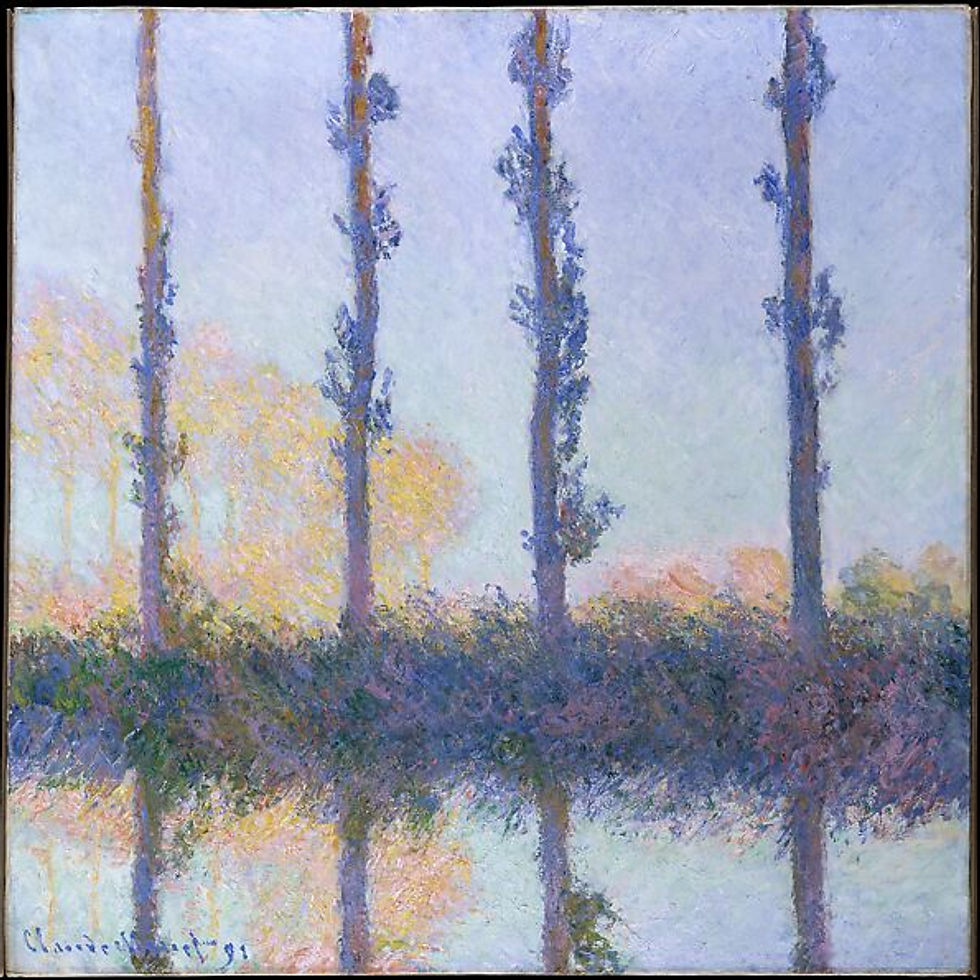
Claude Monet, The Four Trees, 1891. The Metropolitan Museum of Art. Open Access image.
Rouen Cathedral: architecture under pressure
The Rouen Cathedral series brings Monet's method into contact with a subject associated with permanence.
He painted more than thirty views of the cathedral's west façade between 1892 and 1893, moving from one canvas to another as the light and atmosphere changed. The National Gallery of Art notes that the canvases were later finished in the studio at Giverny.
The cathedral is an imposing object, but Monet gradually makes its solidity uncertain. The façade may appear blue, gold, pink, grey, or violet. Deep shadows can make the stone seem carved; sunlight can flatten it into a luminous surface.
At first, this may look like a celebration of colour. It is also a challenge to architectural confidence.
A building promises that something will remain. Light reminds us that every appearance is conditional.
Monet does not erase the cathedral's history or structure. He lets those qualities remain just visible enough for their transformation to matter. We recognise the monument, then feel it slipping toward atmosphere.
This is why the series has such psychological force. It places permanence and change in the same frame. The cathedral stands still, but our access to it is never still.

Claude Monet, Waterloo Bridge, Gray Day, 1903. National Gallery of Art. Open Access image.
Waterloo Bridge: when the city turns atmospheric
In London, Monet carried the logic of the series into a modern city shaped by traffic, smoke, industrial haze, and the reflective surface of the Thames.
The Waterloo Bridge paintings do not treat the bridge as a piece of engineering alone. The structure becomes a horizontal measure across the scene, while fog, smoke, and reflected colour alter its presence. In one version, the bridge may seem almost solid. In another, it dissolves into pale blue, green, rose, and violet.
The National Gallery of Art's Waterloo Bridge, Gray Day shows how the architecture can remain legible while its edges become soft. The bridge is there, but it is there through weather.
That distinction is central to Monet's late nineteenth-century vision. Modernity was not only machines, streets, and speed. It was also a new experience of unstable perception: buildings seen through pollution, rivers carrying fractured reflections, and familiar landmarks transformed by changing conditions.
The city becomes a series of moods without becoming sentimental. Monet is not illustrating London as a story. He is observing what the city does to vision.

Claude Monet, Water Lilies, c. 1914–1917. Musée de l'Orangerie.
The studio was part of the method
There is a romantic image of Monet as a painter who simply stood outdoors and captured whatever he saw. The series paintings complicate that image.
The National Gallery of Art explains that the Rouen canvases began as campaigns in front of the motif but were extensively reworked in the studio. The Met's discussions of late Monet similarly emphasise that he moved between direct observation and sustained revision.
This does not make the paintings less immediate. It makes their immediacy more constructed.
Monet had to remember effects that had already disappeared. He had to compare canvases, adjust relationships between colours, and decide how much instability the composition could hold before the motif vanished altogether.
The series is therefore both an outdoor practice and a studio practice. It begins in changing light, then becomes an argument about memory.
A painting preserves what the eye could not hold on to. It is a record of perception, but also a reconstruction of perception after the moment has passed.
What changes when we compare the canvases
A single Monet can be absorbed as an atmosphere. Several Monets of the same subject invite a different kind of attention.
Comparison makes small decisions visible. A shadow may be warmer in one painting. A reflection may be pushed lower. A façade may lose detail while gaining colour. The changes are not decorative variations placed around an unchanged core. They are the core.
This is why the order in which we see a series matters. The first canvas establishes recognition. The second creates doubt. By the third, we begin to notice that the subject is no longer the only thing being painted.
Time is being painted too.
This is an interpretation rather than a documented statement of Monet's private intention, but it is supported by the visible structure of the series and by the museum records describing his sustained study of light, weather, and time of day. The works make the process of looking part of their subject.
Learning to look in series
When you encounter a Monet series, resist the urge to choose a favourite too quickly.
Begin with what remains constant. Find the tree trunks, the arches, the façade, the stacks, or the bridge. Then ask what the atmosphere has altered.
Look for the colour that does the most unexpected work. Notice where the image becomes less descriptive and more bodily: a patch of warmth, a cool veil, a reflection that seems to breathe.
If you compare two paintings, do not ask which one is more accurate. Ask what each one allows you to feel about the same place.
That question opens into a wider art-historical conversation. The emotional landscapes of Romanticism and the poetic attention to ordinary nature in Qi Baishi approach the world differently, yet both remind us that looking is never empty. You may also return to Monet and the Art of Changing Light, the first essay in this series.
For readers who enjoy bringing art's changing atmosphere into their own rooms, the Havenest Wall Art collection and the Havenest Etsy shop offer a gentle place to continue looking.
Research sources
Louis from Havenest Studio
Comments