The Orchard Beneath the Castle: A Summer Table with Somewhere to Wander
Start with the watermelon. Its opened red surface is so immediate that it can hold the entire first glance. Then look beyond the fruit, through the darker passages, toward the castle on the distant hill. The Orchard Beneath the Castle has somewhere else to take you.
This Havenest artwork sets a closely observed abundance in front of a landscape that is harder to grasp. Green pears, purple plums, and golden fruit gather near the lower edge, while white blossoms brighten the glass bowl. Behind them, the setting becomes spacious and subdued.
The shift can feel like remembering a summer table and the place around it at the same time. That is an imaginative reading, not an established history. The picture gives us a route from nearness to distance, leaving the story of that journey open.

The Orchard Beneath the Castle, Havenest.
In this article
An Open Watermelon Changes the First Glance
Most of the fruit offers a closed surface: rounded skin catching highlights, with shadows defining each body. The watermelon changes that pattern. Its cut face reveals a saturated red interior, turning one piece of fruit into a bold shape that stands out against the surrounding greens and browns.
A smaller slice repeats the red nearby. This repetition keeps the strongest color from feeling completely isolated. The two cuts establish a local relationship at the front of the composition, holding our attention low before the rest of the image begins to emerge.
The seeds and pale boundary between flesh and rind give the bright shape internal variation. Without those details, the red might behave like a flat emblem. Instead, it remains recognizable as something opened and divided. We can connect the appearance with familiar sensations without claiming that the artwork records an actual meal.
From a distance, the red is likely to remain visible after many smaller details have merged. It is the composition’s immediate welcome. Choosing where to hang the print involves deciding how much prominence you want that accent to have in the room, especially beside other red objects or patterned textiles.
Abundance Is Organized into Different Heights
The fruit does not occupy one even band. Some sits low on the left, another group gathers within the glass bowl, and the watermelon reaches toward us below. These changes in height turn a collection of rounded forms into a sequence of distinct areas.
The golden fruit in the bowl catches more light than much of the background. Around it, white blossoms create small bright intervals. The bowl’s curved edge helps gather the cluster without making its boundary feel heavy. Compared with an opaque ceramic container, this vessel allows a more delicate transition between fruit and surrounding darkness.
On the left, the greener and purplish forms stay closer to the stone-colored ledge. Their different tones prevent the arrangement from becoming one continuous yellow mound. Look at the groups through half-closed eyes: the larger patterns of warmth and coolness become easier to recognize.
You can use our questions for reading still life to extend this exercise. Instead of naming everything, ask which group rises, which settles, and which reaches forward. The answers describe the composition’s movement more clearly than an inventory of its ingredients.

Styling mockup: a light wall gives the dark upper landscape a clear boundary.
White Blossoms Keep the Fruit from Feeling Heavy
The blossoms gather around the bowl in a loose, irregular rhythm. Their small pale forms contrast with the larger fruit, and their lighter silhouettes soften the edge of the central group. They add brightness without adding the same sense of weight.
That distinction changes the mood of abundance. A pile made only of round fruit might feel dense and self-contained. Here, petals and leaves extend outward, allowing the arrangement to open into the surrounding space. The blossoms make the grouping feel less like a solid mound and more like several things briefly brought together.
Their white also gives us an intermediate stop between the vivid foreground and the subdued distance. After the watermelon, the eye can rise toward the flowers before continuing into the landscape. A small bright detail becomes part of a larger route through the picture.
In the desk mockup, nearby pale flowers echo that passage. You can choose to repeat the relationship with a small light object or leave the real surface bare. The useful principle is restraint: let the painted blossoms remain distinct rather than surrounding the frame with an equally intricate arrangement that demands the same close attention.

Styling mockup: pale flowers repeat one detail from the painting.
The Castle Is a Destination, Not an Explanation
The castle occupies the upper distance, partly absorbed into the softer tones of the landscape. It is much smaller on the picture surface than the near fruit, even though we understand a building as something far larger in the world. That reversal of apparent scale helps establish depth.
Its architecture introduces an unfamiliar possibility into a familiar subject. Fruit belongs to the immediate scale of a tabletop; a distant castle invites thoughts of travel, shelter, or a place known from stories. None of those associations supplies a verified location. We should not attach a real estate, country, or historical event without supporting information.
The image does not need such an explanation to work. The castle is useful because it offers somewhere for the imagination to go after the close foreground has been explored. Its relative vagueness leaves the journey unfinished. We can see enough to recognize a destination without being told precisely how to reach it.
This makes the artwork different from a still life whose background closes immediately behind its objects. The table remains the point of contact, but the horizon keeps another scale available. Nearness and distance become companions within a single view.
A Dark Tree Gives the Distance Its Opening
A large dark tree form rises along the left and reaches into the upper part of the image. Its mass provides a substantial contrast to the lighter, farther landscape. The distant view appears through and beside this darker enclosure, gaining depth because something visibly nearer interrupts it.
The tree also connects the fruit’s setting with the land behind it. We are not simply looking at a tabletop placed against an unrelated patch of sky. Dark foliage, green forms, and the intervening ground create a visual continuity, even while the exact arrangement remains imaginative.
In the bedroom mockup, this large dark passage gives the framed picture a strong vertical presence above the furniture. The bright bowl of fruit then becomes a concentrated center within that darker structure. The result depends on the whole image, not only the watermelon’s red accent.
When evaluating a placement, look at the dark tree and background as carefully as the fruit. If your wall is very dark, some of the image’s outer shape may blend into it; a distinct frame can restore the boundary. Against a pale wall, the dark upper area is likely to become more immediately apparent.

Styling mockup: muted green connects the room with the painted foliage.
Let the Picture Carry the Summer Color
The room mockups use warm wood, softened light, and relatively restrained furnishings around the artwork. This gives the red, yellow, purple, and green inside the frame a chance to remain the most concentrated color group in the immediate setting.
That is a practical approach when you like richly colored art but prefer an otherwise measured room. Let the image contain the variety. One nearby green or muted gold detail can create a connection without requiring a full palette of matching accessories. The artwork already demonstrates how several colors can be gathered into one coherent area.
For framing, consider whether you want the print to read as an opening or as a clearly bounded object. A narrow dark frame can feel discreet; a warmer, more pronounced edge may emphasize the image’s decorative presence. Consult our guide to framing printable wall art for the practical side, and check the listing’s current details before choosing a format.
A neighboring landscape could continue the distant view; a simpler still life might answer the abundance with a smaller gathering. Our article on pairing still life art on one wall offers ways to compare visual weight. Give this picture enough room that its route from fruit to castle remains easy to follow.
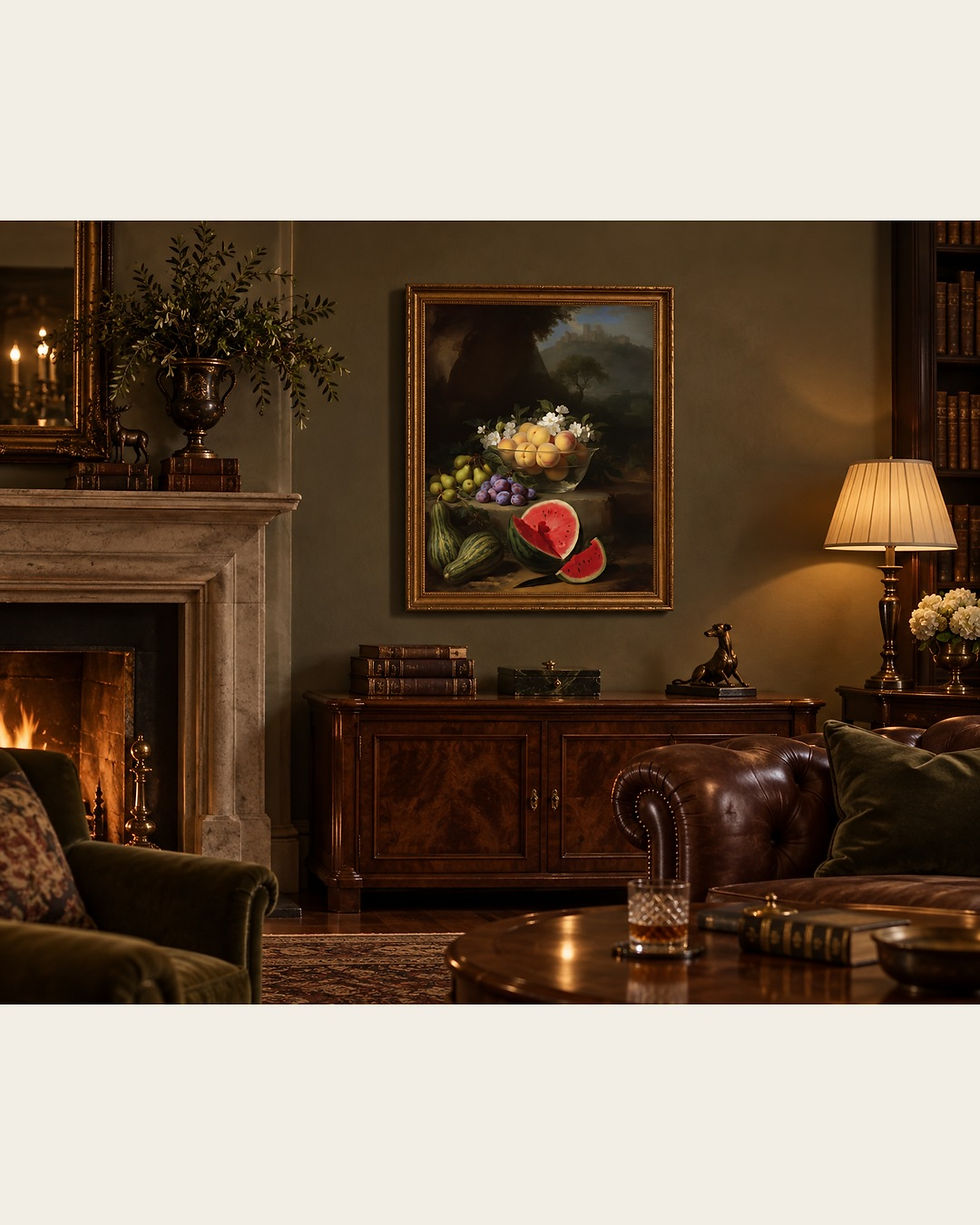
Styling mockup: a darker room brings the illuminated fruit forward.
Keep Both the Table and the Horizon
Some viewers will stay with the fruit: the cut watermelon, the gentle differences among the plums, the pale blossoms resting around the bowl. Others will return to the castle, letting the foreground become the beginning of an imagined journey. The picture accommodates both kinds of attention.
Its emotional reach comes from their coexistence. A table can suggest the pleasures already close to hand, while a distant building can awaken curiosity about somewhere else. The artwork does not force a choice between feeling at home and wanting to wander.
Discover The Orchard Beneath the Castle on Etsy to see the full composition and current listing information. The interior images are styling mockups, so use your own wall measurements and lighting conditions when imagining the print at home.
Before leaving the image, trace its route once more. Begin at the red slice, move toward the glass bowl and blossoms, then lift your gaze into the softer land beyond. The subject is still a gathering of fruit. Yet the space around it has expanded, and the summer table now seems to belong to a world that continues past the frame.
Written by Havenest Studio


Comments