How to Read a Still Life: Five Questions Beyond the Objects

Willem Claesz Heda, Still Life with Oysters, a Silver Tazza, and Glassware, 1635. The Metropolitan Museum of Art, From the Collection of Rita and Frits Markus, Bequest of Rita Markus, 2005. Public domain. Image source.
You can name every object in a painting and still feel that you have barely begun to look. A lemon, a glass, a piece of bread: the inventory is clear, but the image continues to hold something the list does not explain.
Reading a still life begins in that gap. The objects matter, but so do their arrangement, their surfaces, the viewpoint offered to us, and the kind of time the picture seems to contain.
The five questions below are a practical way into those relationships. They work best as invitations to observe, not as a checklist that produces one correct interpretation. Museum records provide historical anchors; your task is to notice how the evidence changes what you see.
In this article
Begin with description before explanation
Give the image a little time before reading its label. Write down a few observations that another viewer could locate in the same picture. A vessel is overturned. A pale shape sits against a dark area. One object appears very close to an edge.
Then separate those observations from your response. “The glass is on its side” describes a visible position. “The scene feels interrupted” proposes an effect. Both can be valuable, but they do different jobs. Keeping them distinct makes interpretation easier to examine and revise.
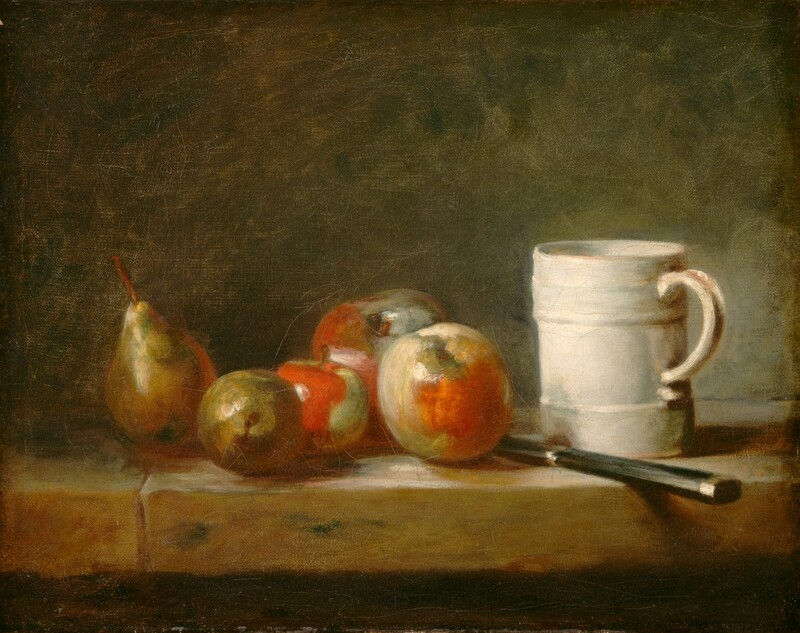
Jean Siméon Chardin, Still Life with a White Mug, c. 1764. National Gallery of Art; Gift of the W. Averell Harriman Foundation in memory of Marie N. Harriman. Public domain. Image source.
Next read the collection record. Confirm the artist, title, date, and medium. Check whether your identification of an unfamiliar object was correct. A form that looks merely decorative may have had a specific use, and that use can change the possibilities you consider.
This sequence allows the museum’s expertise to enrich your encounter without replacing it. You arrive with something noticed, then test it against evidence. The following questions continue that exchange between looking, contextual information, and personal response.
1. Where does the painting send your attention?
A painting’s most visually commanding object is not always its largest. A bright edge, an isolated patch of color, or a small form surrounded by open space may attract the eye first. Notice your point of entry, then follow what happens next.
In Still Life with Oysters, a Silver Tazza, and Glassware, Willem Claesz Heda assembles a tabletop whose materials reward close inspection. The Met dates it to 1635. Before exploring its meanings, consider how the picture moves you from one surface to another.
Do neighboring forms create a continuous route, or do gaps make you pause? Where does the table edge guide your gaze? Which parts of the arrangement seem to gather together, and which seem held apart? These questions address composition through your actual experience of looking.
Try a second pass beginning somewhere less prominent. A minor object may connect areas you originally treated as separate. Your first route is useful evidence of the picture’s appeal, but it need not be the only route available.
2. What do the materials make you imagine?
Still lifes frequently ask the eyes to do some of the work of touch. We infer the coolness of metal, the resistance of a shell, or the softness of cloth from a painted image. That inference is one of the genre’s pleasures.
Ask how the impression is produced. Does a material depend on a sharp highlight? Does its edge disappear into a neighboring dark area? Can you distinguish a reflective surface from a dull one even where their colors are similar?

Jean Siméon Chardin, The Silver Tureen, c. 1728–30. The Metropolitan Museum of Art, Fletcher Fund, 1959. Public domain. Compare these contrasting materials as an additional example of painted surface. Image source.
Then consider the social character of the materials. Willem Kalf’s Still Life with Fruit, Glassware, and a Wanli Bowl, dated 1659, includes Chinese porcelain and a Turkish carpet that the Met identifies as luxurious imports. Their presence connects an intimate tabletop with a much wider world.
The contextual fact adds a question about value, but it does not cancel the sensory experience. A material can invite admiration for the painter’s skill, curiosity about an object’s origin, and reflection on possession at the same time. You do not have to choose only one.
3. Where are you being asked to stand?
Look at the height of the tabletop relative to your imagined eye. Can you see deeply into bowls, or do their rims close down into narrow shapes? Does the ledge feel accessible, as though you could rest your hand on it, or does the arrangement sit beyond reach?
The question concerns an offered point of view, not the literal position of a person who certainly stood there. A painting may construct its space from several decisions that do not add up to one photographically consistent scene.

Paul Cézanne, Still Life with Jar, Cup, and Apples, c. 1877. The Metropolitan Museum of Art, H. O. Havemeyer Collection, Bequest of Mrs. H. O. Havemeyer, 1929. Public domain. Image source.
That distinction becomes especially useful with Cézanne. The Met’s account of his painting describes arrangements in which relationships among objects can take precedence over a single, consistent perspective. An uneasy spatial impression can therefore be worth studying rather than immediately correcting.
At the opposite extreme, a strongly projecting ledge may make the picture feel connected to your own space. Ask what that proximity does to the subject. Does it make an object seem available, precarious, confrontational, or intimate? Treat your answer as a response to specific visual evidence.
4. What kind of time does the picture contain?
A still life can seem suspended, yet many of its objects imply duration. A peeled fruit suggests a prior action. A cut flower carries the possibility of change. A glass placed on its side can prompt us to imagine an interruption, even when we do not know that any particular event occurred.
Some paintings make the theme of time explicit. The Met identifies the skull, overturned glass, and failing lamp in Pieter Claesz’s Still Life with a Skull and a Writing Quill, dated 1628, as reminders of life’s brevity. Here historical interpretation supports an association the objects also make visually direct.

Pieter Claesz, Still Life with a Skull and a Writing Quill, 1628. The Metropolitan Museum of Art, Rogers Fund, 1949. Public domain. Image source.
The lesson is not that every still life delivers the same warning. Time may be presented as abundance, ripeness, decay, interruption, or the possibility of use. The appropriate reading depends on the particular work and the evidence attached to it.
Ask which temporal impression arrives before explanation and which develops after consulting the record. That distinction helps you recognize both the immediate force of the picture and the contribution of historical knowledge.
5. Which meanings need historical evidence?
A symbolic interpretation should become more precise as you learn more about a work. Be cautious when an explanation can travel unchanged from any lemon to any other lemon, regardless of period, artist, or surrounding objects.
Heda’s painting provides a helpful example. The Met identifies a paper cone as a page taken from an almanac and relates it, along with broken glass, to the passing of time. Knowing the paper’s source makes this reading more specific than a vague impression that the table looks disturbed.
Context can also explain why particular things were worth painting. Walter Liedtke’s Met essay on Northern European still life connects the genre with urban life, possessions, trade, and collecting. Those conditions open questions about audiences and values rather than reducing the pictures to decorative inventories.
Leave room for several functions to coexist. A painting may demonstrate skill, offer visual pleasure, display desirable possessions, and invite reflection. Evidence should help you judge the balance among those possibilities. It need not force every object to serve one total explanation.
Put the five questions together without closing the picture
Return to the first image you chose. Describe where your eye enters, which material most strongly suggests touch, how the space positions you, what kind of time you sense, and which contextual fact changes your reading most.
You now have the beginnings of an interpretation grounded in the work. Try expressing it in a few sentences rather than an exhaustive inventory. Name the feature that matters and explain the effect it has. If a claim depends on a museum’s interpretation, say so; if it is your response, allow it to remain one.

Paul Cézanne, Dish of Apples, c. 1876–77. The Metropolitan Museum of Art, The Walter H. and Leonore Annenberg Collection, Gift of Walter H. and Leonore Annenberg, 1997, Bequest of Walter H. Annenberg, 2002. Public domain. Image source.
For further practice, move from vessels and food to Rachel Ruysch’s botanical still lifes. Keep the questions while adapting them to a different arrangement of forms. Then compare how attention operates in Vermeer’s scenes of private life, where people join the objects.
The aim is to become more exact about what you notice and more open about what remains uncertain. A good reading gives you reasons to return to a painting. It leaves the image capable of answering your next visit differently.
A still life begins with things we can often name. Its deeper interest lies in the relations that naming leaves out: how one form depends on another, how a material invites desire or recollection, and how an arrangement places us within reach of an imagined world.
Choose one question on your next encounter. Follow it far enough to notice a detail you missed, then let that detail lead you onward. Looking becomes richer when the picture remains the source of the next question.
Sources and further reading
Written by Theo · Havenest Content Team

Comments