Havenest Countryside Art for Slow Interiors
Some pictures ask to be admired. Countryside art often asks for something quieter: recognition. A road bends out of sight, weather gathers above a field, or a farmhouse sits far enough away to feel remembered rather than observed. We may never have visited the place, yet the scene can carry the odd familiarity of a dream.
This is why countryside art feels so at home in slow interiors. These rooms are built through time, touch, and repeated use rather than a single shopping trip. A pastoral image joins that rhythm. It gives the eye depth, lets the wall breathe, and brings a little weather into spaces made from plaster, timber, linen, and stone.
The Havenest countryside edit is curated around that feeling. The works are not chosen as color patches for a neutral room. Each one has a point of view: a path that invites you forward, a horizon that creates distance, or a patch of light that changes the whole emotional temperature of the scene.
In This Article
Why Rural Art Complements a Slow-Paced Home Perfectly
A slow interior doesn't imply it's empty or overly refined. Instead, it suggests the space has been given time to evolve. Materials enhance with use, objects remain because they hold significance, and visual appeal arises from diversity instead of perpetual newness. Landscape paintings embody this patience, with their impact gradually unfolding over various times and seasons.
Unlike graphic décor, a landscape doesn't reveal its full story at first glance. You initially observe the general weather, then a cluster of trees, and perhaps a small road or a darker crease in the terrain. This gradual unveiling allows a room to feel alive with attention rather than merely filled with objects.
Pastoral art embodies a valuable humility, where human structures seem diminutive against the vastness of fields and sky. When displayed above a sofa or a serene bench, this contrast can alleviate the room's pressure. Not every surface must serve a purpose. The artwork provides a sense of distance, while the furniture stays rooted in everyday life.
If your home already includes warm neutrals, natural woods, vintage items, or subtle luxury, a countryside scene can connect these elements without turning them into a theme. It acts more as an atmosphere the room can adopt rather than merely a decorative piece.

Prioritize Atmosphere Over a Perfect View
The most unforgettable countryside art isn't always the most beautiful. A perfectly blue sky can quickly fade into the background. A field under moving clouds, a wet path, or the late light illuminating a hillside offers the mind a way to engage. A touch of ambiguity keeps the scene vibrant.
Observe the distance between the foreground and the horizon. A deep perspective can make a small room appear more open, while a nearby meadow creates a more intimate and enveloping feel. Neither option is superior; the decision hinges on whether the room requires an outward view or a softer sense of enclosure.
Weather acts as another form of color. Mist cools the greens and softens the contrast. Sunlight following rain enriches earth tones. Dusk brings in shades of violet, charcoal, and muted gold. These subtle changes are more adaptable than a fixed palette because they shift with the room's natural light.

Allow the Painting to Guide the Palette, Softly
Begin with the least obvious color in the artwork. Instead of matching a green field exactly, look toward the clouded sky, a shaded tree trunk, or the pale line at the horizon. These quieter notes often translate better into upholstery, rugs, curtains, and wall tones.
A countryside painting may contain dozens of greens, yet the room only needs one or two echoes. Olive in a cushion, moss in a ceramic glaze, or faded sage in a chair is enough. Repetition should feel incidental, as though the materials and the picture have aged in the same light.
Warm rooms benefit from a small cool note inside the art. A silver-blue distance or soft gray cloud prevents timber and cream from becoming too sweet. Cooler rooms may need the opposite: a strip of ochre field, brown earth, or late sun.
Leave some colors unreferenced. The picture gains authority when it is allowed to introduce something the room does not already contain. Complete coordination can make art look selected after the fact; a slight tension makes it feel genuinely chosen.

Select Scale and Framing with Subtle Assurance
Countryside scenes typically require space to breathe. When placed above a three-seat sofa, a wide landscape should have sufficient visual presence to fit the wall, generally about two-thirds the width of the furniture. A small print can still be effective, but it needs a narrower wall, a substantial mat, or additional pieces to form a distinct grouping.
For frames, oak offers warmth without being heavy. Dark wood enhances misty or light scenes. Antique gold can complement Romantic or darker works, as long as the design isn't so elaborate that it distracts from the art. The frame should provide a boundary for the image and then recede.
Matte paper complements atmospheric art as it captures gentle transitions without reflecting light. Canvas provides a more painterly effect and eliminates the need for glazing. Regardless of the choice, it's important to consider shadow details; printing countryside scenes too dark can diminish their emotional impact.
Printable art allows you to make these decisions at home, enabling you to select the size, paper, and frame to suit the architecture, rather than settling for a one-size-fits-all piece.

Position the Art Where the Room Naturally Slows Down
A living room can carry a large landscape above the sofa, but the most affecting placement is not always the most obvious. A picture beside the reading chair, opposite the dining table, or at the end of a hallway may gather more sustained attention because the eye meets it during unhurried moments.
In a bedroom, choose an image with a low horizon and softened contrast. The landscape should settle rather than activate the wall. In a dining nook, a wider scene can create companionship without competing with faces or conversation.
Entryways welcome a visible path or river bend, subjects that gently echo arrival. Home offices benefit from distance: a far horizon offers the eye relief from screens. Even a small kitchen wall can hold a quiet field, especially where natural materials keep the scene from feeling overly decorative.
Before hanging, walk the normal route through the room. The best position is often the place where the image is discovered in passing and then seen again from a seat.
Treat Printable Art as a Curatorial Choice
A digital file can be reproduced easily, but the final result does not have to feel disposable. The care lies in selection and presentation: choosing the scene that stays with you, printing at a scale the wall can support, and using materials that respect its tonal range.
Print one test at a smaller size before ordering large. View it in daylight and lamp light. Check whether misty highlights retain detail and whether dark trees remain open rather than becoming flat shapes. Small adjustments by a professional printer can protect the mood of the original.
Then resist the urge to fill the surrounding surface. A good landscape does not require a stack of styling objects to validate it. One lamp or handmade vessel may create a useful relationship; beyond that, blank wall is often the most generous companion.
Inside the Countryside Havenest Edit
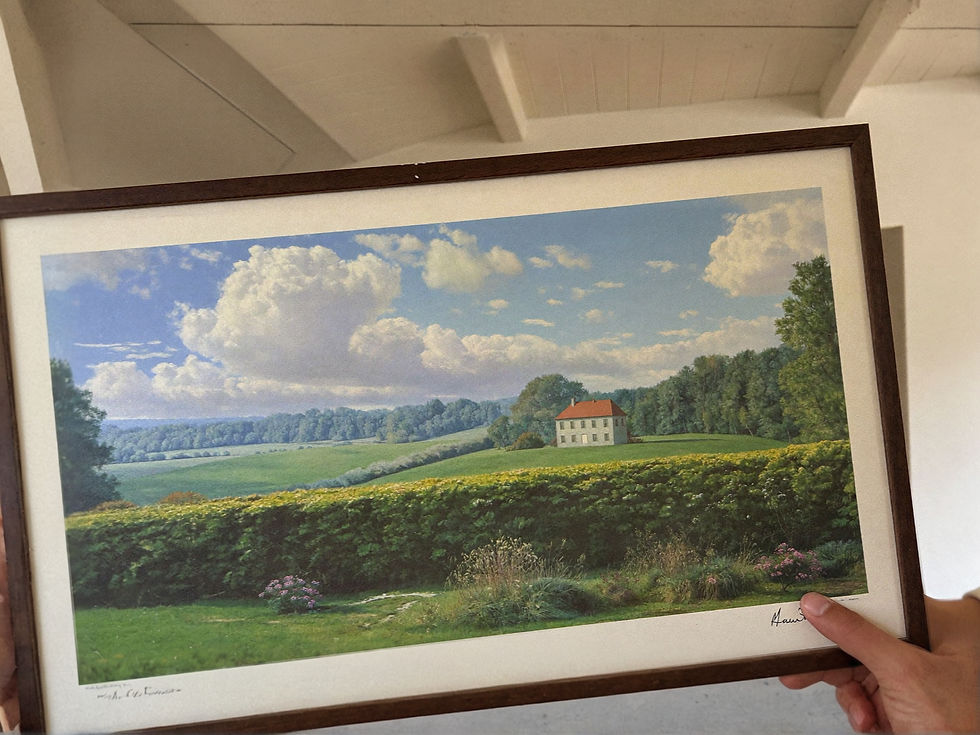
The Havenest countryside collection moves between open meadows, worn paths, distant houses, and weather-softened hills. Some images carry the hush of morning; others hold the darker pull of approaching rain. What connects them is a sense of place that does not resolve too quickly.
When curating, we look for a scene with enough visual quiet to live beside and enough narrative tension to keep returning to. A bend in the road matters because it withholds what comes next. A farmhouse matters because its windows suggest lives beyond the frame. The landscape remains spacious, but never empty.
Choose slowly. Notice which image makes you imagine a sound, a temperature, or a remembered journey. That response is more useful than asking whether the colors match your sofa. Art becomes part of a home when it continues the inner life of the person who chose it.


Comments