Friedrich’s Winter Landscape: Where Hope Appears Through the Mist
The church almost escapes the first glance. Dark fir trees stand closer to us, their branches edged with snow; behind them, pointed forms rise through the grey air. Gradually that distant shape becomes architecture.
In Caspar David Friedrich’s Winter Landscape, looking is a movement between what feels solid and what remains difficult to reach. A man rests against a rock. A crucifix stands among the trees. Two crutches lie apart in the snow. The scene is quiet, yet the small human presence makes its quietness consequential.
The National Gallery, London, dates this oil painting to probably 1811 and records its dimensions as 32.5 × 45 centimetres. This is an intimate canvas with a remarkably expansive distance. Its winter atmosphere rewards a slower approach: begin with the foreground, follow the repeated shapes, and allow the religious details to change the view.
In this article
Begin with the distance you cannot cross
The foreground offers the eye something almost tactile. Snow rests on angular stones, scattered grasses interrupt its whiteness, and the fir branches spread in uneven tiers. These things seem close enough to distinguish individually. Beyond them, the ground becomes broad, pale, and less certain.
There is no inviting road that escorts us to the building. Instead, the eye moves across an interval it cannot fully measure. The church is recognizable, but the land between here and there does not unfold as a sequence of convenient steps. We see a destination without receiving directions.
This is an observation about the picture’s structure, rather than a claim that Friedrich painted a particular personal obstacle. The effect comes from relationships we can follow: dark beside pale, distinct beside dissolved, something near enough to count beside something we must search for.
Try covering the distant church with a hand. The trees still make an arresting winter group, but the composition loses its second place of attention. Uncover it, and the landscape begins to stretch again. The almost-hidden building gives the first encounter somewhere to continue.
That second encounter matters. A painting can make space through the difference between two kinds of seeing, without filling every metre of ground with equally legible detail.
The small figure changes the landscape
At the base of the trees, a person could initially be mistaken for another dark interruption in the snow. Look closer. His head and raised hands bring a human action into a scene that might otherwise feel uninhabited.
The National Gallery identifies a man praying before the crucifix after casting aside his crutches. The painting does not show him rising and walking away. We should resist supplying that next event, or converting an image of faith into a documented account of physical recovery.
What we can see is a change in orientation. The crutches extend across the ground; the prayer directs attention upward. The man stays low, close to the boulder, while the cross continues vertically into the branches. His smallness makes the relationship unusually concentrated.
There is also an important difference between noticing a figure and imagining his biography. We do not know his name from the image. His expression remains difficult to read at this scale. The precise feeling we attach to him belongs partly to our encounter with the painting.
Stay with the posture before naming that feeling. The hands, the stone, and the nearby crucifix are enough to establish an act of devotion. Their scale asks us to lean closer instead of treating the entire landscape as a distant spectacle.

Fir trees and church answer one another
The fir group occupies the right-hand portion of the picture, rising from its rocky footing into the upper air. Its pointed profile has an answering shape farther left: the church towers lift into the same winter sky.
They are different things with a related visual rhythm. A tree spreads into branches; a building organizes walls and spires. Yet both gather the eye upward from a broader base. Moving between them, we recognize a correspondence before deciding what to make of it.
The difference in clarity prevents this from becoming a neat diagram. We can follow the near branches, including small white accents along their lengths. The distant architecture is held together by a much softer contour. Similar shapes occupy unequal distances from us.
To my eye, the repetition creates a form of reassurance without removing uncertainty. Something familiar in the foreground prepares us to recognize something less accessible beyond it. That is a reading of the arrangement, rather than a recovered statement of Friedrich’s private intention.
Havenest’s broader essay on Friedrich and Romantic solitude considers other ways his landscapes organize inward attention. Here, the useful move is narrower: follow the silhouettes and notice exactly where one shape starts to recall another.

Christian hope belongs to this particular picture
It would be easy to describe this work as a peaceful winter view and stop there. The prayer and crucifix make that description incomplete. Religious meaning is present within the scene, not added simply because the atmosphere invites reflection.
The National Gallery interprets the painting through Christian hope and resurrection, identifying the three firs with the Trinity. That account gives the individual motifs a historical framework. It does not require every viewer to share the figure’s faith, but it asks us to recognize what he is doing.
The Met’s 2025 exhibition text also pairs the London painting with Friedrich’s Winter Landscape in Schwerin: a man on crutches among damaged trees. Across that pairing, the contrast between exposed ground and evergreen shelter becomes especially significant.
Even without placing the two canvases side by side, the London picture holds a tension between vulnerability and support. The man remains small. The snow remains cold. The cross is accessible to his gaze while the church is still far away.
My reading is that hope becomes persuasive here because the setting has not turned comfortable. The painting gives devotion a place within difficult conditions. It leaves the winter visible around it, allowing consolation and exposure to occupy the same small field of view.

Mist makes space through differences in clarity
Look at the edges. Near the viewer, branches cut dark shapes into lighter surroundings. Around the distant building, those distinctions soften. The reduced contrast suggests distance, even where the intervening ground offers few landmarks.
Notice, too, that the mist has variations. It is not an even screen of grey laid across the whole scene. Some passages let the architecture assert itself; others draw it back toward the surrounding air. The church seems to arrive through degrees of visibility.
The National Gallery’s technical account describes finely stippled smalt in the mist and detailed underdrawing beneath the architecture. Delicate atmosphere and careful construction belong together in this work. A softened appearance need not imply an imprecise beginning.
For a simple looking exercise, move away from the reproduction until the tiny details disappear. Ask which relationships survive. The dark tree group, pale snow, and faint building remain distinct enough to hold the scene. Return closer and the small marks become available again.
This movement between distances can clarify why the picture feels spacious. We are not responding only to the amount of empty ground. We are responding to a controlled change in how much information the painting allows us to receive at once.

Look again at the snow beneath your feet
The snow can look almost blank beside the dark trees. On a longer inspection, it becomes one of the busiest parts of the picture. Shadows indicate shallow undulations. Fine grasses cross its surface. The crutches sit at different angles within that pale field.
These interruptions keep the ground from becoming a white border. They give the lower part of the painting a scale we can imagine bodily: a short distance to cross, a small irregularity underfoot, an object that could be grasped.
Follow the foreground slowly from one side to the other. The marks do not distribute themselves with perfect regularity. Some areas remain relatively open; others gather around stone or vegetation. The alternation lets the eye rest without making every part of the surface equivalent.
Our feature on the French landscape tradition follows a different historical route through trees, fields, and human scale. Comparison is useful when it sharpens the present picture: Friedrich’s small ground-level details hold their own against an architecture that appears almost beyond reach.
The near and far depend on each other. Without the distant church, the snow loses part of its outward pull. Without this tangible foreground, the church would have less distance from which to emerge.

Let the landscape keep its difficult quiet
Return now to the whole painting. The figure you may have missed is still small. The church has not become clearer simply because you know it is there. The picture rewards recognition while preserving the conditions that made recognition gradual.
That is a useful distinction for anyone drawn to quiet art. Quietness can contain an action, a belief, and a difficult passage of space. It need not mean that nothing is happening. Here, the most consequential gesture occupies very little canvas.
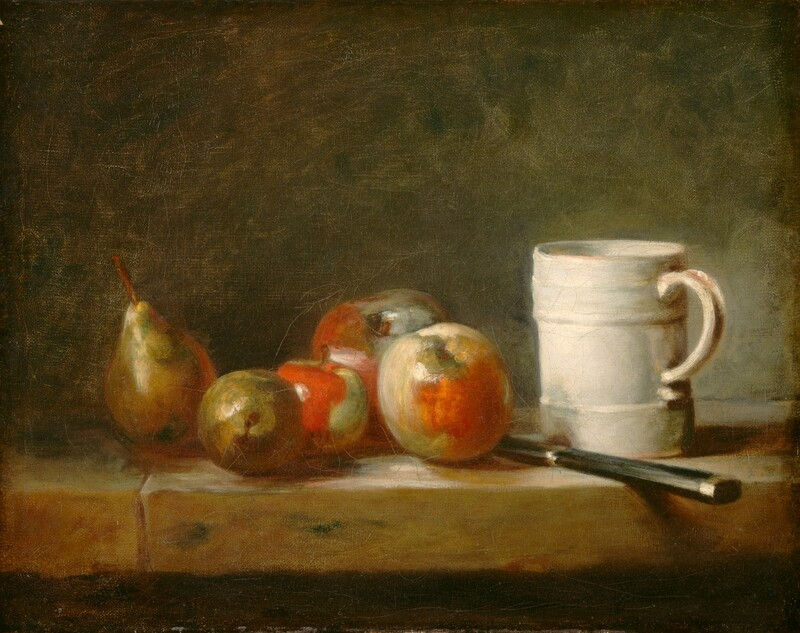
If you want another close-looking exercise, Chardin’s ordinary objects offer a different scale of attention. A mug and fruit ask for scrutiny within reach of a hand. Friedrich holds our attention between that bodily closeness and a building suspended in the distance.
The comparison suggests a habit rather than a rule for interpreting art: identify the smallest detail that changes the whole. In Winter Landscape, the prayer may be that detail. Once recognized, it alters the relationship between trees, cross, snow, and church.
The distant spires remain partly withheld. We have learned how to look toward them without pretending that all the mist has lifted.
Sources and image credits
Related reading
Alex from Havenest Studio


Comments