
When Landscape Became a Mirror of the Soul: Caspar David Friedrich and Romantic Solitude
There are landscapes that describe a place, and landscapes that quietly ask what it means to be alive inside one. Caspar David Friedrich belonged to the second kind. In his paintings, a mountain is never only a mountain, a ruin is never only architecture, and fog is never merely weather. Each element seems to hold open a question.
Friedrich became one of the defining painters of German Romanticism, a movement that treated the natural world as an encounter with the inner self. His figures are often small, seen from behind, and placed before an expanse that refuses to explain itself. That distance is the point. The viewer is not given a story to finish, but a silence in which to notice their own thoughts.

Caspar David Friedrich, Winter Landscape, probably 1811. National Gallery, London. Public-domain reproduction via Wikimedia Commons.
The figure who stands before the unknown
Friedrich’s most familiar figure may be the solitary wanderer standing above a sea of cloud. We see his back, not his expression. This simple decision changes the painting’s emotional temperature: he is not a character being observed from the outside, but a possible self into which we can step.
The man is present, yet the landscape is larger than his presence. Peaks rise and disappear. The horizon is obscured. Nothing announces whether the view promises revelation or disappointment. The scene becomes a threshold between what the mind can imagine and what the world will not disclose.

Caspar David Friedrich, Wanderer above the Sea of Fog, circa 1818. Hamburger Kunsthalle. Public-domain reproduction via Wikimedia Commons.
Nature as spiritual encounter
For Friedrich, nature was not a decorative backdrop placed behind human emotion. It was the medium through which emotion became visible. A pale sky could make attention feel suspended; a dark stand of trees could turn memory into a physical space; a narrow path could suggest movement without promising arrival.
This is one reason the word sublime matters here. The sublime is not simply beauty, and it is not the same as a gloomy mood. It describes the complicated feeling produced when we meet something vast, powerful, or unknowable—something that attracts us while also reminding us of our own limits. Friedrich’s landscapes are calm on the surface, but they make room for awe, uncertainty, and humility.

Caspar David Friedrich, Monk by the Sea, 1809. Alte Nationalgalerie, Berlin. Public-domain reproduction via Wikimedia Commons.
In Monk by the Sea, the scale is almost disorienting. A lone figure faces a broad division of shore, sea, and sky. There is very little visual information to distract us, which makes the smallest changes in tone feel consequential. The painting does not tell us what the monk thinks. It gives thought a place to happen.
Crosses, ruins, mist, and the Romantic sublime
Friedrich’s symbols are powerful because they never close down into a single explanation. A cross can suggest faith, mourning, endurance, or the persistence of human meaning within an indifferent world. A ruin can evoke history, loss, or the possibility that time changes the shape of belief without erasing it.

Caspar David Friedrich, The Abbey in the Oakwood, 1808–1810. Alte Nationalgalerie, Berlin. Public-domain reproduction via Wikimedia Commons.
The Abbey in the Oakwood gathers these tensions into a winter procession of trees, broken stone, and distant light. The dead branches are not arranged as a theatrical horror scene. They feel slower than that—like the visible surface of a culture, a faith, or a private life being carried forward through time.
Even when Friedrich paints catastrophe, he avoids spectacle for its own sake. In The Sea of Ice, fractured slabs of ice rise like a frozen architecture. The image is severe, but its severity is also formal: diagonals, planes, and pale blues turn danger into a structure the eye can contemplate. This is how feeling becomes painting—not through illustration, but through the organization of space.

Caspar David Friedrich, The Sea of Ice, 1823–1824. Hamburger Kunsthalle. Public-domain reproduction via Wikimedia Commons.
Why Friedrich feels contemporary
Friedrich feels close to the present because his paintings understand the difference between being alone and being inward. His figures are solitary, but they are not always isolated. They are given time to look. In a culture full of notifications, movement, and visual noise, that permission can feel almost radical.
His landscapes also resist instant consumption. A first glance may register a misty mountain, a pale moon, or a figure at a window. A longer look reveals carefully controlled intervals: the pause between foreground and distance, the quiet pressure of an empty sky, the way a dark vertical form steadies an otherwise open composition.
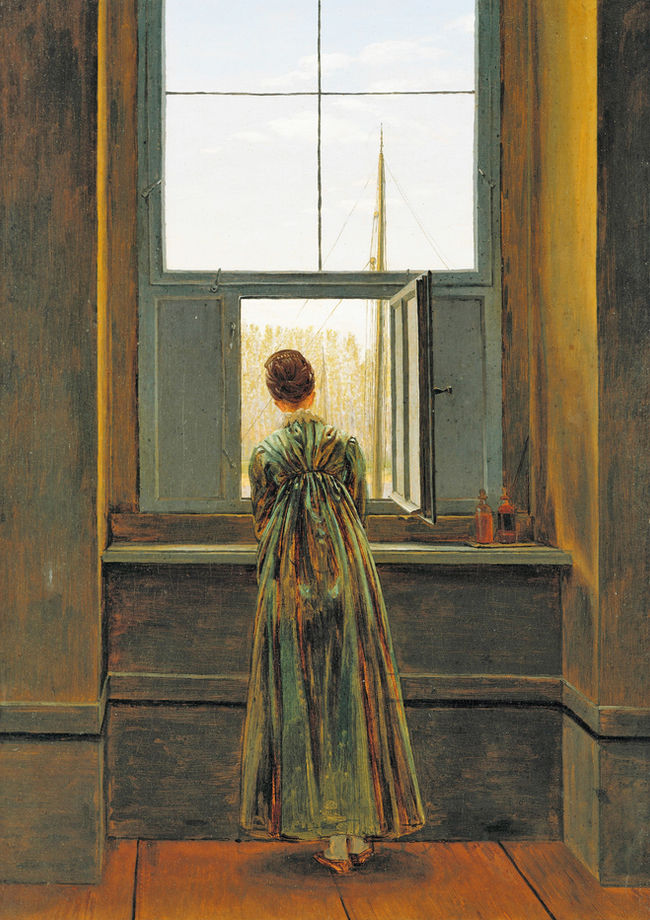
Caspar David Friedrich, Woman at a Window, 1822. Alte Nationalgalerie, Berlin. Public-domain reproduction via Wikimedia Commons.
Woman at a Window makes this inwardness intimate. The woman’s back is turned toward us, as in the wanderer paintings, but here the scale is domestic. The window offers a view and withholds it at the same time. We are left with the gentle knowledge that looking outward does not necessarily mean leaving oneself.
Choosing contemplative landscape art for a room
A Friedrich-inspired landscape works best in a room that allows the eye to rest. Look for a composition with a clear horizon, a restrained palette, and enough open space to create visual breathing room. Mist, water, distant architecture, and solitary trees can all create a sense of depth without making the room feel busy.
The aim is not to turn a home into a museum of melancholy. It is to introduce an image that changes slowly as you live with it. Above a writing desk, a quiet landscape can become a companion during concentration. In a bedroom, it can soften the last minutes of the day. In a meditation corner, it can offer a horizon without demanding a destination.
That is the lasting gift of Caspar David Friedrich’s landscape painting: it makes stillness active. His pictures do not empty the world of meaning. They give meaning enough space to arrive.
Continue exploring at Havenest
For another way of thinking about light and private attention, read “Johannes Vermeer: Light, Private Life, and the Art of Looking”.
For a quieter approach to choosing artwork at home, continue with “How to Choose Wall Art for a Calm Living Room”.
Research sources
National Gallery, London — Caspar David Friedrich, Winter Landscape.
The Metropolitan Museum of Art — Caspar David Friedrich: The Soul of Nature.
Wikimedia Commons — Friedrich artwork files and public-domain notices.
Alex, Holland, and Louis from Havenest Studio
Comments