Chardin and the Dignity of Ordinary Objects
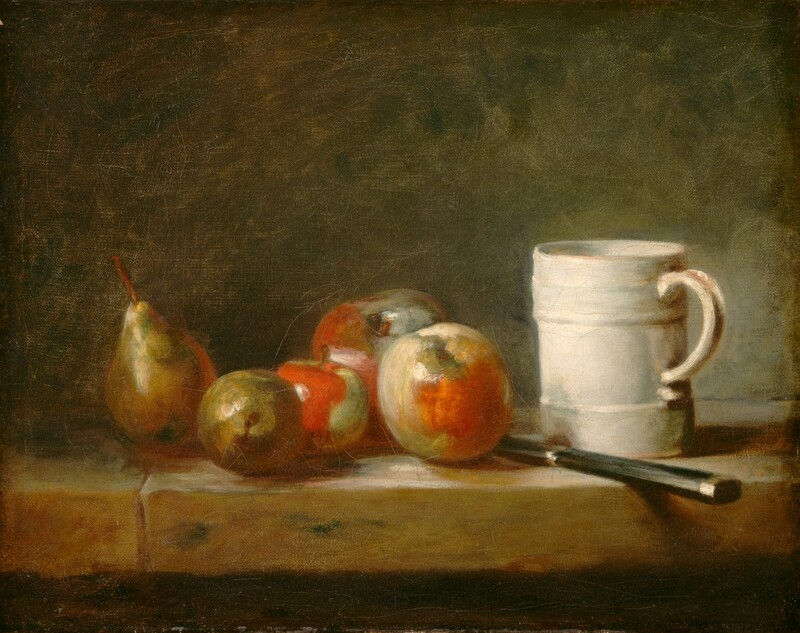
Jean Siméon Chardin, Still Life with a White Mug, c. 1764. National Gallery of Art; Gift of the W. Averell Harriman Foundation in memory of Marie N. Harriman. Public domain. Image source.
There is a particular kind of painting that makes you look again at the cup beside you. Its subject is so familiar that you almost pass over it. Then a small difference in light, the space around a handle, or the weight of a piece of fruit holds your attention.
Jean Siméon Chardin gives ordinary things this kind of presence. His paintings invite a question more useful than whether a subject is impressive enough for art: what becomes visible when someone pays it sustained attention?
The answer is not simply domestic comfort. Chardin can be tender, materially precise, and surprisingly uneasy. Looking across a restrained fruit arrangement, an abundant kitchen still life, and a scene of absorbed play reveals an artist whose everyday world has considerable range.
In this article
An ordinary subject can carry a serious painting
We often approach pictures with an informal hierarchy already in place. A dramatic event seems to promise a story; a portrait offers a person; a landscape gives us somewhere to go. A mug and several pieces of fruit can initially seem to offer very little.
That apparent limitation is a useful beginning. With fewer narrative distractions, relationships become easier to notice. Does one shape press toward another? Where does the light stop? How much empty background does a small object require before it feels substantial?
Chardin’s professional standing also cautions against assuming that his subject matter made him marginal. The Metropolitan Museum of Art dates his admission to the French Royal Academy to 1728, the period surrounding The Silver Tureen. A still life could demonstrate considerable ambition without borrowing a battlefield or a myth.
For a present-day viewer, the rewarding move is to postpone the question of what the objects represent. First ask how they have been made available to sight. Their familiarity lets us recognize them quickly. The painting asks us to remain after that recognition.
For a related figure scene, compare The House of Cards. The young person’s activity gives folded cards a different kind of importance. Ask how the tabletop objects organize the attention of both the participant and the viewer.

Jean Siméon Chardin, The House of Cards, probably 1737. National Gallery of Art, Andrew W. Mellon Collection. Public domain. A figure scene that makes attention to small objects visible. Image source.
The white mug asks for a second look
The National Gallery of Art dates Still Life with a White Mug to around 1764. It is a small oil painting, approximately thirteen by sixteen inches, with fruit, a knife, and a pale mug occupying a stone surface.
The museum’s visual description identifies three apples and two pears beside the vessel. That modest inventory matters because it sets a limit on the subject. There is no need to supply an absent banquet or imagine an elaborate household biography. The painting gives us enough to study without either invention.
A useful viewing exercise is to treat the mug as a shape before treating it as a container. Follow its upright body, then the turn of its handle. Compare those forms with the less regular shapes of fruit. Consider where the objects touch and where the surrounding space separates them.
Then return to their use. A mug can be lifted; fruit can be held; a knife belongs to an action. These possibilities give the arrangement a human scale even though no person appears. Our knowledge of handling things becomes part of looking at them.
Surface carries much of the drama
Still life depends partly on a remarkable agreement between painter and viewer. We accept that a flat painted surface can suggest something cool, rough, soft, reflective, or ripe. Our eyes infer qualities that our hands cannot test.
Chardin makes that agreement especially interesting. In its account of The Silver Tureen, the Met emphasizes both the convincing materials and the continuing visibility of paint. The image can evoke an object without erasing the substance that makes the image possible.
Try looking from two distances, whether in a gallery or using a museum’s zoomable reproduction. At one scale, identify a material. At another, notice how the marks cooperate to suggest it. You are following two kinds of information at once: what a thing might feel like, and how painting proposes that feeling.
This approach also makes room for uncertainty. A digital reproduction cannot show every property of an original surface, and screens change color and contrast. It can still help us notice a useful distinction: convincing texture is not the same as a photographically smooth finish. The act of painting remains part of the subject.
A second example, Still Life with Game, brings fur, feathers, and fruit together. Compare these materials with those in The Silver Tureen. Which differences depend on broad color areas, and which ask you to look closely at individual marks?

Jean Siméon Chardin, Still Life with Game, probably 1750s. National Gallery of Art, Samuel H. Kress Collection. Public domain. Fur, feathers, and fruit provide contrasting surfaces for close looking. Image source.
Domestic life includes abundance and discomfort
It would be easy to turn Chardin into a mascot for a tidy, uncomplicated home. The Silver Tureen resists that simplification. The Met describes a composition that brings living and dead creatures into relation with raw and prepared food, reflective metal, and other contrasting surfaces.
Its kitchen world contains appetite and material plenty, but also the fact that food comes from living things. That combination gives the arrangement more friction than the phrase “cozy still life” allows. A domestic subject can hold discomfort without losing its visual appeal.

Jean Siméon Chardin, The Silver Tureen, c. 1728–30. The Metropolitan Museum of Art, Fletcher Fund, 1959. Public domain. Image source.
Compare your response to this painting with your response to the white mug. Which arrangement feels closer to a room you know? Which requires you to confront something you would usually leave outside the frame? The difference is a productive part of the encounter, not a problem to smooth away.
Chardin’s range matters here. Dignity does not require making every object charming, nor does attention guarantee reassurance. Giving a thing pictorial importance may make its unfamiliar or difficult qualities harder to ignore. The familiar table can become a place where several kinds of experience meet.
A scene of play makes attention visible
Soap Bubbles, which the Met dates to about 1733–34, is a figure painting rather than a still life. A young person blows a bubble while a child watches. Including it beside the object paintings helps clarify the larger subject of attention.
The museum distinguishes Chardin’s everyday treatment from the moralizing associations that bubble imagery could carry in earlier Northern European art. That distinction is valuable. An inherited motif need not perform exactly the same work whenever it appears.

Jean Siméon Chardin, Soap Bubbles, c. 1733–34. The Metropolitan Museum of Art, Wentworth Fund, 1949. Public domain. Image source.
The scene also offers an analogy for looking. Something familiar becomes absorbing because it is happening with such particularity. The participant attends to a small process, and the viewer attends to that attention. No spectacular event is necessary to organize the picture.
Without claiming that every cup or apple conceals the same meaning, we can carry this thought back to the still lifes. Their objects are available for an equivalent concentration. Havenest’s essay on Vermeer and private life offers a neighboring route into domestic subjects, while leaving the differences between the painters intact.
Let interpretation grow from what is actually there
The impulse to decode a painting is understandable. Once someone mentions symbolism, each piece of fruit begins to look like a word in a language we ought to know. Yet an interpretation becomes weaker when it can be attached to almost any picture.
A firmer method separates three stages. Identify what the museum record establishes, describe what the image presents, and only then propose what the arrangement suggests to you. Those stages can enrich one another without becoming interchangeable.
For example, recognizing that a vessel is an everyday utensil does not establish who used it, whether it belonged to the artist, or what emotional memory it carried. Such claims require evidence. You can still discuss familiarity, weight, and human scale as features of your encounter with the work.
The same care is useful with flower paintings. Our article on Rachel Ruysch’s botanical still lifes provides another setting in which close attention and historical context can meet. Comparison should sharpen the differences between paintings rather than turn their objects into a single universal code.
Return to the things you already know
After looking at Chardin, try a small experiment at home. Choose an object you use often and set it where daylight reaches it. Leave the arrangement otherwise ordinary. The point is to examine a familiar thing before deciding whether it would make a pleasing photograph.
The utensils in The Attentive Nurse offer a useful comparison: familiar things appear within an activity rather than as an isolated arrangement. Look at the vessels on the table and consider how their relationship to a person changes your sense of their scale and purpose.
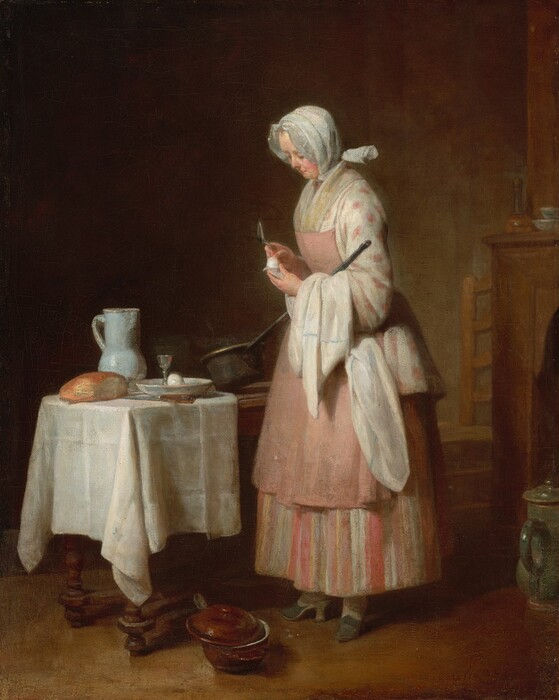
Jean Siméon Chardin, The Attentive Nurse, 1747. National Gallery of Art, Samuel H. Kress Collection. Public domain. Everyday utensils return to their setting of human use. Image source.
Notice the shape of the shadow beneath it, then the space between the object and its nearest neighbor. Look for an edge that becomes less definite as the light changes. These are observations you can make without knowing a date, an artistic movement, or a specialist vocabulary.
Then ask what the object’s usual purpose makes you overlook. A handle designed for your fingers may also create an opening of a particular shape. A useful container can be an arrangement of volumes. Practical knowledge and visual knowledge need not compete; each can make the other more precise.
This is one reason Chardin remains a rewarding companion for people interested in their homes. He offers a way to recognize substance in what is already present. The lesson concerns attention before acquisition, and the pleasure of looking before the urge to arrange everything anew.
The dignity of Chardin’s ordinary objects lies in the seriousness of the encounter he makes possible. Their worth does not depend on becoming rare, grand, or symbolically exhaustive. A painting can give a familiar thing enough presence to interrupt our habitual way of passing it by.
Return to the white mug after the more complicated scenes. Notice whether your first impression has changed. The subject has stayed where it was; your attention has acquired more room.
Sources and further reading
Written by James · Havenest Content Team

Comments