Willem Kalf’s Wanli Bowl: The Small Imbalance Inside Luxury
A blue-and-white bowl leans in the lower half of a dark painting. A lemon peel spills from it, and nearby fruit catches enough light to become recognizable before the surrounding room does. The glassware above seems to emerge in fragments, as though the eye has to earn its view of each object.
Willem Kalf’s Still Life with Fruit, Glassware, and a Wanli Bowl, painted in 1659, stages luxury through partial revelation. Yet the detail that most animates the arrangement is humble: the bowl balances on a piece of bread.
That slight instability offers a way into the picture. Rather than treating the work as a catalog of costly possessions, we can follow the physical relationships that bring its objects to life: one thing supports another, a peel changes direction, and light makes some surfaces available while withholding others.

Willem Kalf, Still Life with Fruit, Glassware, and a Wanli Bowl, 1659. Oil on canvas. The Metropolitan Museum of Art, Maria DeWitt Jesup Fund, 1953. Public-domain image, The Met Open Access. Museum record.
In this article
Start with what the darkness allows you to see
The first impression may be almost too dark. Then pale porcelain appears, the lemon peel becomes a ribbon, and small highlights locate glass above the central group. The arrangement does not surrender all its information at once. Looking involves adjustment, and that delay is part of the experience.
This does not mean every dark passage hides a symbol. Darkness also has practical pictorial effects. It reduces competition around illuminated edges, allows objects to overlap without every boundary being equally emphatic, and makes a small bright mark feel consequential. The pale bowl has more visual authority because so much around it remains restrained.
The Met’s record identifies the work as oil on canvas, dated 1659. Before proceeding to the objects’ origins, spend a moment following only the brightest areas. Our five questions for reading a still life recommend separating observation from interpretation. Here that means noticing the distribution of light before deciding whether the scene feels lavish, ominous, intimate, or theatrical. Those responses begin with specific visual conditions.
Give the darker areas time rather than immediately increasing the brightness of a reproduction. Although screens vary, a heavily brightened image can flatten the hierarchy between the bowl and the nearly submerged glassware. The relevant experience is the difference in their visibility. Looking should preserve that difference long enough to notice how recognition advances from the most available object toward the more elusive ones.
A piece of bread changes the porcelain’s posture
The museum points out that the bowl rests on bread. This small support tilts a vessel we would ordinarily expect to sit securely on its base. Once noticed, the detail changes the arrangement from a static display into a set of physical dependencies. The bowl’s position is contingent on something beneath it.
Its precariousness is gentle rather than spectacular. Nothing is shown falling. Yet we can imagine how removing the support would alter the angle, and that imagined adjustment gives the object a kind of potential movement. The lemon peel exaggerates the effect by traveling out from the bowl and down across the group.
Compare Cézanne’s Still Life with Apples and Pears. There, the question of support arises through shifting viewpoints and the relationship between dishes and tabletop. Kalf offers a more localized mechanism: a particular object is held at a particular angle. These are different approaches to making a still arrangement active. Their comparison helps us recognize balance as something a painting can ask us to feel, rather than simply a compositional rule it follows.

Paul Cézanne, Still Life with Apples and Pears, ca. 1891–92. Oil on canvas. The Metropolitan Museum of Art, Bequest of Stephen C. Clark, 1960. Public-domain image, The Met Open Access. Museum record.
Porcelain and carpet carry histories into the room
The Met identifies the Chinese porcelain bowl and Turkish carpet as luxurious imports. Those origins matter because the setting is not culturally self-contained. Objects made in different places meet on the same wooden table, and their material differences become part of the picture’s visual richness.
It would require further evidence to reconstruct the exact route traveled by the particular bowl or textile represented here. We should not infer a documented shipment or owner from the painted image alone. What the museum’s identification securely establishes is a relationship between this domestic display and the circulation of desirable goods across regions.
De Heem’s Still Life: A Banqueting Scene broadens the comparison through an expansive table crowded with vessels, food, and other objects. Its luxury is distributed across a larger field. Kalf concentrates ours into a darker, narrower encounter. Instead of surveying an entire spread, we attend to a few surfaces and their carefully managed illumination. The comparison clarifies that abundance need not depend on quantity. Selection, proximity, and visibility can make a small group feel materially extensive.

Jan Davidsz de Heem, Still Life: A Banqueting Scene, ca. 1640–41. Oil on canvas. The Metropolitan Museum of Art, Charles B. Curtis Fund, 1912. Public-domain image, The Met Open Access. Museum record.
The lemon peel joins color to movement
The peel carries a brighter yellow through an arrangement dominated by browns, deep reds, and shadow. It curls over the lip of the bowl and changes direction as it descends. Because it is thin, it can appear as both a material object and a line drawn through space.
Follow its shifts between illuminated surface and darker underside. Those turns make a narrow strip of rind feel three-dimensional. They also interrupt the bowl’s more stable curve. A rigid vessel and a flexible peel occupy the same area but describe different kinds of shape. Their contact makes each more noticeable.
In De Heem’s Still Life with a Glass and Oysters, another curling peel helps connect a glass, grapes, and opened shells. Looking across the two paintings reveals how a familiar motif can perform different tasks. De Heem’s brighter, compact grouping invites close sensory inspection; Kalf’s deeper surrounding darkness gives the peel a more isolated directional force. We do not need a universal symbolic definition of lemons to see how responsive that painted ribbon is to its setting.

Jan Davidsz de Heem, Still Life with a Glass and Oysters, ca. 1640. Oil on wood. The Metropolitan Museum of Art, Purchase, 1871. Public-domain image, The Met Open Access. Museum record.
Glass asks the eye to assemble an object from fragments
Unlike the bowl, the glassware does not present one continuously bright body. A rim, a stem, or a reflected mark can establish its presence while much of its surface remains absorbed into the darkness. We recognize a transparent object through limited evidence and then mentally connect those parts.
This economy is one reason the picture repays repeated visits. A highlight first experienced as a stray point may later become attached to a vessel. The scene gains structure without becoming uniformly illuminated. Kalf preserves the difference between knowing an object is present and being able to inspect every part of it.
Abraham van Beyeren’s Still Life with Lobster and Fruit offers another dark arrangement animated by reflective surfaces. Its red lobster draws attention strongly across the lower grouping, while additional vessels and fruit distribute smaller visual events. Kalf’s bowl is cooler in color and more concentrated in its pale presence. Comparing those anchors helps explain how dark paintings can remain compositionally distinct: the placement and temperature of their strongest accents determine the paths our attention takes.

Abraham van Beyeren, Still Life with Lobster and Fruit, probably early 1650s. Oil on wood. The Metropolitan Museum of Art, Gift of Edith Neuman de Végvár, in honor of her husband, Charles Neuman de Végvár, 1971. Public-domain image, The Met Open Access. Museum record.
Luxury does not give us a complete statement of intention
It is reasonable to recognize wealth in imported porcelain and an elaborate textile. It is less reasonable to assume that recognition settles everything the painting is doing. Materials have social histories, but they also have colors, textures, and shapes. Those aspects are inseparable on the canvas, even when we discuss them one at a time.
The Met includes a later writer’s account of Kalf as someone drawn to subjects that pleased him. Such testimony belongs to the work’s historical reception; it should not be treated as a direct explanation spoken by the painter over this particular canvas. Neither a moral warning nor a celebration of possession should be imposed as its sole possible meaning.
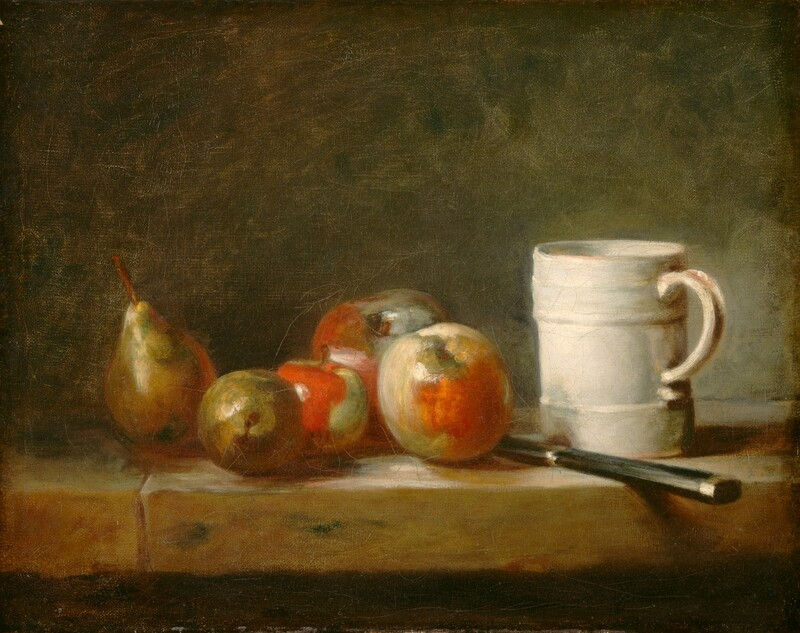
For a different encounter with objects and value, read Chardin and the dignity of ordinary objects. The comparison invites a useful question without flattening the artists together: what makes an object worthy of sustained attention? In Kalf, costly materials are certainly present, but a piece of bread proves just as consequential to the arrangement. Its ordinary function as a support makes the extraordinary vessel more visually alive.
Return from possession to relationship
After inspecting the materials, look again at the contacts between them. The bowl touches its support; the peel crosses the lip; fruit presses near porcelain; the textile meets the wooden table. These relationships keep the display from becoming a set of disconnected trophies. Each thing affects the visibility and posture of another.
The darkness now feels less like a generalized atmosphere and more like the condition that allows those contacts to emerge selectively. We do not see everything at equal strength. The picture asks us to move among partial disclosures, carrying one observation forward until it changes the next. That process gives a stationary arrangement duration.
Our essay on Cézanne’s unsettled still lifes pursues another way objects can remain active under prolonged attention. Kalf’s painting leaves us with a particularly modest source of activity: bread beneath porcelain. Once we have noticed it, the costly bowl can no longer seem entirely self-sufficient. Its elegance depends on contact, support, and a slight departure from balance, all made visible within a handful of carefully chosen light.
Written by Havenest Studio


Comments