Silent Night by Viggo Johansen: Why the Tree Glows
The brightest thing in the room is also the thing that brings everyone together. Around a Christmas tree, children and adults join hands. Some faces catch a yellow-white glimmer; others almost disappear. Before we recognize individual people, we recognize a shared direction of attention.
Viggo Johansen’s Silent Night, also known by its Danish title Glade jul, makes a holiday gathering depend on what remains unlit. The painting offers plenty of decoration, but its emotional center comes from the relationship between a luminous tree and the people circling it.
For an early winter moodboard, this is a rewarding place to begin: with a painting that asks how a room gathers people, and how a small concentration of light can make that gathering visible.

In this article
A Copenhagen Christmas in 1891
The Hirschsprung Collection identifies Silent Night as a painting of 1891. Its account of the Skagen painters locates this Christmas scene in the Johansen family’s Copenhagen living room, rather than in the fishing town associated with the artists’ colony.
That distinction matters. A painter’s familiar geographical label can become a shortcut that hides the particular place before us. Here, walls, a mirror, framed pictures, and a densely occupied floor establish a domestic interior. The celebration takes place within the ordinary architecture of family life.
Johansen’s wife Martha and their six children frequently appeared in his work. The museum describes his reputation as both a painter of the home and a painter of lamplight. Those subjects meet here: artificial light turns a familiar room into a place that deserves concentrated attention.
We do not need to make the room stand for every Danish Christmas. It belongs to a particular household. Its intimacy becomes more persuasive when we preserve that specificity instead of treating the figures as interchangeable illustrations of seasonal happiness.
The holiday that lasted until April
The scene looks fleeting, but the painting took time. In an account by Hirschsprung curator Anna Schram Vejlby, Johansen continued working until April. Paper covered the windows, candles were lit, and fresh branches replaced the tree’s shedding foliage while family members modeled.
This history changes the apparent instant. The circle before us is a constructed image, sustained through repeated sittings and practical adjustments. A convincing sensation of evening did not require the painter to finish everything during one evening.
A surviving Christmas Eve, study, dated 1891, offers another encounter with the motif. Its looser passages and more compressed figures let us follow the same central problem: how to make a tree’s scattered points of brightness hold a group together. Looking between the study and the finished work makes composition feel like a set of decisions rather than a scene simply captured.
The extended process also restores labor to the picture. Keeping a room available, maintaining its lighting conditions, and returning bodies to their places are part of making a domestic image. The celebration becomes art through considerable repetition, even when the result feels spontaneous.

A tree that organizes the darkness
Begin with the large masses. The tree rises slightly to the right of center, spreading across much of the room’s height. A dark adult figure in the foreground interrupts its lower branches. Smaller figures extend the grouping toward both sides, while the left wall provides a broad, less illuminated counterweight.
The tree’s lights do not behave like one flat patch. They form small events at different heights and depths. A bright mark pauses the eye, then another carries it upward or sideways. The branches connect those interruptions into something substantial enough to occupy the room.
Darkness gives each event its scale. If every curtain fold and piece of furniture had equal brightness, the candles would lose much of their force. Here, the surrounding surfaces remain available to patient looking without demanding the first glance.
Follow the brightest marks toward the top of the tree, then descend through the smaller flames. The route does not stay symmetrical. Branches protrude at different angles, and the lights gather more densely in some passages than others. That irregularity prevents the decorated tree from reading as a diagram. It remains an object with width, interruptions, and branches that reach into the same space as the people.
A different arrangement of this relationship appears in our essay on Willem Kalf’s Wanli bowl. The subjects differ, but both pictures reward attention to partial visibility. Brightness becomes meaningful through the less available forms around it.

The circle is made of hands
The joined hands give the gathering a readable structure. We cannot see a complete, unobstructed ring: the tree and overlapping bodies conceal parts of it. Yet the visible connections allow us to infer how the figures belong together in space.
Look at the children nearest the front. Their arms stretch between neighboring bodies, crossing the lower part of the composition. These thinner diagonals interrupt the heavier shapes of skirts and the tree. The circle feels held through contact, even where its path disappears.
The foreground adult turns away from us. Her dark dress occupies a large area, and her extended arms connect the nearer children with the group beyond. Rather than supplying a face for us to read, this figure supplies a position within the gathering.
Vejlby identifies her as Martha, standing between her daughters Ellen and little Nanna. Knowing their names gives the arrangement historical particularity. The visible relationships still matter in their own right: an adult body makes room between smaller bodies, and the chain of hands keeps that space shared.

What waits at the edge of the room
A slower look travels away from the tree. At the left, vessels and branches stand near a tall reflective surface. Framed pictures occupy the wall behind the figures. An older woman remains farther back, her pale collar emerging from the darker setting.
These objects and this more distant presence keep the gathering attached to a room. Christmas has altered the household’s arrangement, but the surrounding possessions have not vanished. The holiday coexists with furniture and pictures that belong to other days.
The mirror adds a second, weaker register of the tree. Its reflection is less commanding than the illuminated branches themselves. That difference lets the room feel deeper without producing a rival center. We register a surface, reflected greenery, and a place beyond the immediate circle.
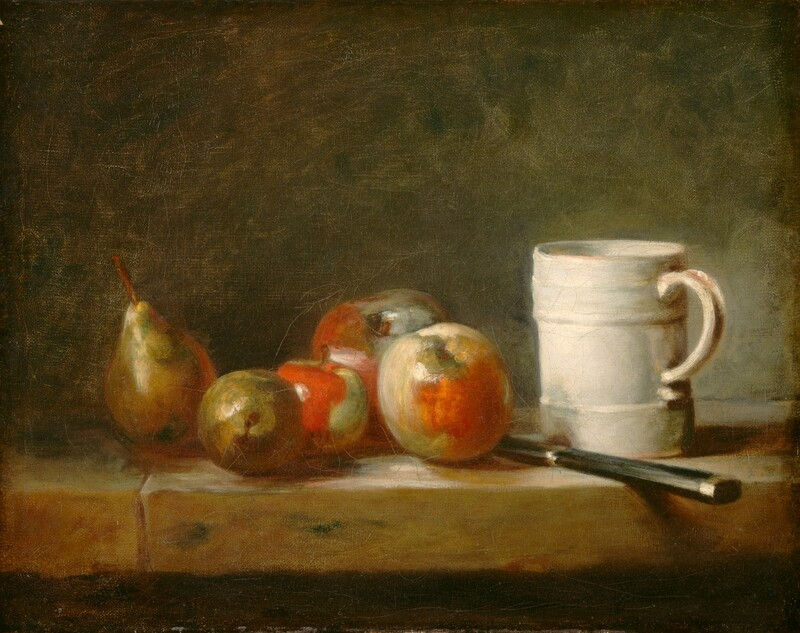
This attention to ordinary things has a useful companion in Chardin and the dignity of ordinary objects. The connection concerns the act of looking: background objects can establish the human scale of a scene without requiring an invented story about who owned each vessel or what each object symbolized.

Blue-green branches, warm faces
The tree is colorful within its darkness. Blue-green needles meet gold, pale yellow, red, and smaller decorative accents. The cooler foliage helps separate the candle flames from the branches, while faces and hands return some of that warmth to the surrounding people.
Notice how unevenly faces become visible. A cheek or forehead can catch enough light to locate someone; the rest of the head remains less definite. This unevenness makes us travel through the gathering rather than read every person at the same speed.
The apparent softness of an edge also matters. A dark sleeve may merge with a neighboring shadow, then become distinct where a hand approaches the tree. Such changes let overlapping figures feel connected to a common atmosphere rather than cut out and arranged against a backdrop.
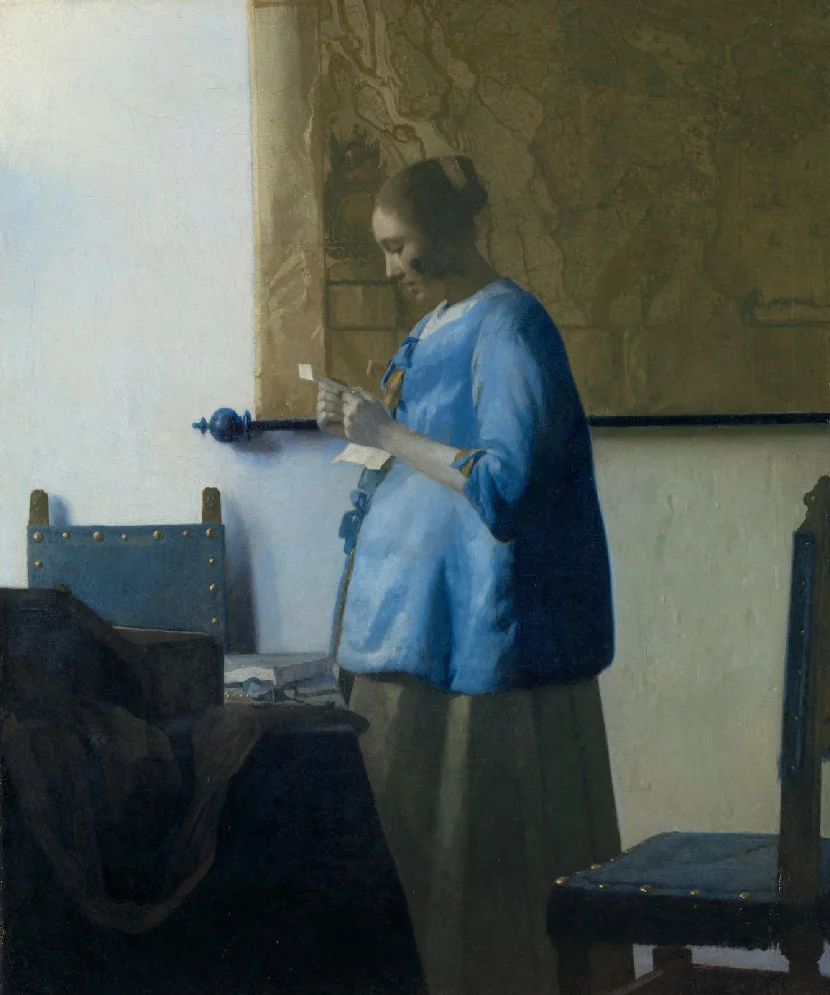
Our essay on Vermeer’s light and private life offers a different interior for comparison. Instead of treating the painters as versions of one idea, attend to the difference: Johansen distributes attention among bodies gathered around an internal light source. The room’s intimacy is collective.
A winter reference worth looking at slowly
As a present-day winter reference, Silent Night suggests beginning with relationships rather than a shopping list of seasonal objects. Ask which area holds the strongest light, which colors remain restrained, and how the spaces between people make their gathering legible. This is a contemporary reading of the image, not a claim about Johansen’s decorating advice.
The lesson is especially clear when looking at a small reproduction. Even before individual ornaments resolve, the tree and dark foreground figure establish a recognizable structure. At a larger scale, linked hands, reflected branches, and distant pictures complicate that first impression. The painting gives close looking somewhere to go.
It also leaves different forms of participation visible. Some bodies occupy the circle’s foreground; another presence watches from farther back. Our response need not assign the same emotion to everyone. A shared occasion can contain several distances from its center.
Return finally to the candles. Their brightness feels generous because it reaches only parts of the room. A face receives it, a hand passes through it, a branch interrupts it. To me, the painting’s enduring tenderness lies in this uneven distribution: people become visible to one another within a space that still has shadows.
Sources and image credits
Related reading
Alex from Havenest Studio

Comments