
"The Poet’s First Verse": Vintage Literary Wall Art for Thoughtful Rooms
Some rooms ask for art that fills an empty wall. Others ask for an image that slows the room down. "The Poet’s First Verse" belongs to the second kind: vintage literary wall art shaped around a quiet pause, a feather quill, and the uncertainty of beginning.
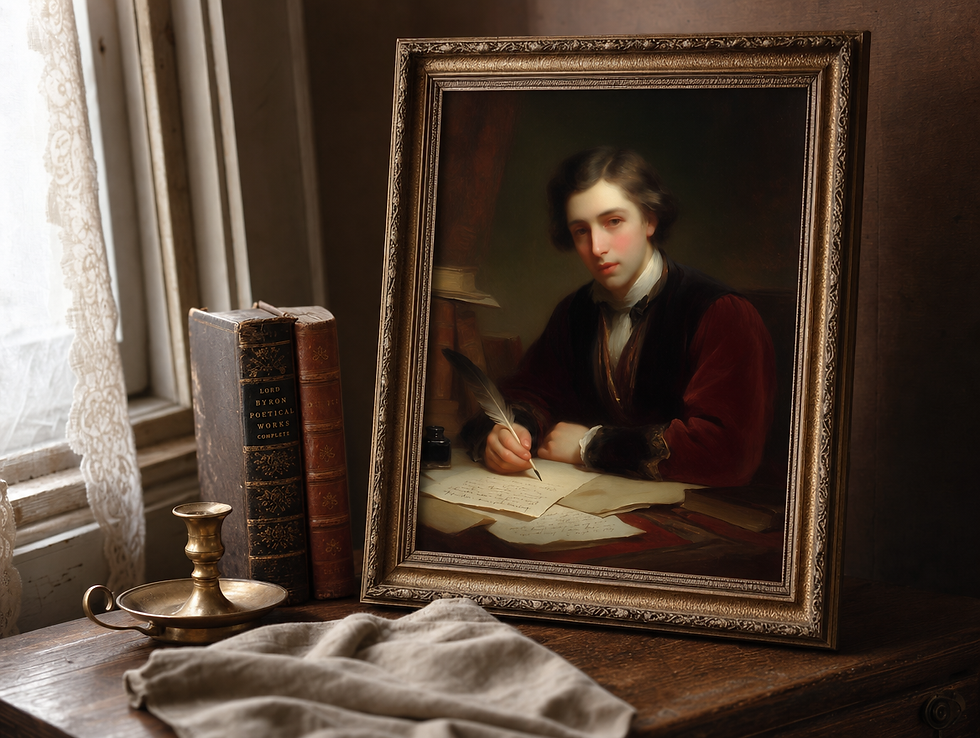
The young poet is not shown in triumph. He sits close to the page, with books, ink, and loose manuscripts gathered around him. Deep burgundy velvet warms the shadows while pale paper draws the eye toward the words that may—or may not—have arrived.
It is a portrait for thoughtful rooms: a study, reading corner, bedroom, or hallway where the atmosphere matters as much as the subject. The image brings old-world intimacy without asking the whole interior to become theatrical.

In This Journal
The Moment Before the First Line
A first verse carries a peculiar kind of hope. It may become the beginning of something lasting, or it may be crossed out before the ink has dried. "The Poet’s First Verse" holds that delicate threshold rather than the comfort of a finished work.
The figure is alone with the tools of the task: paper, an ink bottle, a pale feather, and books that suggest both companionship and pressure. We are not seeing genius after the world has recognized it. We are seeing the private patience required to stay with an idea while it is still fragile.
That emotional opening is part of what makes Romanticism vintage art so compelling in a contemporary home. Narrative paintings do not finish the story for us; they leave enough space for our own ambitions, doubts, and unfinished thoughts to enter.

What Gives the Portrait Its Stillness
The composition is close and almost conversational. The poet looks outward, yet the quill remains lowered toward the manuscript, as though concentration has been interrupted for only a second.
The face is softly illuminated against a dark background. Burgundy sleeves frame the center of the painting; the black vest and warm brown books keep the palette grounded. Cream-colored pages catch the remaining light and guide the eye from expression to unwritten space.
Nothing needs to be loud. The emotional weight comes from restraint: a paused hand, scattered papers, closed books, and the contrast between pale skin and deep shadow. The sitter is not presented as a documented historical figure, so the story stays open rather than pretending to offer a provenance the image does not provide.

Where Literary Wall Art Feels at Home
Because "The Poet’s First Verse" is an intimate vertical portrait, it works especially well in spaces designed for reading, writing, reflection, or quiet conversation. A home office is the natural setting, but not the only one. The artwork can anchor a narrow wall beside a bookcase, add depth above a writing desk, or bring a more personal mood to a bedroom.
• Above a compact writing desk or antique-inspired console.
• Between two bookcases in a study or library.
• Beside a reading chair with warm directional lighting.
• On a narrow bedroom wall where a vertical composition feels balanced.
• Within a literary gallery wall of manuscripts, botanical studies, or small classical portraits.
Give the frame enough open wall to preserve its stillness. For more help with proportion and placement, see Vintage Art for Homes: A Thoughtful Styling Guide.

Framing the Burgundy Palette
The palette is rich but disciplined: burgundy velvet, ink black, parchment cream, warm brown, and muted gold. These colors pair naturally with walnut, dark oak, aged brass, linen, leather, and softly textured walls. One or two echoes of the painting are enough; the room does not need to become a literal poet’s study.
A dark walnut frame deepens the scholarly feeling and connects easily with nearby books or wooden furniture. A restrained antique-gold frame adds contrast around the illuminated face and manuscript. In a cleaner interior, a narrow black frame with a warm ivory mat can bridge the old-world image and contemporary furniture.
Warm, indirect light will reveal the burgundy and brown tones without flattening the shadows. This is the same balance explored in Romanticism Wall Art: Emotion, Nature and the Beauty of the Unrestrained: mood comes from a few deliberate choices, not from filling every surface.

Choosing, Printing and Sizing the Artwork
"The Poet’s First Verse" is offered as a digital download, giving you control over the final size, material, and frame. The high-resolution JPG set is prepared at 300 DPI in five common aspect ratios: 2:3, 3:4, 4:5, 5:7, and 11:14. Choose the file that matches the frame ratio before sending it to the printer.
Canvas can make the portrait feel closer to a traditional oil painting, while matte fine-art paper, textured paper, cotton rag, or heavyweight archival paper creates a softer framed presentation. If the shadows look too dense in a test print, ask the printer to preserve detail in the dark areas rather than increasing overall brightness.
For a practical comparison of surfaces, brightness, weight, and printer settings, read Best Paper for Printable Wall Art.
Bring the quiet tension of an unwritten page into your own creative space. Explore "The Poet’s First Verse" on Etsy.
Before ordering the final print, tape a paper template to the wall and view it from the room’s main entrance. Keep the center near natural eye level, leave enough space around the frame, avoid reflective glass opposite a bright window, and repeat only one or two colors from the portrait nearby.
A Room for Unfinished Thoughts
"The Poet’s First Verse" is ultimately a portrait of beginning. Its beauty lies not in a public triumph or a grand declaration, but in the private courage of placing the first words on an empty page. That feeling belongs not only to poets. It is familiar to anyone who has tried to make something before knowing whether it would succeed.
In a home, the portrait becomes a gentle reminder that meaningful work often begins in silence: one uncertain line, one careful gesture, one page at a time. Styled with breathing room and honest materials, it can make a study or reading corner feel more reflective without becoming overly formal.
For the room where your own ideas begin, discover "The Poet’s First Verse" on Etsy.
Words and visual direction by Havenest.
Comments