Romanticism Wall Art: Emotion, Nature and the Beauty of the Unrestrained
Some art asks to be admired. Romanticism wall art asks for something less comfortable: to be felt before it is understood. A sky gathers until it becomes almost unbearable. A hand reaches and stops. A figure stands at the edge of a sea that does not care whether the human heart is ready for its scale.
This is not beauty made obedient. Romanticism emerged from a refusal to keep imagination, fear, desire, grief, and awe within polite boundaries. Its paintings do not arrange emotion as a decorative accent. They build the entire world from it—light, weather, gesture, distance, even silence.
The previous Havenest essay, When a Painting Reads You Back, explored the private story a viewer brings to an image. This chapter turns toward the force already inside the picture: why Romantic art made feeling structural, why nature became immense, and why its unrestrained beauty still feels startlingly modern.
In This Article
Romanticism Began Where Restraint Ended
Romanticism gathered force in Europe around 1800, when confidence in reason, order, and inherited systems had begun to crack. The Metropolitan Museum of Art describes a movement centered on imagination and emotion, shaped by revolution, literature, distant histories, spiritual unease, and the overwhelming power of nature.
The important word is not escape. Romantic artists were not simply fleeing reality into prettier dreams. They were insisting that reality included the irrational, the haunted, the ecstatic, and the unresolved. A person could be brave and terrified in the same instant. A landscape could be beautiful because it threatened human control, not because it behaved like a garden.
This loosened the emotional range of painting. Heroes could fail. Lovers could remain separated. The natural world could dwarf the human figure. A historical scene could feel like contemporary crisis, and a private gesture could carry the weight of an epic. Romanticism gave contradiction permission to remain visible.
Emotion Is Not the Subject—It Is the Structure
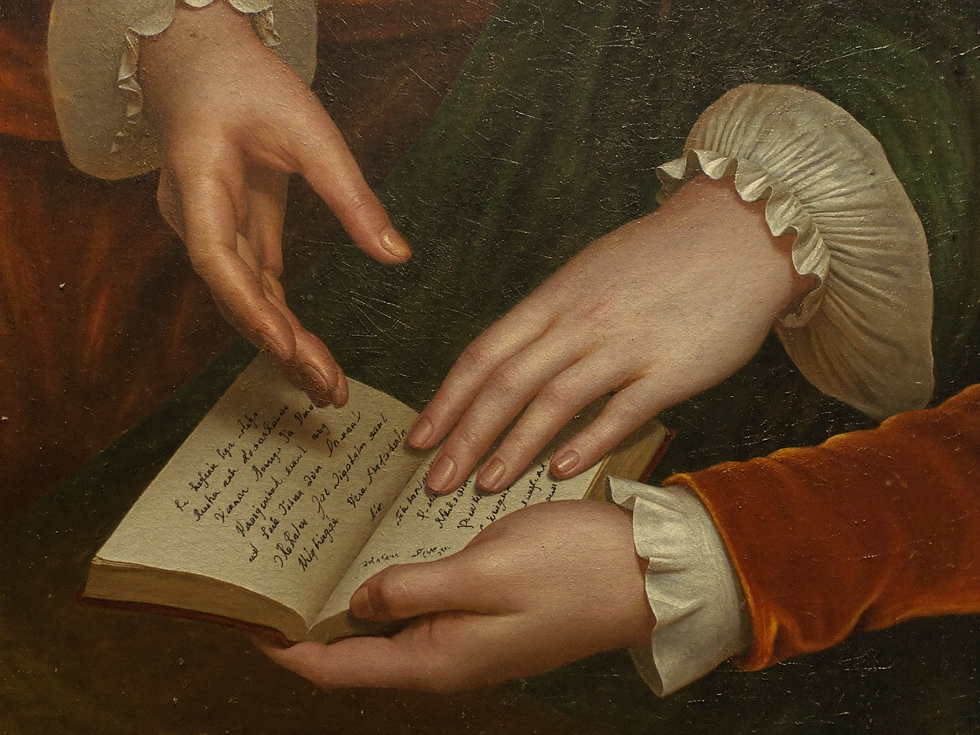
In lesser dramatic art, emotion is often added after the composition has been built: a tear, a storm cloud, a desperate pose. In strong Romantic painting, feeling determines the composition from the beginning. Bodies lean toward or away from one another. Light isolates the figure who matters. A doorway divides duty from desire. Empty space becomes the distance no character can cross.
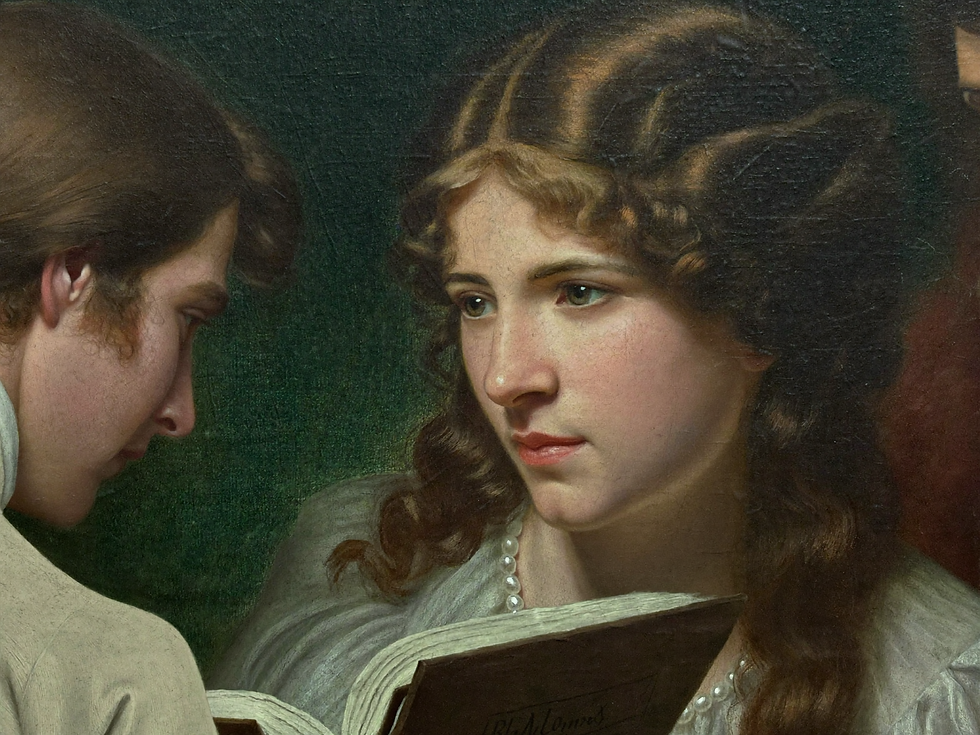
This is why small details can hold more power than a theatrical expression. A hand resting on an unread page may suggest hesitation, authority, exhaustion, or the end of an argument. A listener placed at the edge of a literary circle can appear included socially yet absent emotionally. The painting does not announce the conflict. It lets arrangement reveal it.
Romanticism also understood that people rarely feel one thing cleanly. Devotion can contain resentment. Freedom can arrive with grief. Longing can survive even after someone has chosen to leave. The best narrative paintings keep these competing truths in the same frame, without selecting a single moral for the viewer.
That complexity is the reason emotional wall art need not feel sentimental. Sentiment tells us what to feel. A Romantic image creates pressure and allows us to discover our own response. We may sympathize with a figure, distrust them, or recognize an uncomfortable part of ourselves in the gesture they make.
Nature Refuses to Stay in the Background
Before Romanticism, landscape could support history, mythology, or pastoral order. Romantic painters allowed it to become an active presence. Mountains, cliffs, seas, forests, snowfields, and storm systems do not merely surround the figure. They answer, challenge, conceal, or overwhelm the human story.
A lone traveler before a vast horizon is not necessarily conquering anything. Often the scale reverses the usual hierarchy: the person becomes fragile, temporary, and uncertain, while the weather possesses the real authority. Nature reveals the limit of human intention.
In J. M. W. Turner’s Dutch Boats in a Gale, the National Gallery notes that the contrast of light and shade intensifies movement while sea and wind exceed human effort. This is the Romantic sublime: not beauty as comfort, but beauty mixed with awe, danger, and the recognition that the world is larger than us.
And yet these landscapes are deeply interior. The storm can become panic; the clearing light, reprieve; the distant mountain, a desire that refuses to become practical. Romantic nature is powerful because it remains physically convincing while carrying an emotional weather system at the same time.

The Beauty of the Unrestrained
Modern visual culture often makes beauty easy to consume: balanced, polished, instantly legible, and quickly replaced. Romantic beauty is slower and less cooperative. It may be asymmetrical, dark, wounded, or excessive. It may ask us to stay with an image whose emotional temperature is not immediately pleasant.
Unrestrained does not mean uncontrolled. The wildness is carefully composed. A diagonal drives the eye into danger. A burst of pale sky releases a field of darkness. A red cloak carries urgency across brown and grey. The painter controls form precisely so that the viewer can experience the sensation of something exceeding control.
The result is a beauty with consequence. The sea matters because someone may not return. The embrace matters because it may be the last. The gathering matters because one person may finally be understood—or may discover that even among brilliant minds, they remain alone.
Look for tension, not just drama: the almost-touch, the turned face, the path that disappears.
Notice where the light chooses to fall and which figure it leaves unresolved.
Ask whether nature comforts the characters or exposes their smallness.
Stay long enough to see whether the first emotion gives way to a second.

Why These Paintings Still Feel Contemporary
We live inside systems designed to make every feeling immediately nameable, shareable, and brief. Romantic paintings move in the opposite direction. They permit emotional duration. The viewer is not pushed toward a conclusion, a reaction button, or a neatly resolved identity.
That permission feels contemporary because our private lives remain contradictory even when our public images do not. We can want independence and still mourn what it costs. We can belong to a community and feel unseen inside it. We can admire ambition while longing for a life with less noise.
Romanticism gives those tensions scale and dignity. It does not treat longing as a productivity problem or solitude as a defect to be corrected. It allows a feeling to become a landscape, a gesture, a roomful of witnesses, or one illuminated face.
Explore the Havenest Romanticism wall art collection on Etsy—an edit of narrative images chosen for the stories they refuse to finish without you.
The attraction is not nostalgia for a more elegant century. The past in these works is a visual language through which present emotions become easier to see. Velvet, candlelight, cliffs, letters, and storm skies are not the point. They are containers strong enough to hold feelings that still have no expiration date.
Choosing a Romanticism Piece Without Reducing It to Decor
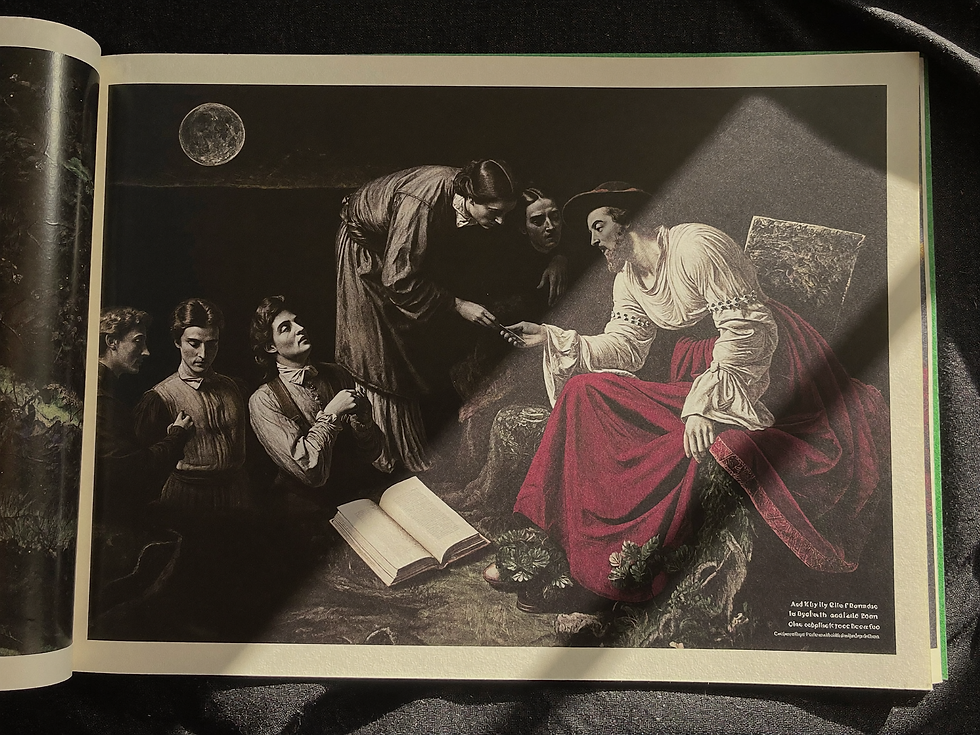
A meaningful Romanticism piece should first survive outside the room you imagine for it. Before thinking about wall color or frame finish, look at the image alone. If it still creates curiosity after the initial beauty has registered, it has narrative life.
Notice the element that holds you: the weather, the face, the social tension, the physical distance, the suggestion of literature or history. That point of attraction will tell you more than a style label. It also helps you choose between a group scene, a solitary figure, a lovers’ narrative, or sublime landscape art.
Then consider how loudly you want the story to speak. A large print makes the atmosphere environmental; a smaller one becomes intimate, almost private. In a quiet luxury interior, one strong image often carries more presence than a wall crowded with pieces selected only for coordination.
For printing, matte fine-art paper, cotton rag, or subtly textured paper protects the visual softness of vintage Romantic paintings. Canvas can amplify brushwork and depth. A narrow dark-wood, aged-gold, or warm black frame usually supports the period feeling without turning the piece into theatrical set dressing.
Most importantly, choose the work whose emotional logic remains open. A painting that tells you everything on the first encounter may become silent quickly. A painting that keeps one secret can remain in conversation with you for years.
Romanticism wall art is not powerful because it is old, ornate, or dramatic. It is powerful because it refuses to pretend that human feeling is tidy. It makes room for the storm and the stillness, the gathering and the outsider, the hand that reaches and the hand that stops.
Its beauty is not restrained into harmlessness. It is shaped, framed, and offered intact. We do not have to live inside its drama. We only have to let it remind us that depth is not disorder—and that some of the most honest things we feel were never meant to match the furniture.
Browse the Havenest Romanticism vintage art collection and begin with the image whose feeling arrives before its explanation.


Comments