"The King’s Last Embrace": Medieval Wall Art About Love and Loss
Power is easy to recognize in a portrait: a crown, a jeweled clasp, a velvet mantle. Love is harder to paint. It appears in the moment when power can no longer protect the person held closest to the heart.
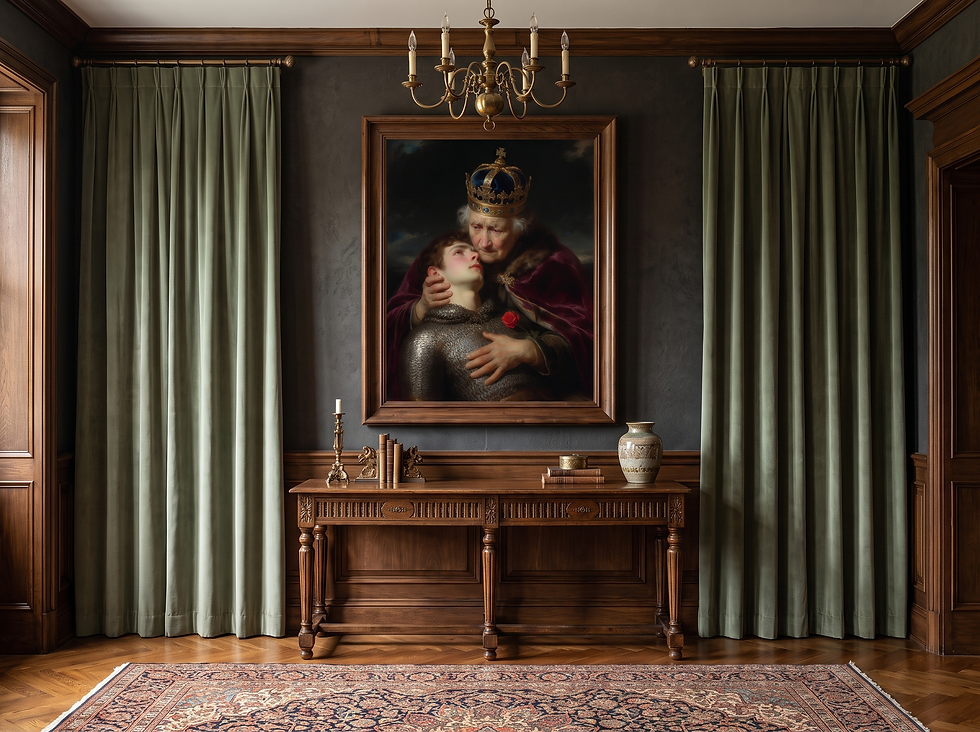
"The King’s Last Embrace" is medieval wall art shaped around that painful contrast. An aging monarch bends toward a young knight whose head rests against his chest. The crown remains magnificent, yet the king’s expression belongs not to ceremony but to helpless tenderness.
Silver chainmail catches the light below; burgundy velvet gathers around the two figures; a single red rose rests near the place where their bodies meet. The scene suggests love, sacrifice, and farewell without explaining exactly what has happened—and that openness is where the painting becomes personal.

In This Journal
The Moment Beneath the Crown
The crown is the first symbol we notice, but it is not the emotional center of "The King’s Last Embrace." The king’s hands are. One supports the knight’s neck with careful strength; the other spreads across the chainmail as though trying to keep him present for one more breath.
The young knight looks upward, his face pale and softened against the metallic weight of his armor. Whether he is wounded, exhausted, or already beyond saving is left unresolved. The painting does not document a named ruler or battle, so its meaning should remain imaginative rather than historical.
That uncertainty gives the scene the emotional openness found in Romanticism vintage art: the viewer is not handed a complete answer, but invited to recognize a private feeling inside a dramatic image.

What the Painting Says Without Words
The composition brings the two faces unusually close. The king’s eyes are red with grief, yet his mouth is held in restraint. The knight’s lifted gaze creates a quiet line between them, making the embrace feel like a final conversation conducted without speech.
Every material carries meaning. Chainmail suggests duty and danger; velvet suggests rank and protection; the ornate blue-and-gold crown represents authority that has reached its limit. The red rose introduces something fragile beside all that metal and weight.
Because the background falls into darkness, there is nowhere else for the eye to escape. The painting asks us to remain with the figures. Its drama is not created through a crowded battlefield, but through the small distance between one face and another.
Where Medieval Wall Art Feels at Home
"The King’s Last Embrace" suits rooms where art is allowed to carry emotional gravity. Its vertical format and concentrated composition make it effective above a writing desk, between bookcases, on a stair landing, or within a quiet reading corner.
• Choose a wall with enough open space around the frame so the two faces remain the focal point.
• Use warm, directional lighting that reveals the chainmail and crown without creating glare.
• Pair the artwork with dark wood, aged brass, leather, linen, or restrained velvet accents.
• Avoid surrounding it with too many equally dramatic pieces; one or two smaller companions are enough.
• Test the intended print size with a paper template before ordering the final frame.
For practical guidance on proportion and placement, Vintage Art for Homes: A Thoughtful Styling Guide explains how scale, negative space, and viewing distance help narrative art feel intentional rather than crowded.

Framing Burgundy, Gold and Chainmail Silver
The palette of "The King’s Last Embrace" is rich but disciplined: wine-dark burgundy, antique gold, deep blue, silver-gray, and a single clear red. A frame should deepen that mood without competing with the crown.
Dark walnut with a narrow gold inner edge is the most balanced choice. It connects the shadowed background to traditional furniture while giving the metallic highlights a quiet echo. An antique-gold frame can feel more ceremonial, especially against muted crimson, olive, or warm cream walls.
In a simpler interior, a narrow black frame with a warm ivory mat can create a useful bridge between medieval imagery and modern furniture. Havenest’s guide to Romanticism wall art offers more ideas for styling emotionally charged artwork without turning the room into a stage set.

Printing and Sizing "The King’s Last Embrace"
"The King’s Last Embrace" is offered as a digital download, so the final surface and scale can be chosen for the room. A medium or larger print gives the expressions and hand gestures enough presence, while a smaller framed version can feel intimate on a desk, shelf, or narrow wall.
Matte fine-art paper keeps reflections low and preserves the softness of the faces. Cotton rag can add gentle texture, while canvas creates a more traditional painted presence. Ask the printer to preserve the original proportions and avoid automatic cropping around the crown, shoulders, or lower chainmail.
If you are deciding between surfaces, Best Paper for Printable Wall Art compares matte paper, cotton rag, and canvas, including how each option affects shadow, detail, and perceived depth.

A Portrait of Love Beyond Power
"The King’s Last Embrace" begins with the visual language of royalty, but it ends somewhere more universal. The crown cannot command the moment to reverse. Armor cannot keep every wound outside. Rank cannot make grief less human.
What remains is the embrace itself: an older figure holding a younger one with a tenderness that makes every symbol of power feel secondary. In a home, the artwork can become a reminder that devotion is measured not by what we rule, but by whom we refuse to abandon when certainty disappears.
This is why the scene lingers. It does not ask us to admire a king from a distance. It asks us to recognize the person beneath the crown.
Words and visual direction by Havenest.
Comments