"The Evening Lesson": Vintage Family Portrait Art for Story-Rich Rooms
Some family portraits announce status. Others preserve something quieter: the way attention gathers around a table, the small gestures through which one person cares for another, and the ordinary rituals that slowly become memory.
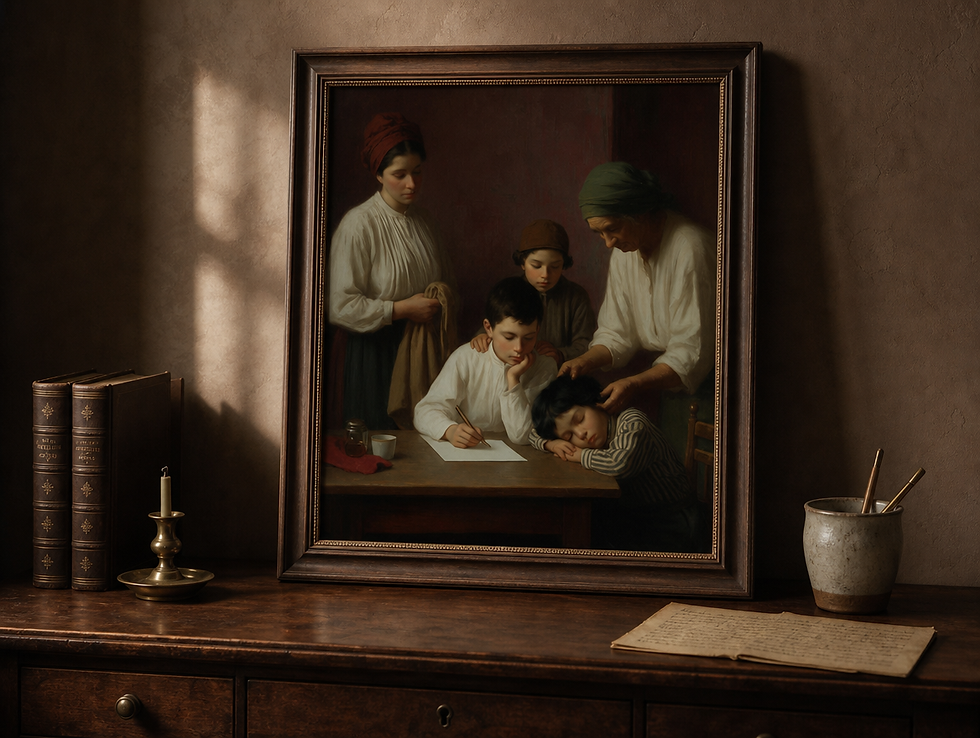
"The Evening Lesson" belongs to the second kind. In this intimate vintage family portrait art, two women and three children share a dimly lit domestic scene. One child bends over a page, another watches from behind, and a younger girl sleeps against the table while an older woman gently tends her hair.
The image does not need a grand event to hold our attention. Its story lives in proximity—in hands resting on shoulders, warm white blouses emerging from shadow, and the contrast between a child still working and another who has surrendered to sleep.

In This Journal
A Table Where Everyone Gathers
At the center of "The Evening Lesson" is not a single sitter but a shared surface. The wooden table gives every figure a reason to lean inward. It holds the page, a small cup, a dark jar, folded cloth, and the sleeping child’s arms. These modest objects make the scene feel inhabited rather than arranged.
The boy’s pencil creates the clearest action, yet his concentration is supported by everyone around him. A child stands close behind with a hand near his shoulder. The woman at left pauses with fabric gathered in her hands. At right, an older woman bends toward the sleeping girl. The composition suggests that learning and care are not separate activities here; they belong to the same evening rhythm.
This is one reason narrative art can feel so personal in a contemporary home. It leaves enough space for viewers to recognize their own family rituals without insisting on a single biography. Havenest explores that openness further in Romanticism Vintage Art: When a Painting Reads You. The most memorable scenes meet us halfway, offering atmosphere while allowing our own memories to complete the story.

The Tender Details That Hold the Scene
The tenderness of "The Evening Lesson" is carried through gestures rather than posed smiles. The older woman’s hands hover protectively over the sleeping child. The standing child leans toward the writer. No one looks outward to perform for the viewer; every gaze remains within the circle of the family.
Color reinforces that inward feeling. Cream sleeves catch the limited light, while red and green headwraps create two quiet anchors at either side of the group. The brown wall and dark table recede, allowing faces, hands, and the white page to emerge gradually.
That controlled light gives the image its old-world character. It feels oil-painting-inspired without requiring a documented sitter or a fixed historical story. We can describe what the scene suggests—patience, fatigue, teaching, protection—while leaving its precise narrative open.

Where Vintage Family Portrait Art Feels at Home
"The Evening Lesson" works best in rooms where people read, gather, or slow down. Its vertical format creates presence without demanding an entire wall, and its dark palette can add depth to both traditional interiors and cleaner contemporary spaces.
• Above a writing desk, where the page within the artwork echoes the purpose of the room.
• Beside a bookcase or reading chair, with enough open wall around the frame to preserve the scene’s stillness.
• On a stair landing or hallway wall, where a vertical composition can create a thoughtful pause.
• In a family room, paired with warm wood, linen, leather, or softly aged brass.
• In a bedroom or quiet home office, where the restrained mood feels more intimate than decorative.
For help choosing scale and breathing room, see Vintage Art for Homes: A Thoughtful Styling Guide. The goal is not to recreate a period room, but to give the artwork enough visual quiet to feel collected and intentional.

Framing the Burgundy and Cream Palette
The palette of "The Evening Lesson" is restrained: burgundy-brown shadow, warm cream, muted green, deep red, and the pale rectangle of the page. A frame should support those colors without competing with the faces.
Dark walnut is the most natural choice for a scholarly, understated presentation. Antique gold introduces a little more light and can draw attention to the warm skin tones. In a modern room, a narrow black frame with a warm ivory mat creates a useful bridge between the old-world image and simpler furniture.
Nearby colors can be equally subtle. A burgundy cushion, olive throw, aged brass lamp, or stack of brown clothbound books may be enough. The broader principles in Havenest’s guide to Romanticism Wall Art can help shape a room around emotion and atmosphere without making it feel themed.

Printing and Sizing "The Evening Lesson"
"The Evening Lesson" is offered as a digital download, giving you the freedom to choose the surface, frame, and finished scale that suit your space. Before ordering a final print, place a paper template on the wall and view it from the room’s main entry point. This simple step is often more reliable than judging dimensions in isolation.
Matte fine-art paper keeps glare low and gives the creams and soft shadows a calm, velvety appearance. A subtly textured cotton paper can add tactility, while canvas creates a more traditional painted presence. Whichever surface you choose, ask the printer to preserve the artwork’s proportions and avoid automatic cropping.
If you are comparing surfaces, Best Paper for Printable Wall Art explains how matte paper, cotton rag, and canvas change the final result. For a smaller display, the image can also feel especially personal on a desk, shelf, or narrow wall beside a bookcase.
A Room That Remembers Care
"The Evening Lesson" is not simply a portrait of people sharing a room. It is a portrait of attention: one child studying, another observing, one resting, and two adults holding the scene together through their presence.
That makes the artwork quietly suited to homes where meaning matters more than spectacle. Hung above a desk, placed in a reading corner, or framed within a family room, it can become a gentle reminder that care is often expressed through repeated, unremarkable acts—the hand on a shoulder, the lesson completed, the child allowed to sleep.
The scene remains open enough to gather new associations over time. Like the best storytelling wall art, it does not explain everything at once. It waits for the room, the light, and the viewer to add the final lines.
Words and visual direction by Havenest.
Comments