Sisley’s Snow at Louveciennes: A Village Held by Winter
Updated: Oct 23
The lane is open, but it does not feel exposed. Walls stand close to the snow. A small figure occupies the distance, and the buildings offer their yellow, rose, and brown surfaces to a sky that seems almost the same temperature as the ground.
Alfred Sisley’s La Neige à Louveciennes, or Snow at Louveciennes, gives winter a scale we can recognize with our bodies. There is room to walk, a boundary to follow, and somewhere beyond the turn that remains unseen. Its intimacy begins with these ordinary arrangements.

In this article
A winter painting with a precise identity
The Musée d’Orsay’s collection record identifies this work as an oil on canvas dated 1878, measuring 61 by 50 centimeters, under inventory number RF 2022. It entered the French national collection through Isaac de Camondo’s bequest in 1911. This essay follows the museum’s current dating and dimensions.
The upright format matters. A snowy village could easily spread across a broad horizontal view. Here, the lane rises into the image, while bare branches and buildings occupy the space above it. Ground and sky remain close companions, held inside a relatively narrow frame.
Sisley belonged to the Impressionist circle, but the label should help us look rather than substitute for looking. The Museo Nacional Thyssen-Bornemisza’s biography records his participation in the first Impressionist exhibition in 1874 and emphasizes his sustained commitment to landscape and atmospheric effects.
That context is useful without supplying an emotional script. We do not need to turn the lane into a confession about the painter’s private life. We can begin with the visible problem: how does a largely pale painting retain such a clear sense of distance, shelter, and inhabited space?

The lane gives the eye somewhere to go
Look first at the lower edge. The foreground snow is wide enough to receive us, yet its boundaries quickly become more definite. At the left, a fence and built surfaces recede toward the middle distance. Opposite it, another boundary helps narrow the route. These edges guide attention without forming a perfectly symmetrical corridor.
The path appears to continue beyond the small figure, into a compressed meeting of buildings and trees. We cannot inspect every turn. This partial concealment is important: the village feels continuous because the picture allows some of it to remain outside our knowledge.
Notice how differently the wall and the snowy surface describe distance. The wall gives us a firm direction. The snow offers looser marks, pale interruptions, and patches whose edges are less settled. One supplies structure; the other prevents that structure from feeling diagrammatic.
The result is a route we understand before we have counted its details. Our eyes can travel inward, pause around the figure, and return along a roof or branch. The composition provides enough certainty for exploration. In Havenest’s essay on Sisley’s Meadow, a different landscape offers another opportunity to examine how an ordinary place becomes a sustained encounter.

Warm walls hold the village together
The buildings carry a modest but essential warmth. Cream and ocher gather around the façades on the left, while brown and muted rose appear along the enclosing surfaces. These colors do not overwhelm the snow. Their smaller areas make them more noticeable against the surrounding grays and pale blues.
Try imagining those walls replaced by the same cool color as the sky. Much of the scene’s sense of enclosure would remain, because the perspective would still work. Yet the village would lose an important distinction between the weather that surrounds it and the surfaces people have built within it.
This does not establish that anyone is warm indoors. No open doorway invites us into a room, and a yellow wall is not evidence of a fire. The warmth belongs first to a relationship between colors. Any feeling of refuge that follows is the viewer’s response to that relationship.
The distinction makes the picture more interesting. It allows an impression of shelter without requiring a fictional household behind every window. Walls can carry the suggestion of human presence simply by interrupting the snow, supporting roofs, and directing a road. The village’s familiarity comes from its visible organization, even when its inhabitants remain almost entirely beyond view.

Snow is a surface of differences
From a distance, the ground reads immediately as snow. At a closer scale, that apparent unity breaks into neighboring temperatures and values. Gray, cream, faint blue, and warmer touches keep the surface from becoming a single blank expanse.
Some marks run across the path; others gather near its edges. The brushwork does not explain each small irregularity. Instead, repeated differences let us recognize a surface that receives light unevenly and changes as it approaches walls or recedes into the village.
The sky is pale too, but it occupies the picture differently. It is interrupted by branches and the more solid outlines of architecture. Below, small changes in the snow help us imagine a ground plane. Above, the lighter field gives the upper shapes room to separate. Similar colors can perform different spatial tasks.
This is worth studying on a screen with a little restraint. Reproductions vary in brightness and color, and a digital image cannot replace the painted surface. Even so, the broad relationships remain available: compare the snow nearest the foreground with the area around the figure, then compare both with the sky. Winter’s apparent simplicity resolves into a set of distinctions that the first glance passes over.

One small figure establishes a human scale
The distant person is easy to find and difficult to know. A dark vertical shape interrupts the pale route. We can recognize a human presence, yet the reproduction does not offer a readable expression or a secure account of what that person is doing.
Their smallness gives us useful information. The walls become comparable to a body; the distance stops being merely a decorative recession. A route that initially looked like an arrangement of light shapes becomes a place someone occupies.
Try covering the figure with a fingertip. The lane still recedes, and the color relationships still hold. What changes is our measure of the scene. Without that small presence, we have less immediate help imagining how far away the buildings stand or how long it might take to reach them.
I read this economy as one source of the painting’s intimacy. The figure leaves room for a viewer’s recognition without demanding a biography. There is no need to decide whether the person is lonely, content, late, or returning home. The picture permits a human encounter while withholding the personal information that would turn it into a particular anecdote. A person can belong to a landscape without becoming its entire story.

Another winter street makes the choices clearer
Sisley returned to winter streets in a later work, Rue Eugène Moussoir at Moret: Winter, dated 1891 by the Metropolitan Museum of Art. The museum identifies the wall beside that street as the boundary of the village hospital. This is a separate place and painting, rather than another title for the Louveciennes canvas.
The comparison helps isolate compositional choices. At Moret, a broad wall stretches diagonally across the scene beneath buildings and bare trees. The street feels wider, and the horizontal format lets architecture spread across the field. In the Louveciennes painting, the upright frame concentrates the route and brings its enclosing surfaces nearer together.
Neither arrangement is inherently more intimate. The point is to notice the different kind of access each supplies. One gives the eye a long boundary to follow across a neighborhood; the other channels it deeper between surfaces.
Landscape comparisons become richer when we keep such differences intact. Havenest’s discussion of Caspar David Friedrich and the soul of landscape offers another context for asking how a place addresses its viewer. Shared weather, trees, or distant figures do not automatically establish a shared meaning.

Return to the whole before deciding what it means
After studying the details, return to the complete image. The warm buildings may now seem more distinct, and the figure may seem smaller. The lane should also recover something that separate details cannot preserve: the relationship between an available foreground and a distance that gradually closes.
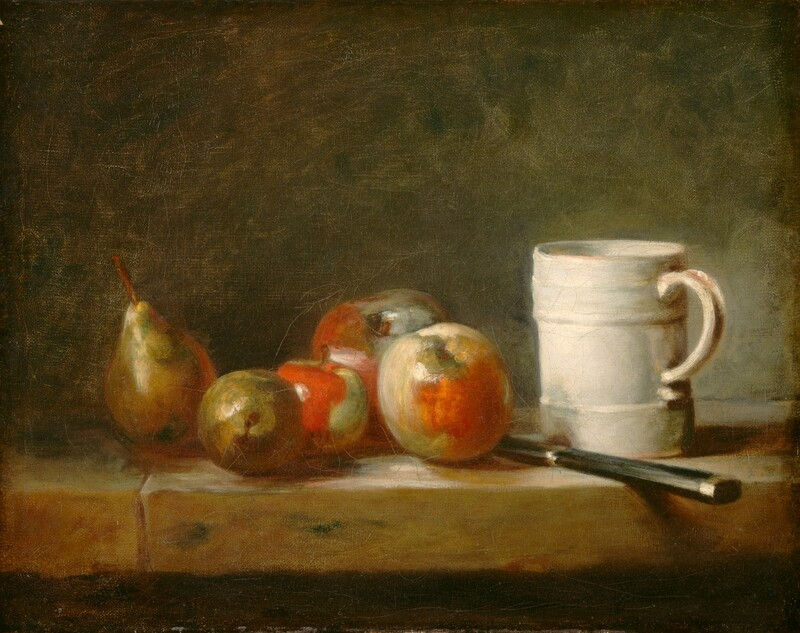
This is a useful way to look at familiar subjects. Begin by recognizing what is there. Then examine the relationships that make recognition feel specific. Havenest’s essay on Chardin and the dignity of ordinary objects follows a neighboring question through cups and fruit rather than a village street.
Here, the question returns to shelter. To me, the painting feels inhabitable because it offers boundaries without sealing the path. The snow connects one surface to another, while small differences of color keep the village legible. We can enter with our eyes without being told who we would become inside it.
That reading belongs to an encounter with the picture, rather than a documented statement of Sisley’s intention. The visible facts remain sufficient: a pale sky, buildings, a route, and a person farther along. Look once more at the broad snow nearest you. Its openness makes the narrow place beyond it feel reachable.
Sources and image credits
Image credits: painting photograph by Szilas, Wikimedia Commons, CC BY-SA 4.0. Source photograph and adapted mockups are shared under CC BY-SA 4.0. Adaptations: AI-generated antique-frame interior visualizations using the painting as reference. These spaces are illustrative, not the painting’s actual location; consult the original reproduction for close study.
Related reading
Alex from Havenest Studio


Comments