Giuseppe Ruoppolo: The Rhythm Inside a Table of Plenty
The grapes are likely to catch you first. Pale and amber on the right, dark and green on the left, they give Giuseppe Ruoppolo’s table two substantial anchors. Between them lies an untidy-looking world of apples, nuts, baskets, and dried fruit. Stay with it, and the apparent heap begins to acquire an exact rhythm.
The smallest things make the difference. A few loose grapes cross the foreground. Nuts rest separately enough to show their individual shapes. Near the lower right, a snail introduces a scale of life quite different from the great hanging bunch above it. Abundance becomes something we can examine one encounter at a time.
Ruoppolo’s *Still Life of Fruit and Nuts*, dated about 1660–69, is held by The Metropolitan Museum of Art. Its collection record identifies an autumnal gathering of fresh and dried produce. That seasonal reading provides a useful beginning; the painting’s arrangement rewards an equally close account of how we see.

Giuseppe Ruoppolo, Still Life of Fruit and Nuts, ca. 1660–69. Oil on canvas. The Metropolitan Museum of Art, Bequest of Errol M. Rudman, 2020. Public-domain image, The Met Open Access. Museum record.
In this article
Find the ledge before counting the fruit
Begin at the bottom. The horizontal stone support establishes a firm limit beneath the overflowing objects. Its edge is irregular, and a visible break interrupts the front. Against that comparatively plain foundation, every rounded nut and grape gains a precise location. We feel that the objects have weight because there is a surface capable of carrying them.
The painting stretches broadly from left to right. That format lets the eye travel sideways rather than climb immediately toward a single summit. Two dense fruit groups flank the middle, while strings of dried fruit create uneven ridges between them. It is tempting to inventory everything, but tracing the support first makes the inventory intelligible. You begin to see where clusters gather, where they loosen, and where a solitary object interrupts the larger pattern.
This is also why the gaps in the foreground matter. A continuous carpet of produce would make the arrangement harder to read. Small exposed areas of stone separate one rounded form from the next. The pauses are narrow, yet they provide enough room for the eye to register distinctions before entering another cluster.
The ledge also establishes a boundary between the pictured arrangement and our own space. A loose grape near its edge makes that boundary conspicuous. We can imagine the object continuing downward, but the painted moment holds it where it is. Such small placements give the wide composition a surprisingly immediate foreground.
Notice what repetition changes
Roundness recurs everywhere, but it never becomes perfectly regular. Grapes repeat at one scale, apples at another, and nuts introduce smaller units with harder edges. Strings of dried fruit compress the rounded form into folds and ridges. The composition makes a family of shapes without flattening their differences.
Follow the pale grapes on the right. Some face the light directly, some recede behind neighboring fruit, and some hang along the edge of the bunch. A repeated circle becomes a sequence of changes in transparency and shadow. Now move toward the scattered nuts. Their surfaces interrupt that luminous rhythm with creases, seams, and broken contours. The shift makes the grapes seem more delicate and the nuts more resistant.
For another approach to repeated fruit, consider Cézanne’s *Still Life with Apples and a Pot of Primroses*. His apples are separated by broad white folds, and their color helps organize the whole surface. Ruoppolo often binds his forms into clusters. Comparing the two makes it easier to notice whether a painting builds its rhythm through gathering or spacing; our essay on Cézanne’s unsettled still lifes follows that second approach.

Paul Cézanne, Still Life with Apples and a Pot of Primroses, ca. 1890. Oil on canvas. The Metropolitan Museum of Art, Bequest of Sam A. Lewisohn, 1951. Public-domain image, The Met Open Access. Museum record.
Let texture set the pace
The dried fruit at the center asks for a different kind of looking from the fresh grapes. Its ridged surfaces hold many small shadows. Instead of reading one clear outer contour and moving on, the eye follows folds within folds. There is a sense of handling, compression, and material resistance even though no hand appears.
The Met connects this work to Neapolitan painting and emphasizes the rougher character of Ruoppolo’s surfaces. That observation is useful when held beside what is visible: pale seams in nuts, dense wrinkles in dried fruit, and leaves whose edges turn and curl. We can describe these effects without inventing the market, household, or exact day from which the arrangement came. The museum’s account supplies context; the image supplies the evidence for our own looking.
Jan Davidsz de Heem’s *Still Life with a Glass and Oysters* offers a concentrated comparison. Glass, lemon peel, shell, and grapes occupy a much tighter field. There, a handful of contrasting textures makes a small arrangement feel complete. Ruoppolo multiplies those differences across a wide ledge, asking us to sustain attention over a longer distance.

Jan Davidsz de Heem, Still Life with a Glass and Oysters, ca. 1640. Oil on wood. The Metropolitan Museum of Art, Purchase, 1871. Public-domain image, The Met Open Access. Museum record.
Read autumn through differences in condition
Fresh and dried produce share the same space. The distinction introduces time into the image without requiring a clock. Some things appear plump and translucent; others have been transformed into tougher, folded forms. They belong together as food, while suggesting different stages of storage and use.
That is a more grounded way to approach the seasonal atmosphere than assigning a fixed symbolic meaning to every nut. The Met’s autumnal reading is supported by the combination of produce. Beyond that, we can acknowledge a personal response: the arrangement may remind us of a pantry being filled or of the pleasure of keeping something for later. Those associations belong to the encounter, not to a documented narrative about Ruoppolo’s intentions.
Henri Fantin-Latour’s *Still Life with Roses and Fruit* changes the balance. A small cluster of grapes, a large pear, and roses occupy a relatively open tabletop. The pear’s broad body can be taken in almost at once. Set beside Ruoppolo, the painting helps us feel how abundance depends on relationships and density, not simply on whether fruit is present. One composition offers a few sustained notes; the other works through overlapping repetitions.

Henri Fantin-Latour, Still Life with Roses and Fruit, 1863. Oil on canvas. The Metropolitan Museum of Art, Bequest of Alice A. Hay, 1987. Public-domain image, The Met Open Access. Museum record.
Follow the light across the darker passages
The pale grapes on the right are conspicuous, but their brightness works because nearby leaves and background stay subdued. The light does not illuminate the entire arrangement evenly. It picks up a nut, catches an apple, then disappears into a recess before returning on another surface. Those intervals prevent the crowded table from becoming visually flat.
The dark grapes at the left repay a second look. Their highlights are less immediately commanding than those of the pale bunch, yet they establish many separate small volumes. The vessel behind them provides a larger, quieter shape. It helps collect the busy cluster into a readable group. Looking at that passage reveals how a comparatively restrained area can stabilize a more active one.
Abraham van Beyeren’s *Still Life with Lobster and Fruit* makes another useful comparison. Bright metal reflections and a red lobster emerge from extensive darkness. Ruoppolo’s light is spread across a wider field of produce, but both paintings use unequal illumination to control the order of discovery. Neither requires us to comprehend every object on the first glance.

Abraham van Beyeren, Still Life with Lobster and Fruit, probably early 1650s. Oil on wood. The Metropolitan Museum of Art, Gift of Edith Neuman de Végvár, in honor of her husband, Charles Neuman de Végvár, 1971. Public-domain image, The Met Open Access. Museum record.
Give the smallest detail a full minute
Choose one of the loose nuts nearest the lower edge and stay with it. Ask where its contour is sharpest, where its shadow meets the stone, and which neighboring form makes its size legible. The exercise can feel disproportionate in front of such a plentiful image. That disproportion is precisely its value: the small detail tests the care that holds the larger picture together.
Then locate the snail near the right. Its compact spiral introduces another rounded structure, but one associated with movement rather than harvest. There is no need to force it into an elaborate allegory to appreciate the change it makes. Against the suspended grapes and resting fruit, the little form activates the edge of the ledge and draws our attention downward.
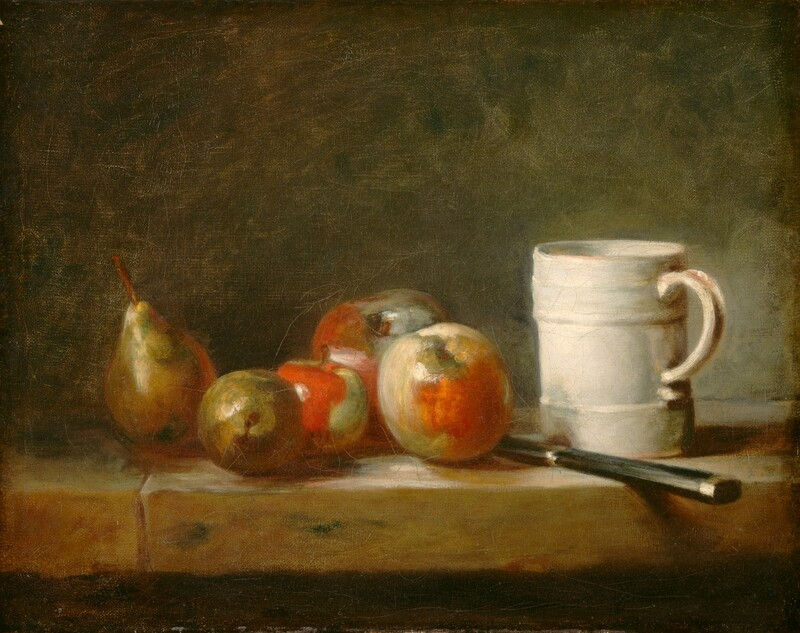
This habit of granting ordinary things sustained attention also runs through our reading of Chardin. The paintings differ greatly in arrangement and historical context, yet both reward a viewer who refuses to let humble subjects become anonymous. A nut is not merely one more unit in a pile once its particular surface has been seen.
Take the rhythm back into everyday looking
After spending time with Ruoppolo, an actual bowl of fruit may look less uniform. You may notice the difference between a taut skin and a dry stem, or how one fallen grape changes the space around a cluster. The painting has given those relationships enough attention that they become easier to recognize elsewhere.
For a final pass, look at the complete image from a little farther away. Find the two grape groups, the rough center, and the small scattered foreground forms. Then approach again. The composition should remain legible at both distances, while offering different rewards at each. That movement between the whole and the particular is the real rhythm of this table.
If you would like to use the same method with another painting, five questions for reading a still life provides a useful next step. Start with one question, not all five. Ruoppolo has already supplied a generous lesson: a crowded picture does not demand hurried looking. It can give us more reasons to stay.
Written by Havenest Studio


Comments