Manet’s Peonies: What One Flower Outside the Vase Changes
One flower lies below the bouquet. Its pale head rests near the front of the table, while its stem and green leaves stretch sideways. Above it, a tall vase carries the rest of Manet’s peonies into pink, cream, and dark green.
That separation changes the picture. The bouquet asks us to see a group; the low flower offers an individual. Our attention can move between them, comparing a bloom surrounded by others with one whose shape is exposed against the table.
Manet painted Peonies in 1864–65. Its broad marks remain visible enough that looking becomes a negotiation between flower and paint. A curved stroke can describe a petal and announce itself as a stroke at the same time. The detached blossom gives us a particularly clear place to watch that happen.

Edouard Manet, Peonies, 1864–65. Oil on canvas. The Metropolitan Museum of Art, Bequest of Joan Whitney Payson, 1975. Public-domain image, The Met Open Access. Museum record.
In this article
The Bouquet Occupies the Upper Room
The upper arrangement is full without forming a perfectly regular outline. Leaves project at different angles, pink heads press against cream ones, and several flowers remain partly obscured. The group reads first as a broad mass, then gradually as separate blooms.
The Met places the painting within Manet’s peony series of 1864–65. It notes that he grew peonies at Gennevilliers and describes them as reportedly his favorite flowers. The qualification matters: we can repeat the museum’s account without converting a reported preference into a documented personal declaration.
Visually, the flowers offer broad surfaces for the brush. Petals curve through comparatively large passages of pale color, while leaves establish firmer green directions. The difference between these marks helps separate flower from foliage even when individual edges remain loosely described.
Start by noticing the bouquet’s outer contour rather than counting its flowers. Where does a leaf extend beyond the main group? Where does a pale blossom dissolve toward the background? Those questions reveal an arrangement built from unequal edges. Some hold firmly; others allow neighboring colors to become part of the form we perceive.
The Flower Below Gives the Eye Another Scale
The low blossom is large enough to meet us individually. Its light head curves through the foreground, and the stem carries the eye sideways rather than upward. After the vase’s strong vertical presence, this horizontal gesture feels like a release.
It is tempting to describe the flower as fallen. The painting shows a cut blossom lying on the table; it does not tell us how it arrived there. It could have been placed. Holding that distinction leaves room for a personal sense of interruption without turning an imagined event into the work’s history.
Fantin-Latour’s Still Life with Roses and Fruit, painted in 1863, offers another division of attention. A group of pale roses stands at the left, while a single pear occupies the right. A clustered form and an individual one address us differently.
Manet makes that difference within one kind of subject. Because the separated object is another peony, we can compare its handling with the bouquet above. The flower becomes a small study inside the larger arrangement. Its exposure helps us notice the thickness of a pale stroke, the turn of a petal, and the dark edge beneath the head.

Henri Fantin-Latour, Still Life with Roses and Fruit, 1863. Oil on canvas. The Metropolitan Museum of Art, Bequest of Alice A. Hay, 1987. Public-domain image, The Met Open Access. Museum record.
The Vase Has Its Own Broad, Pale Body
The vase occupies a substantial portion of the picture. Its light surface continues the cream of the flowers, while subtle gray passages turn through the body. Small colored decorative marks appear low on the vessel, but they do not compete with its larger shape.
The curved sides narrow toward the base, giving the bouquet a support that feels both weighty and elegant. The vessel also establishes an interval between the upper flowers and the cut blossom below. Without that pale middle passage, the two groups could feel much more immediately connected.
In Fantin-Latour’s Still Life with Flowers and Fruit, dated 1866, a dark vase supports a branching bouquet beside a fruit basket. Its darkness collects the stems into a relatively concentrated shape, while the flowers extend into the lighter surrounding field.
Manet’s pale vessel behaves differently against its gray background. Its body remains conspicuous, carrying the light downward. The comparison reminds us that a vase is more than an accessory selected to hold flowers. Its value, width, and height determine how much visual space the bouquet occupies and how the upper and lower parts of the composition meet.

Henri Fantin-Latour, Still Life with Flowers and Fruit, 1866. Oil on canvas. The Metropolitan Museum of Art, Purchase, Mr. and Mrs. Richard J. Bernhard Gift, by exchange, 1980. Public-domain image, The Met Open Access. Museum record.
Pink and Green Meet Without Being Smoothed Away
Several pink flower heads are built from muted, broad passages rather than a succession of finely described petals. Green leaves sometimes meet them through firm edges, sometimes through less resolved transitions. The surface remains active because the marks are not hidden everywhere beneath a seamless illusion.
Looking at one blossom, we may first recognize its rounded form. Looking longer, we begin to notice the separate changes of direction in the paint. Those two experiences coexist. The painting does not have to stop being a flower for the brushwork to become interesting.
The background contributes to this effect. Its restrained gray allows differences within the pale colors to register, while the dark leaves give them sharper neighbors. A cream passage beside green can feel brighter than a similar passage beside gray. Color is experienced through adjacency, not as a set of isolated samples.
Our guide to reading a still life offers questions for keeping close observation at the center of interpretation. Here, try replacing “the flowers are delicate” with something more precise: which edge is delicate, which mark is broad, and which neighboring color makes that difference visible? The mood becomes more convincing when its visual causes are named.
Beside a Seventeenth-Century Bouquet, the Marks Become Clearer
Nicolaes van Veerendael’s A Bouquet of Flowers in a Crystal Vase, painted in 1662, supplies a useful comparison. Fine stems, patterned petals, and the contours of individual blossoms remain available against a deep dark field. A low pink rose and butterfly encourage close inspection.
Manet’s flowers meet us through larger areas of color. Although both paintings include a lower bloom outside the main upper mass, they offer different surfaces for the eye to explore. Van Veerendael gives many tiny transitions; Manet often lets a broader stroke stand for a complex petal.
This is not a ranking of patience or skill. It is a comparison of pictorial choices. A meticulously articulated edge and a loosely resolved one can both direct attention, but they ask different kinds of participation. With Manet, the viewer often helps complete a form from comparatively few marks.
Try changing the size of each reproduction on your screen. At a small scale, both bouquets gather into coherent color masses. Enlarged, their differences become more apparent. The exercise helps separate composition from handling: how the forms are arranged is one question; how paint makes those forms visible is another.

Nicolaes van Veerendael, A Bouquet of Flowers in a Crystal Vase, 1662. Oil on canvas. The Metropolitan Museum of Art, Bequest of Stephen Whitney Phoenix, 1881. Public-domain image, The Met Open Access. Museum record.
The Table Keeps the Flowers in a Material World
Below the vase, warm brown wood introduces a stronger horizontal direction. Its edge and changing levels keep the arrangement from becoming a bouquet floating in gray. The cut stem extends across this surface, giving the tabletop a task beyond supporting the vessel.
The warmth also changes the low flower’s appearance. Pale petals meet darker brown and a small reflected light, while the upper blossoms meet gray and green. The same family of flower colors is encountered under different visual conditions within one painting.
Cézanne’s Still Life with Apples and a Pot of Primroses, around 1890, offers another relationship between flowers and support. The potted plant rises above fruit and extensively folded white cloth. A network of ridges connects the tabletop to the leaves, making the whole arrangement feel more spatially complicated.
Manet’s composition gives us a more direct vertical journey through bouquet, vase, and table, interrupted by the low flower’s sideways line. Reading it beside Cézanne makes that clarity easier to recognize. Our essay on Cézanne’s shifting still-life space follows the alternative: a table whose supports and viewpoints keep asking to be reconsidered.

Paul Cézanne, Still Life with Apples and a Pot of Primroses, ca. 1890. Oil on canvas. The Metropolitan Museum of Art, Bequest of Sam A. Lewisohn, 1951. Public-domain image, The Met Open Access. Museum record.
Give the Separated Flower a Second Look
At the end, return to the cut peony before looking upward. Notice how its stem changes the direction of your attention. Follow the leaves sideways, then let the vase bring you back toward the larger bouquet. The composition becomes a circuit, with the lower flower offering a different entrance each time.
We do not need to supply a romantic anecdote about who picked it. The visible relationship already contains a small drama: one bloom is separated from the group yet continues its colors. It changes our distance from the subject, making something individual out of an abundant arrangement.
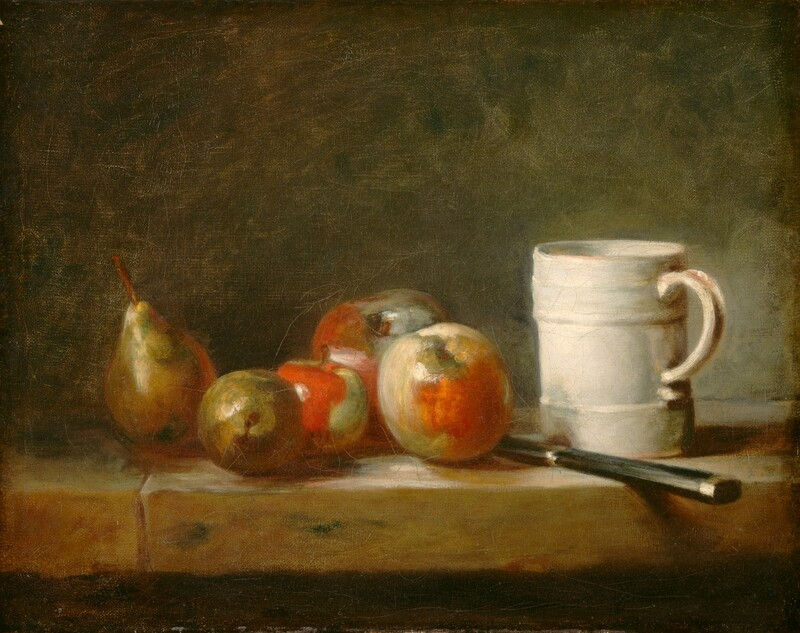
The same respect for an ordinary presence runs through Chardin and the dignity of ordinary objects. A painting can deepen attention through the placement of something familiar. Its importance develops as we discover how it relates to the surrounding space.
For me, Manet’s low flower makes the bouquet feel temporary and touchable. That is a viewer’s response, grounded in the exposed stem, broad petals, and nearby table edge. Another person may be held longest by a pink bloom above. The painting leaves both possibilities open, giving us a whole bouquet and one flower to return to.
Written by Havenest Studio


Comments