"The Lady of the Golden Chalice": A Close Look at a Romantic Vintage Portrait
Updated: Aug 27
At first glance, the gold cup appears to explain the picture. It sits near the center of the frame, bright against a purple gown and held with deliberate care. Look longer, however, and the portrait becomes less certain.
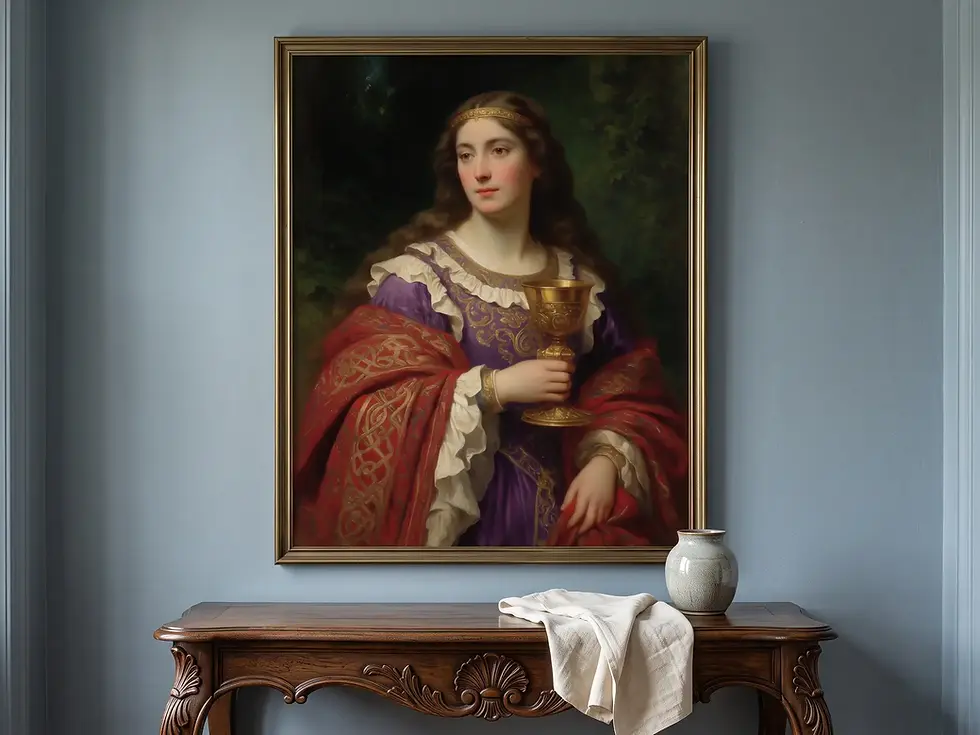
"The Lady of the Golden Chalice" shows a dark-haired woman wearing an embroidered purple dress, an ivory ruffled neckline, a gold headband and a red mantle patterned in gold. Behind her, dense green foliage fades into shadow. Her gaze moves away from the viewer.
The listing identifies the work as a romantic vintage portrait with medieval mystery. Beyond that, the record remains open. There is no confirmed sitter, event or legend—and that absence is not a weakness. It is the mechanism that keeps the image under investigation.

In This Journal
The First Detail You Notice
The chalice is the first hard fact in the composition. It is large, ornate and reflective. Its engraved bowl catches the strongest metallic light, while the stem is held firmly at chest height. The object is not placed on a table or offered forward; it stays within the woman’s control.
That position matters because the portrait provides no action. There is no ceremony, crowd or visible destination. The viewer arrives after—or before—whatever event might give the cup a fixed meaning.
The woman’s expression contributes to the uncertainty. She does not look at the chalice, and she does not meet the viewer. Her attention is directed outside the frame, creating the impression that the most important information may be located elsewhere.

What the Evidence in the Frame Shows
The sitter has long brown hair, a narrow gold band across her forehead and clothing built from three dominant colors: purple, red and ivory. Gold embroidery connects the gown, headband, mantle and cup.
Her right hand closes around the chalice stem. Her left hand rests lower against the red fabric. The pose is composed rather than defensive. The dark wooded background offers no architecture, crest, inscription or secondary figure that could establish identity.
What can be inferred must therefore be labeled as inference. The scene suggests rank or ceremonial significance because of the textiles and metalwork. It may imply guardianship because the chalice is held closely. But the portrait does not prove a title, a kingdom or a specific myth.
This restraint makes the image more useful in a home. A fully explained illustration can become a single story. An unresolved portrait continues to change as viewers bring different associations to it.
Why the Portrait Holds Attention
The portrait holds attention through contrast. The face is softly lit against a dark green field. The chalice reflects warm gold. Purple and red occupy broad areas of the lower frame, while ivory ruffles create small breaks that keep the textiles legible.
The vertical composition also slows the eye. Viewers move from the gold headband to the face, across the neckline and down toward the chalice and hands. The cup may be the stated subject, but the sidelong gaze supplies the tension.
That is why "The Lady of the Golden Chalice" works as more than decorative medieval-inspired imagery. The scene contains a visual question: is the object a possession, a responsibility, a prize or simply an emblem chosen to keep the sitter’s story beyond reach?

How It Changes a Room
In room terms, this is a high-contrast portrait with a strong vertical axis. It performs best where the frame can stand alone: above a desk, beside a bookcase, over a compact console or on a narrow wall between windows.
Warm cream gives the red and purple space to separate cleanly. Blue-gray cools the composition and makes the gold more precise. Oxblood creates a darker, enveloping result. Muted plum and moss green translate the palette without repeating it literally.
Three placement rules are worth close observation plainly:
• Leave open wall around the frame; the textiles already contain considerable detail.
• Use one directional lamp or picture light instead of several competing light sources.
• Repeat no more than two colors from the portrait in nearby furniture or textiles.

A Practical Display and Printing Brief
"The Lady of the Golden Chalice" is offered as a digital download, which shifts the final production decisions to the buyer. The first task is not selecting a frame; it is confirming the print ratio and testing the intended dimensions on the wall.
Matte fine-art paper or cotton rag will usually preserve the dark greens, fabric transitions and soft facial modeling without adding glare. Canvas creates a more painterly surface, though very small sizes can reduce the clarity of the embroidery and chalice.
A short pre-print brief:
• Match the file ratio to the intended dimensions before ordering.
• Request a high-quality or fine-art print setting.
• Ask for a proof if the printer tends to close up dark shadows.
• Choose low-reflection glazing for walls facing windows.
• Check that the gold remains warm rather than turning orange or green.

What the Portrait Leaves Unanswered
The portrait does not identify the woman or settle the chalice into a single meaning. Her poised stance, controlled gaze and ceremonial setting suggest status, restraint and ritual weight. Yet the ambiguity remains intact, allowing the image to hold its mystery without forcing a final explanation.
That unresolved quality is the artwork’s durable advantage. In one room, the portrait may read as strength. In another, it may suggest vigilance, inheritance or distance. The object remains visible; the motive remains withheld.
A successful display should preserve that tension. Give the portrait enough light to reveal its factual details, enough space to command attention and enough restraint that the viewer can reach a conclusion without the room supplying one.
Words and visual direction by Havenest.
Comments