Jacob Vosmaer’s Flower Vase: The Bouquet and Its Missing Edge
A striped tulip turns toward us, its pale surface crossed by red. Nearby, a blue-white iris opens into a different shape entirely. Jacob Vosmaer’s A Vase with Flowers asks the eye to keep changing scale: from the bouquet’s imposing outline to a curled petal, a small creature, or a dark gap between stems.
Then something at the top interrupts the illusion of completeness. An orange flower reaches beyond the picture’s edge. That cut-off shape has a history: the painting itself was trimmed after it was made.
Looking closely therefore involves two forms of attention. We can study the world represented in the bouquet, and we can notice the physical painting that has carried that world across time. Both make this flower arrangement more complicated, and more rewarding, than it first appears.

Jacob Vosmaer, A Vase with Flowers, probably 1613. Oil on wood. The Metropolitan Museum of Art, Purchase, 1871. Public-domain image, The Met Open Access. Museum record.
In this article
A Bouquet That Will Not Resolve into One Shape
The flowers occupy a tall, irregular field. Pink blooms lean outward at different heights, while striped tulips punctuate the center and lower half. Dark stems weave between them. The vase settles below, relatively subdued beside the display it supports. Our first impression is abundance, but the abundance has internal differences.
Look at the angles of the flower heads. Some turn outward, some droop, and some reveal a side. A bouquet can become visually static when every bloom addresses the viewer in the same way. Here, orientation keeps changing. The eye has to adjust its understanding of a petal each time it encounters another flower.
The Met dates the oil-on-wood painting to probably 1613 and describes Vosmaer as an early specialist in flower pictures. It also notes the role illustrated books could play in such paintings, particularly for rare specimens. That context cautions us against assuming we are seeing one bouquet gathered on one particular morning.
The painting gives a convincing abundance of individual forms. Whether every flower shared a vase in life is a separate historical question. We can appreciate its careful construction while remaining curious about the sources from which such a display could be assembled.
The Picture Has a History Outside Its Flowers
The Met records that the panel was reduced at its sides and shortened at the top before 1870. About nine inches were removed from the upper portion, cutting into the crown imperial. This is not an effect we need to explain as Vosmaer’s original choice: the present boundary reflects a later alteration.
That fact changes the way we meet the topmost flower. Its interruption can feel forceful to a modern viewer, but the surviving image does not preserve the artist’s complete upper arrangement. The missing area should remain missing in our account, rather than being filled with an invented reconstruction.
Compare Nicolaes van Veerendael’s A Bouquet of Flowers in a Crystal Vase, dated 1662. Its upper stems and blossoms are surrounded by dark space. The margins allow us to follow their contours and feel the bouquet’s extension within a larger field.
This comparison does not show how Vosmaer’s lost portion originally looked. It clarifies the role a margin can play. Space above a flower can make an upward gesture feel complete; an edge cutting through it produces a different encounter. The object’s history has become part of the way we see the represented flowers.

Nicolaes van Veerendael, A Bouquet of Flowers in a Crystal Vase, 1662. Oil on canvas. The Metropolitan Museum of Art, Bequest of Stephen Whitney Phoenix, 1881. Public-domain image, The Met Open Access. Museum record.
Stripes Make a Petal Turn
The striped tulips offer some of the clearest passages for close looking. Red markings follow the curves of pale petals, bending as the flower opens. Decoration and description become difficult to separate: a stripe can delight us as color while helping us understand the direction of a surface.
Choose one tulip and follow a stripe until it disappears. The interruption may indicate a turn, overlap, or deep fold. That small act of tracing makes the flower more three-dimensional without requiring us to name its exact variety. We learn how it occupies space from the behavior of its markings.
Manet’s Peonies, from 1864–65, provides a distant comparison in paint handling. Broad pink and white passages build flower heads whose individual petals sometimes merge into visible sweeps of paint. The larger marks remain part of the pleasure of recognition.
Set the two images side by side and vary your viewing distance. Vosmaer’s internal detail invites one kind of inspection; Manet’s broader handling invites another. Neither requires a competition over which flower looks more real. The useful question is how each painting makes the transition from a colored surface to a flower we can recognize.

Edouard Manet, Peonies, 1864–65. Oil on canvas. The Metropolitan Museum of Art, Bequest of Joan Whitney Payson, 1975. Public-domain image, The Met Open Access. Museum record.
The Small Creatures Change Our Position
A pale butterfly appears among the lower flowers. Near the base of the arrangement, a small lizard occupies the tabletop. These discoveries can arrive after the larger blossoms, once our attention has slowed enough to distinguish a creature from a stem or shadow.
Their scale matters. The bouquet first addresses us as a large display; the creatures ask for closer inspection. The experience resembles moving through a garden, where a mass of color becomes an individual flower and then something smaller living nearby. That resemblance is an imaginative response to the image, not a claim about its original setting.
A fallen petal near the foreground adds another kind of interruption. It belongs to the flowers but has separated from their main structure. The eye must cross a dark interval to meet it. In doing so, we notice the surface supporting the vase more clearly.
Such details may invite symbolic readings, but they should not be reduced automatically to a fixed code. Before deciding what a butterfly means, describe what it does here: its pale wings catch attention, its small body changes scale, and its placement brings the lower bouquet into focus. Our guide to reading still lifes develops this habit of beginning with visible relationships.
Darkness Gives Each Flower a Different Amount of Room
The background is deep and relatively undifferentiated, but it does not produce the same effect everywhere. Around a pale iris, darkness sharpens an intricate edge. Between dark leaves, it makes their separation harder to see. Some forms appear immediately; others require another look.
These uneven encounters give the bouquet rhythm. A picture in which every contour was equally bright might be easier to inventory, but it would offer fewer changes of pace. Here, visibility itself varies. Our attention travels between clear blossoms and passages where several forms nearly merge.
Fantin-Latour’s Still Life with Roses and Fruit, painted in 1863, uses a dark ground around a much smaller gathering. Pale roses fill one side; a golden pear answers them on the other. The broad interval between the upper forms becomes a visible part of their relationship.
That open interval helps us recognize how little uninterrupted space remains inside Vosmaer’s bouquet. Darkness mostly appears in narrow pockets threaded between stems. The feeling of fullness comes partly from this distribution of gaps, rather than merely from the number of flowers. We are looking at an arrangement of spaces as much as an arrangement of blossoms.

Henri Fantin-Latour, Still Life with Roses and Fruit, 1863. Oil on canvas. The Metropolitan Museum of Art, Bequest of Alice A. Hay, 1987. Public-domain image, The Met Open Access. Museum record.
A Modest Flower Can Ask Just as Much Attention
Henri Fantin-Latour’s Still Life with Pansies, dated 1874, gathers flowers close to a tabletop. The pansies turn in different directions, their pale rims and dark centers making a repeated pattern across pots and a basket. The scale feels more intimate than Vosmaer’s tall display.
The comparison offers a useful question: how much variety is necessary to sustain looking? Vosmaer presents many distinct flower shapes and changes of size. Fantin-Latour creates differences within a more restricted field, where one face, one leaf, and one turned blossom are enough to redirect attention.
Both paintings can be approached through repetition and exception. Find a repeated color or curve, then locate the place where it changes. In Vosmaer, a striped tulip interrupts a neighborhood of fuller pink blooms. In the pansies, a large yellow face stands among smaller, darker flowers. The exception makes its surroundings easier to perceive.
This way of looking travels beyond floral painting. Cézanne’s still lifes make repetition and variation visible through fruit, cloth, and vessels. The materials change, but the reader’s task remains attentive comparison: what returns, what differs, and where the eye pauses.
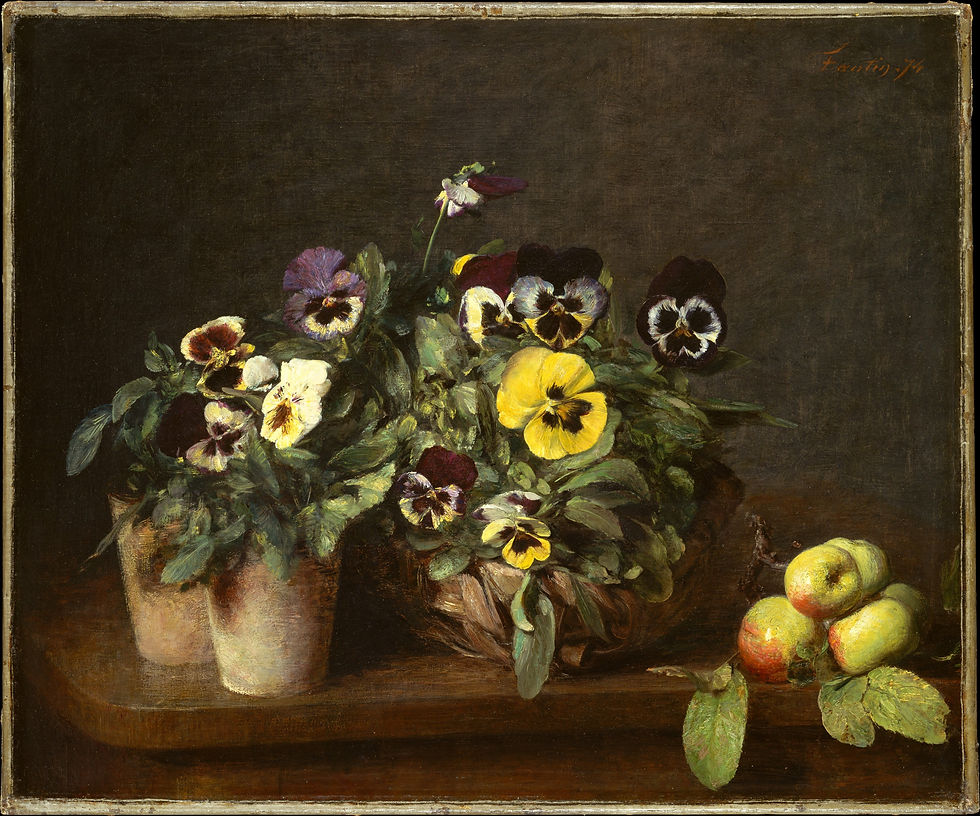
Henri Fantin-Latour, Still Life with Pansies, 1874. Oil on canvas. The Metropolitan Museum of Art, The Mr. and Mrs. Henry Ittleson Jr. Purchase Fund, 1966. Public-domain image, The Met Open Access. Museum record.
Look Once for Splendor, Then Again for Evidence
On your next encounter with Vosmaer’s bouquet, take two passes. In the first, allow the flowers to act as a whole. Notice the height, the darkness, and the distribution of pale and warm colors. In the second, choose a single small detail and follow its relationship to the rest.
The altered upper edge is worth keeping in mind during both passes. It reminds us that a historical painting is an object with a material life. What survives can be compelling without being complete. Responsible looking makes room for both the evidence we have and the part that is no longer available.
Our essay on Chardin and ordinary objects offers a different scale of attention, one less dependent on floral spectacle. Read beside Vosmaer, it can sharpen the question of how much a painting asks us to notice before we decide what counts as important.
For me, the bouquet becomes most memorable when its smaller inhabitants appear. The grand display remains, but a butterfly and a fallen petal give it another measure. They make the painting feel like somewhere we have looked around, rather than something we have merely admired.
Written by Havenest Studio


Comments