Fantin-Latour’s Still Life: A Whole Afternoon on One Table
The cut pear is easy to miss. A tall arrangement of flowers occupies the upper half of the painting; golden fruit catches the light below. Yet a small pale slice at the right edge of the table holds a different kind of attention. Everything around it presents an outer surface. Here, something has been opened.
Henri Fantin-Latour’s 1866 Still Life with Flowers and Fruit gives us enough objects to keep looking, and enough space to see them separately. A woven basket settles to the left. A dark vase rises to the right. Between them, the tabletop remains visible in narrow passages of reddish brown. The arrangement feels familiar without becoming anonymous.
Our first impression might be an afternoon suspended. That is a response to the painting, rather than a record of what happened in its room. Looking more closely, we can begin to understand which choices produce the feeling: the difference between a flower and a fruit, the weight of a basket, and the brief pale interruption of the opened pear.

Henri Fantin-Latour, Still Life with Flowers and Fruit, 1866. Oil on canvas. The Metropolitan Museum of Art, Purchase, Mr. and Mrs. Richard J. Bernhard Gift, by exchange, 1980. Public-domain image, The Met Open Access. Collection record.
In this article
Flowers Rise; Fruit Settles
Begin with the largest shapes. The bouquet reaches toward the top of the canvas, spreading through white blossoms, pink-purple clusters, and leaves that bend in several directions. At the left, fruit gathers in a low basket. One pear stands above its neighbors, making a smaller upward gesture that answers the flowers across the painting.
The two groups do not balance through equal height. They balance through different kinds of density. The basket is compact and visibly woven, its curved bands crossing beneath the bright fruit. The bouquet is irregular, broken by small openings. Its dark vase brings some of that airy upper structure back down toward the table.
The Met dates the painting to 1866 and identifies it as one of four still lifes commissioned by Michael Spartali, a businessman and diplomat living in London. That documented commission gives the work a specific history; our experience of its space begins with what is visible. See The Met’s record of Still Life with Flowers and Fruit.
Try tracing only the silhouettes. Even without naming a single flower, you can follow how the arrangement becomes tall, broad, narrow, and grounded. The recognizable objects carry an abstract structure beneath their familiarity.
The Cut Pear Changes the Tempo
At the front right, the pear half lies with its interior facing us. Its pale flesh differs sharply from the yellows, greens, and reds of the whole fruit. A few dark marks near its center are small enough to reward a second look. Its stem curls toward the table’s edge, making the form feel particular rather than interchangeable.
Across the foreground, a knife rests at a diagonal, its dark handle at the left and its blade reaching inward. Together, knife and cut fruit suggest an action that could have taken place before the scene we see. The painting does not identify a person or tell us when that action occurred. It leaves the relationship available to our imagination.
Visually, the opened fruit also breaks a pattern. Rounded, enclosed forms fill the basket and tabletop; the cut face introduces a flatter, brighter shape. Its importance comes partly from this difference, not simply from its possible story.
This is a useful way to approach other still lifes: first describe the exception, then consider what it makes you feel. Havenest’s five questions for reading a still life offers a broader method for keeping observation and interpretation in conversation.
The Gray Around the Bouquet Is Part of the Composition
The background gives us little information about the room. Its gray surface opens broadly to the left of the flowers and continues around their outer edges. There is no window to locate the light, no doorway to supply a destination. Our attention stays with the objects and their intervals.
Those intervals are worth looking at as shapes. Follow the gray beside the upright pear, then the more complicated gap under the leaves. The background separates forms that might otherwise become a crowded mass. At the right, it continues below the tabletop, clarifying the furniture’s edge and the bouquet’s position above it.
A useful comparison is Fantin-Latour’s Still Life with Roses and Fruit, painted in 1863. There, pale roses occupy the left, a golden pear stands to the right, and grapes spread low between them. The dark ground makes the cream-colored petals especially prominent.
The earlier painting’s broad horizontal format asks us to travel sideways between its main forms. The 1866 composition draws us upward as well. Neither feeling depends only on flowers being beautiful. Format, placement, and the amount of surrounding space help determine how we meet them.

Henri Fantin-Latour, Still Life with Roses and Fruit, 1863. Oil on canvas. The Metropolitan Museum of Art, Bequest of Alice A. Hay, 1987. Public-domain image, The Met Open Access. Collection record.
A Flower Has a Different Surface from an Apple
Return to the red apple near the front of the basket in the 1866 painting. A bright mark on its skin gives the curved surface a small flash. Nearby, the weave breaks into narrow bands of brown and amber. Higher up, light spreads through petals in smaller, less continuous touches.
These differences matter because the same painted light becomes legible in several ways. The apple appears smooth, the basket fibrous, and the flowers layered. The dark vase is almost a pause between these textures, although a few lighter marks at its base describe its rounded foot.
In Still Life with Pansies of 1874, Fantin-Latour gathers flowers much closer to the tabletop. Yellow and cream petals face outward among deeper purple blooms. Pale pots occupy the left, while a basket and trailing leaves extend through the center. A small group of apples sits apart at the right.
Here the varied flower faces invite repeated comparison: one bright edge, one dark center, one turned blossom. The eye can move from surface to surface without needing a dramatic event. In both paintings, attention accumulates through differences that an ordinary glance might compress into the single word “flowers.”
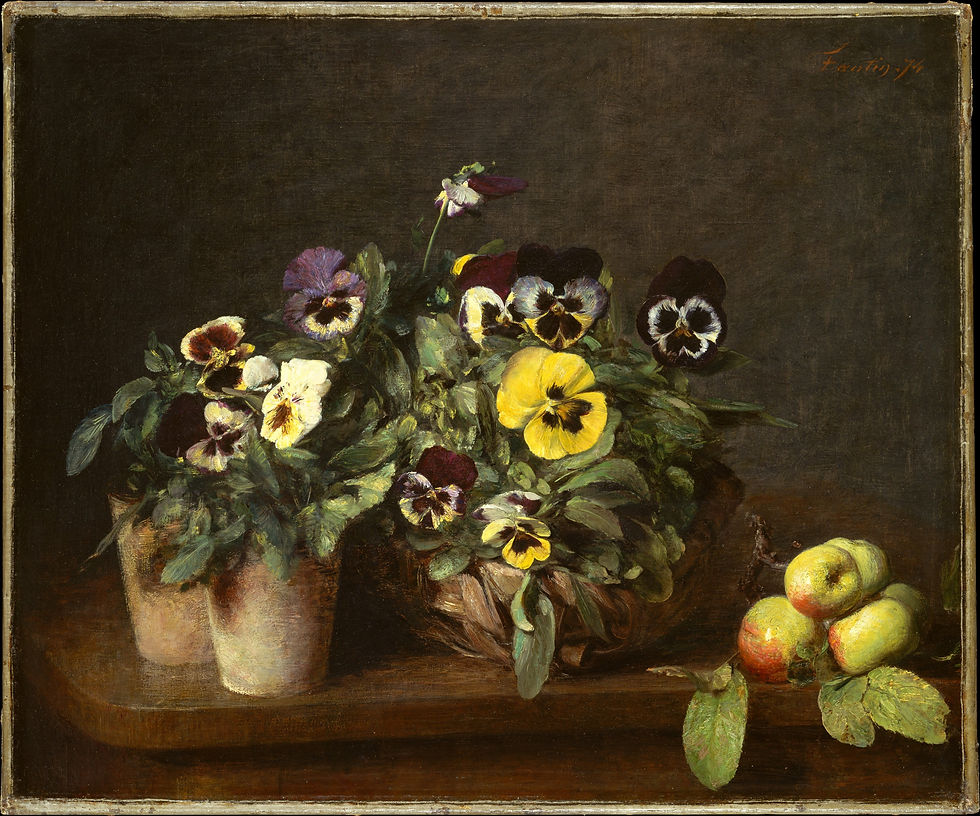
Henri Fantin-Latour, Still Life with Pansies, 1874. Oil on canvas. The Metropolitan Museum of Art, The Mr. and Mrs. Henry Ittleson Jr. Purchase Fund, 1966. Public-domain image, The Met Open Access. Collection record.
Beside Manet, the Marks Become Easier to See
Édouard Manet’s Peonies, dated 1864–65 by The Met, offers another way to look at a bouquet. Cream, pink, and mauve blossoms fill the upper composition above a pale vase. A flower lies low in the foreground, bringing the bouquet’s colors down toward the viewer.
The broad marks are readily visible. Curving strokes turn through the petals; long green shapes carry the leaves. In several places, a blossom registers as a rounded area of color before its individual parts become clear. The handling asks us to notice how paint can describe something without giving every edge the same degree of definition.
Place this beside Fantin-Latour’s 1866 arrangement in your mind. The basket’s interwoven structure and the separate fruit skins offer many small transitions, while Manet’s bouquet often holds together in larger passages. This is a comparison of these particular paintings, rather than a rule that explains either artist’s entire career.
It also makes looking more active. Instead of asking which bouquet seems more real, ask where each picture resolves into detail and where it remains a visible brushstroke. The answer changes as your attention moves through the surface.

Edouard Manet, Peonies, 1864–65. Oil on canvas. The Metropolitan Museum of Art, Bequest of Joan Whitney Payson, 1975. Public-domain image, The Met Open Access. Collection record.
Cézanne Makes the Table Feel Less Settled
Paul Cézanne’s Still Life with Apples and a Pot of Primroses, around 1890, returns us to fruit and flowers with a very different sense of space. A white cloth rises into ridges between the apples. Dark leaves spread above it, while a blue-green wall opens broadly to the left.
In Fantin-Latour’s painting, we can follow the polished wooden tabletop toward its near edge. In Cézanne’s, folds repeatedly interrupt that journey. Warm fruit rests against cool passages of cloth, and the table feels harder to reconstruct as one continuous surface.
The comparison sharpens a quality we may initially take for granted in the Fantin-Latour: the apparent security of each object’s place. His vase has a visible foot; the basket settles into the table; separate fruit casts and receives light within an intelligible arrangement. Cézanne lets the relationship between surface and volume become more conspicuous.
Neither painting needs a human figure to create tension. The tension can belong to a stem leaning away, an apple meeting a fold, or a tabletop that seems to shift. Our essay on why Cézanne’s still lifes refuse to sit still follows that last question further.

Paul Cézanne, Still Life with Apples and a Pot of Primroses, ca. 1890. Oil on canvas. The Metropolitan Museum of Art, Bequest of Sam A. Lewisohn, 1951. Public-domain image, The Met Open Access. Collection record.
Return to the Smallest Interruption
After the comparisons, look again at the 1866 painting without trying to remember every observation. Let the bouquet gather your eye, then allow it to move downward through the vase. Notice whether the large yellow fruit holds you, or whether the pale cut pear now appears sooner than it did at first.
Nothing in the image has changed. What has changed is the number of relationships available to you. Flowers can be both recognizable blossoms and a branching silhouette. A basket can hold fruit and establish a dense low shape. An empty gray passage can give an object more presence than another object would.
For another view of how modest objects hold our attention, continue with Chardin and the dignity of ordinary objects. Carry the same question with you: which small visual relationship makes a familiar thing feel worth looking at again?
For me, that is where the sense of an afternoon begins: in having enough time to notice one thing without losing the others. It is a way of looking that the painting makes possible, rather than a mood every viewer must share.
When you return to Fantin-Latour’s table, which detail makes you stay: the flowers reaching upward, the fruit held in the basket, or the pear that has been opened?
Written by Havenest Studio


Comments