Fantin-Latour’s Roses and Fruit: The Distance Between Two Things
The pear stands apart. Across from it, pale roses gather above a narrow glass, leaving a broad interval of brown between the two upper forms. Grapes remain close to the tabletop, making a low connection across that distance.
Henri Fantin-Latour painted Still Life with Roses and Fruit in 1863. The composition is small in subject but surprisingly assertive in its spacing: flowers occupy the left, a single pear claims the right, and the center refuses to become another large object.
This is a painting to read through unequal relationships. Height and width, pale petals and golden skin, clustered blossoms and solitary fruit all contribute to its balance. The pleasure comes from seeing how little the objects need to resemble one another to belong together.

Henri Fantin-Latour, Still Life with Roses and Fruit, 1863. Oil on canvas. The Metropolitan Museum of Art, Bequest of Alice A. Hay, 1987. Public-domain image, The Met Open Access. Museum record.
In this article
An Arrangement That Keeps Its Unevenness
The bouquet begins high on the left and spreads outward in several pale heads. The pear is lower, broader, and closer to the right edge. They do not form matching halves. Their difference gives the composition its character before we examine any individual petal.
The Met’s account of the painting calls attention to this early work’s unusual balance and its subtle color relationships. It identifies the flowers as Malmaison roses and dates the canvas to 1863. Those facts give us a firm starting point without prescribing how the arrangement must feel.
Visually, I find the asymmetry companionable. Each group occupies its own space, yet the low grapes prevent the two sides from becoming entirely separate. Someone else may experience a stronger sense of tension, especially in the pear’s distance from the bouquet. Both responses can begin with the same visible interval.
Try covering the pear briefly with your hand while viewing the reproduction. The flowers suddenly dominate a much less balanced field. Cover the roses instead and the pear seems unusually exposed. This simple exercise reveals how an object can depend on another across space, even without touching or sharing a similar outline.
The Empty Center Has a Shape
The brown field between the roses and pear is easy to call background and move past. Look again at its outline. It narrows beneath the lower blossoms, opens above the grapes, and rises beside the pear’s shoulder. The objects shape this interval as decisively as they shape themselves.
Negative space is a useful term here when it remains concrete. It means the area around and between the forms, with its own size and contour. In this painting, that area allows the bouquet’s many small edges and the pear’s simpler silhouette to remain distinct.
Compare Fantin-Latour’s Still Life with Flowers and Fruit, painted three years later. A tall bouquet, woven basket, whole fruit, and a cut pear establish several levels of height. The gray ground remains visible around them, but the arrangement offers more objects and more routes across the table.
Returning to the 1863 painting makes its economy conspicuous. The center does not need a knife, another vessel, or additional fruit to feel active. Distance already creates a relationship. That is the specific question this earlier work poses: how much can an unoccupied interval do before we are tempted to fill it?

Henri Fantin-Latour, Still Life with Flowers and Fruit, 1866. Oil on canvas. The Metropolitan Museum of Art, Purchase, Mr. and Mrs. Richard J. Bernhard Gift, by exchange, 1980. Public-domain image, The Met Open Access. Museum record.
A Golden Pear Answers Pale Roses
The roses are not uniformly white. Cream, pink, and muted gray move through their curved petals. The pear is similarly varied: yellow opens into warmer orange, then deepens toward its darker edge. Naming each object with one color misses the small transitions that make it present.
Their relationship depends partly on warmth. The petals and fruit both carry warm passages against the brown surrounding field. The grapes introduce cooler, less emphatic notes close to the table. Color connects the two larger forms without erasing their differences in shape or texture.
Manet’s Peonies, from 1864–65, offers another arrangement of pale flowers against a restrained background. Pink, cream, and green are handled in broad areas, while a light vase continues the bouquet’s brightness down toward the table.
The comparison clarifies Fantin-Latour’s choice to place a different material opposite his roses. The pear cannot repeat their layered structure, so it answers through color and weight. The scene gains variety from this mismatch. We can feel a visual rhyme without requiring identical objects, an effect familiar to anyone who has noticed two unlike things working well together in a room.

Edouard Manet, Peonies, 1864–65. Oil on canvas. The Metropolitan Museum of Art, Bequest of Joan Whitney Payson, 1975. Public-domain image, The Met Open Access. Museum record.
The Glass Holds Light Without Taking Over
The flowers emerge from a transparent stemmed glass. Its narrow stem, rounded bowl, and pale foot make a different kind of shape from either roses or pear. Small highlights establish the material without making it the brightest presence in the scene.
At the foot, a pale reflection touches the warm tabletop. This is a small but useful connection: the glass does not simply hover between flowers and surface. Its base and reflected light make contact visible. Above, the stems can be followed into the darker bowl, giving the bouquet a physical support.
Look at the contrast between the vessel’s slender middle and the fullness of the flowers above it. That change of width helps the bouquet feel lifted. On the right, the pear rests directly on the table and has no such narrow support. Their different relationships to gravity reinforce the asymmetry of the composition.
Our five questions for reading a still life encourages attention to these ordinary facts before assigning a story. What supports each object? Where does it touch the table? What catches the light? Such questions make the scene richer without needing to invent who arranged it or why the pear was left apart.
Grapes Make the Lowest, Most Complicated Passage
Between the glass and pear, the grapes gather in a low, irregular band. Their rounded forms repeat at a much smaller scale than the pear. Some are clearly separated; others nearly merge with the tabletop or neighboring fruit. This uneven visibility slows our passage through them.
The bunch also provides a transition between the large forms. We can move from the glass foot across individual grapes toward the pear’s base. The route stays close to the table, then rises again. It prevents the open upper center from becoming a complete separation between left and right.
In Still Life with Pansies, from 1874, Fantin-Latour develops another low arrangement. Flowers gather across pots and a basket, while apples occupy the right. Leaves extend through and beyond the group, making transitions between its separate elements.
The two paintings differ in fullness, but both reward attention near their lower edges. The most conspicuous flower is only one part of the arrangement. A leaf, a grape, or a narrow visible strip of tabletop can connect forms that seem distant at first. Once noticed, these small passages become essential to the experience of the whole.
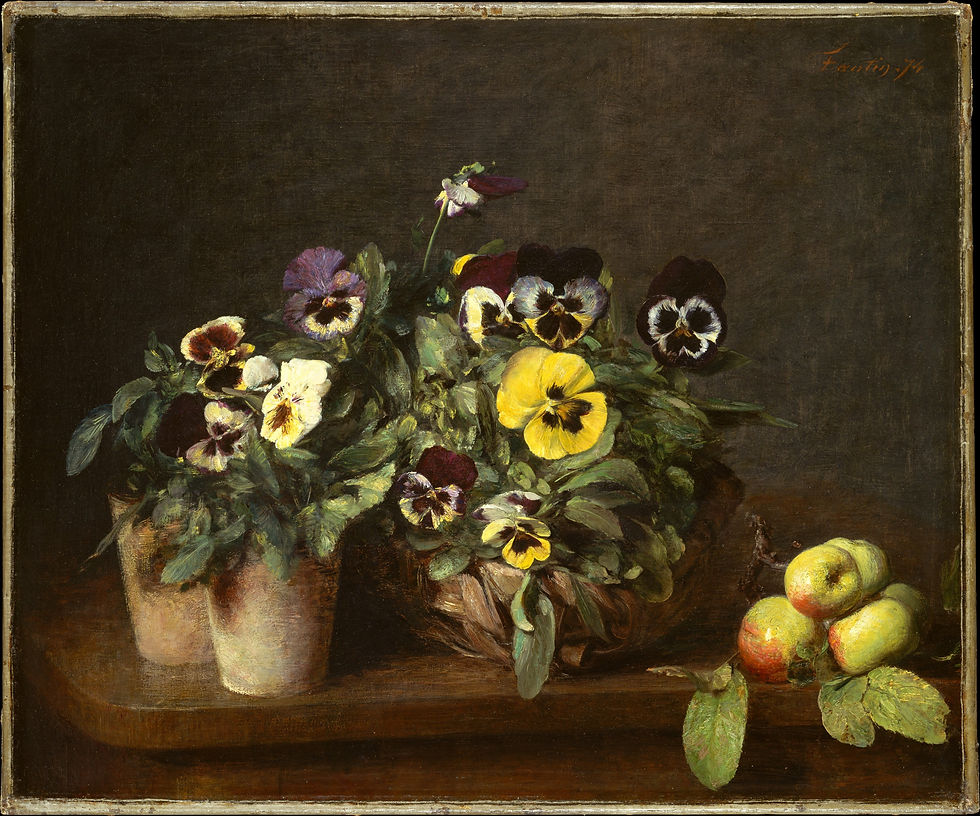
Henri Fantin-Latour, Still Life with Pansies, 1874. Oil on canvas. The Metropolitan Museum of Art, The Mr. and Mrs. Henry Ittleson Jr. Purchase Fund, 1966. Public-domain image, The Met Open Access. Museum record.
The Pear Becomes Different Beside Cézanne
Place Fantin-Latour’s pear beside those in Cézanne’s Still Life with Apples and Pears, dated about 1891–92. Cézanne spreads fruit across pale plates and exposed wood. Color changes and firm contours make the individual pieces feel weighty, while their supports invite close inspection.
Fantin-Latour’s pear is comparatively isolated. Its broad body is allowed to register as one major presence against a dark ground. In Cézanne, several fruits compete and cooperate across a wider sequence. The difference is compositional before it is a matter of style: one dominant pear answers flowers; several fruits establish relationships among themselves.
Cézanne also makes the tabletop feel more conspicuously constructed. We notice edges, plate angles, and the relationship between front and rear. Fantin-Latour’s dark field offers fewer spatial cues, concentrating attention on the meeting of surfaces and silhouettes. Neither approach makes an ordinary pear a minor subject.
For the larger question of how fruit can unsettle pictorial space, continue with why Cézanne’s still lifes refuse to sit still. Keep Fantin-Latour’s solitary pear in mind. Comparing a single familiar motif is often more illuminating than treating an artist’s entire practice as one uniform manner.

Paul Cézanne, Still Life with Apples and Pears, ca. 1891–92. Oil on canvas. The Metropolitan Museum of Art, Bequest of Stephen C. Clark, 1960. Public-domain image, The Met Open Access. Museum record.
A Way to Leave Things Unfilled
The painting offers a useful practice for looking at arrangements beyond art. Before adding another object to a shelf or table, notice the interval between what is already there. Does one shape need room to become legible? Can a low element connect two taller ones? Where does the eye get to pause?
This is not a formula requiring a vase, grapes, and a pear in every room. The transferable idea is relational. A tall, intricate object and a lower, simpler one may create more interest than a row of equal heights. An open area may help their differences become visible.
There is another version of this attention in Chardin and the dignity of ordinary objects. The shared invitation is to look carefully at what has already been placed before us. Importance can emerge from arrangement and observation, without an extravagant subject.
Return now to Fantin-Latour’s center. The brown space may no longer look empty in the casual sense. It holds the distance that allows roses to remain roses and the pear to keep its fuller, solitary weight. For me, that is the painting’s enduring intimacy: two different presences, close enough to belong, with enough room to be seen separately.
Written by Havenest Studio


Comments