Fantin-Latour’s Pansies: When Two Seasons Share a Table
The yellow pansies arrive first. Their faces turn out of a loose gathering of leaves and darker flowers, and one bloom seems almost to hover over the tabletop. At the far right, apples remain attached to a leafy branch. The arrangement looks readily available, as though someone had brought a few things indoors and set them down.
That apparent simplicity contains a seasonal puzzle. Henri Fantin-Latour’s Still Life with Pansies, painted in 1874, brings flowers and fruit into a shared space that may not correspond to an ordinary moment outdoors. The tabletop has become a place where different times can meet.
The pleasure of the work lies partly in that meeting, but also in its scale of attention. Nothing here needs the drama of an enormous bouquet. Small blooms, modest containers, and a handful of apples sustain an entire painting.
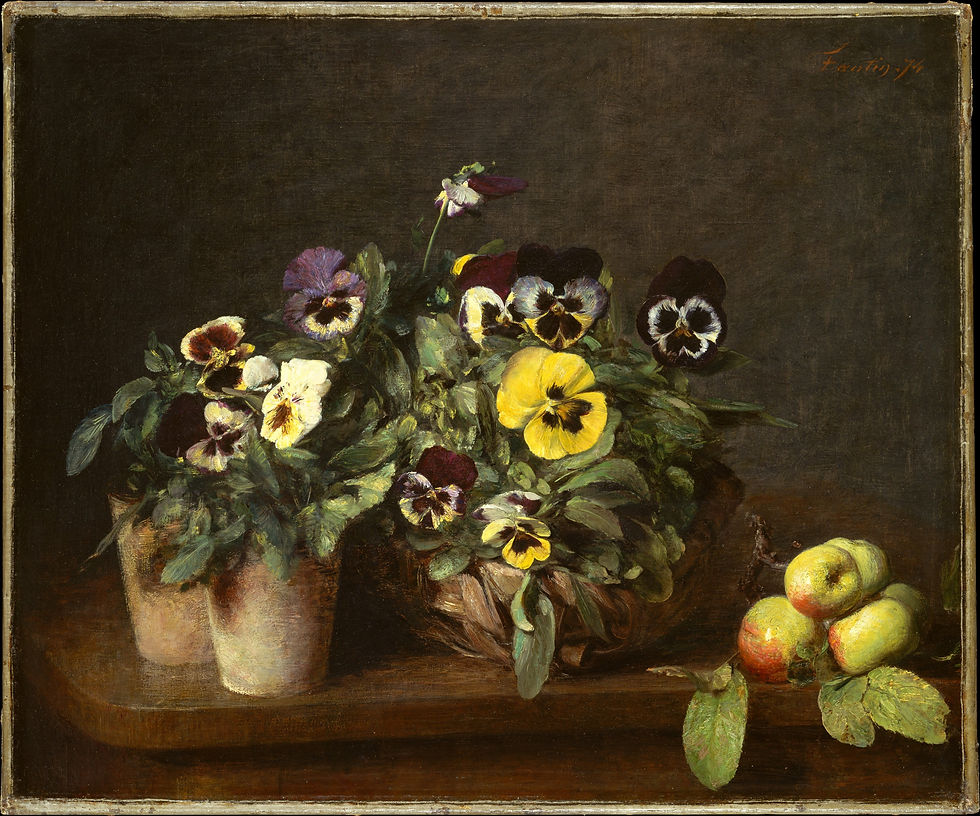
Henri Fantin-Latour, Still Life with Pansies, 1874. Oil on canvas. The Metropolitan Museum of Art, The Mr. and Mrs. Henry Ittleson Jr. Purchase Fund, 1966. Public-domain image, The Met Open Access. Museum record.
In this article
Begin with the flowers that face you
The pansies do not form a symmetrical bouquet. Some blossoms turn toward the viewer; others angle sideways or disappear among leaves. Yellow flowers remain legible against the dark ground, while purple petals take longer to distinguish. The arrangement gives us several degrees of visibility instead of presenting every bloom equally.
That unequal visibility matters. A florist’s diagram might separate each specimen so that its shape could be identified. Fantin makes overlap part of the experience. We discover one flower through the interruption of another, and a dark patch changes from background to petal as the eye adjusts. Looking therefore has a duration, even though the objects do not move.
The Met’s collection record dates the oil painting to 1874. For a first encounter, those few facts are sufficient. Before consulting meanings assigned to pansies, examine what the blossoms actually do in this composition: face outward, lean, cluster, and recede. Our guide to reading still life develops this order of attention, beginning with the arrangement before asking what it might suggest.
The lowest leaves are worth their own inspection. They carry the cluster toward the tabletop and soften the boundary between plant and vessel. A flower head draws attention through its color, but these less conspicuous passages establish how the plants occupy space. Following them can change an initial impression of scattered blossoms into an understanding of connected growth, with stems and leaves sustaining the visible faces.
A branch of apples complicates the calendar
The museum explains that the apple branch suggests an autumn setting, while the pansies, spring flowers, were probably grown in a hothouse. Its wording leaves room for uncertainty. We should preserve that qualification rather than turn a plausible reconstruction into a documented account of the artist’s working day.
The observation nevertheless changes the picture. A table can gather things that a garden would not normally offer together. Painting does not have to function as a seasonal report. Its arrangement can bring materials into contact for their color, scale, or shape, while retaining enough natural detail to make the meeting convincing.
Compare Still Life with Roses and Fruit, painted by Fantin in 1863. Pale roses occupy one side, while a large golden pear anchors the other. Here too, flowers and fruit coexist as distinct presences. In Pansies, the lower flower heads and smaller apples create a more horizontal conversation. The comparison directs us away from treating all floral still lifes as interchangeable: the height and character of the plants change how the entire tabletop behaves.

Henri Fantin-Latour, Still Life with Roses and Fruit, 1863. Oil on canvas. The Metropolitan Museum of Art, Bequest of Alice A. Hay, 1987. Public-domain image, The Met Open Access. Museum record.
Small containers keep the flowers close to the ground
The plants sit low. The left container has an unassuming pale surface, and the central gathering opens above a broader vessel. Leaves descend toward the tabletop rather than being disciplined into a tall, carefully exposed arrangement. The flowers appear to inhabit their containers instead of merely decorating them.
This low center of gravity gives the painting its particular hospitality. We view a group that seems approachable at the scale of a seated person. There is no towering stalk that forces the eye upward through a ceremonial display. Even the small bloom rising near the center remains connected to the earthbound cluster below it.
In Fantin’s Still Life with Flowers and Fruit, from 1866, a dark vase lifts a bouquet above a basket and larger fruit. The vertical distance between blossoms and tabletop creates a different kind of poise. Returning to Pansies after that comparison, we can appreciate the spreading leaves and low pots as positive compositional choices. Modesty is not an absence of design; it is a proportion between things, and between those things and the space available to them.

Henri Fantin-Latour, Still Life with Flowers and Fruit, 1866. Oil on canvas. The Metropolitan Museum of Art, Purchase, Mr. and Mrs. Richard J. Bernhard Gift, by exchange, 1980. Public-domain image, The Met Open Access. Museum record.
The dark background does more than set a mood
A dark ground can easily be described as moody, but that word does little to explain its work. Here, the background reduces distraction around the thin stems and irregular petal edges. It makes a yellow bloom read clearly at a distance, while permitting darker leaves to merge partly with their surroundings.
Look at the transitions rather than only the strongest contrasts. A leaf may remain distinct along one edge and dissolve along another. Those changes allow the plant to feel embedded in space. If every contour were equally sharp, the cluster could resemble a set of cutouts. The softer passages give the flowers a surrounding atmosphere.
Manet’s Peonies offers another solution to floral presence. Its broad petals and larger leaves create comparatively open patches of color against a lighter setting. The comparison is not a contest between careful and careless painting. Each arrangement asks the eye to assemble blossoms differently. Manet’s more conspicuous patches make a useful counterpoint to the small faces and interwoven greenery of Fantin’s pansies, where recognition often happens gradually.

Edouard Manet, Peonies, 1864–65. Oil on canvas. The Metropolitan Museum of Art, Bequest of Joan Whitney Payson, 1975. Public-domain image, The Met Open Access. Museum record.
Two kinds of yellow keep the eye moving
The yellow petals and the yellow-green apples belong to different materials, but their colors connect across the painting. A flower offers a thin, spreading surface. An apple provides a rounded body. Similar hues therefore behave differently: one appears in a face-like patch, the other turns through light and shade.
Between them, greens act as a bridge. Leaves surround the flowers and remain attached to the fruit branch. We can follow a route from bloom to foliage to apple without finding a rigid line that tells us where to go. The connection is dispersed through repeated color rather than enforced by symmetry.
Consider Cézanne’s Still Life with Apples and a Pot of Primroses. A flowering plant rises above scattered fruit and a large white cloth, and the brighter surrounding colors give the objects a more restless spatial relationship. Fantin’s pansies remain gathered against brown. Reading the two together makes the shared ingredients more interesting: flowers plus apples can support very different experiences of weight, distance, and balance. The subject alone does not determine the atmosphere.

Paul Cézanne, Still Life with Apples and a Pot of Primroses, ca. 1890. Oil on canvas. The Metropolitan Museum of Art, Bequest of Sam A. Lewisohn, 1951. Public-domain image, The Met Open Access. Museum record.
Resist turning every flower into a secret message
Because pansies have accumulated cultural associations, it is tempting to begin with a symbolic dictionary and then assign the painting a single emotional meaning. That shortcut can obscure the very things that distinguish this work. We do not need to identify a hidden recipient or a specific sentiment to recognize the care given to the leaves and blossoms.
The museum’s record instead offers a grounded glimpse of artistic practice: a list compiled by Fantin’s wife includes this work among thirty-one flower-and-fruit compositions made in 1874. Repetition here need not imply sameness. Returning to related subjects allows an artist to test changes in arrangement, color, spacing, and the relation between an object and its ground.
The question of sustained attention also animates Chardin and the dignity of ordinary objects. Without claiming that Fantin intended the same ethical lesson, we can recognize how a modest subject rewards extended looking. A pansy does not become important because we attach an elaborate story to it. The painting makes its small differences available, and the viewer decides to spend time with them.
Let the seasonal puzzle remain open
Return now to the apple branch at the right. It does more than identify a fruit. The attached leaves preserve something of its recent connection to a growing tree, while the containers hold another form of cultivated life. Two kinds of bringing nature indoors share the tabletop: a branch gathered from elsewhere and plants sustained in vessels.
That distinction makes the seasonal question more vivid without resolving every uncertainty. We can imagine the labor behind such an arrangement, but we cannot reconstruct its exact setting from the image alone. The strongest reading keeps what is known, what is visible, and what is imagined in conversation rather than merging them.
For a different way that flowers and fruit can reshape our perception, continue with why Cézanne’s still lifes refuse to sit still. Then look once more at Fantin’s yellow blooms. Their appeal survives the research. They remain small, particular faces within a crowded patch of leaves, and the painting gives them enough room to hold our attention across the distance of a century and a half.
Written by Havenest Studio


Comments