De Heem’s Banqueting Scene: When a Table Becomes a Landscape
The pale cloth falls like a path through the foreground. Above it, a red lobster stretches across a table crowded with fruit and vessels. A chair reaches in from the right, while an opening at the left gives a glimpse beyond the room. Jan Davidsz de Heem’s *Still Life: A Banqueting Scene* feels large enough to enter.
Calling it a landscape is a way of describing that experience, not changing its subject. The arrangement has heights, hollows, obstacles, and routes. Light touches one surface and leaves another in shadow, making the eye travel rather than simply take an inventory.
The Metropolitan Museum of Art dates the painting to about 1640–41 and records its substantial width of 73 inches. Its collection account also points to the clock as a reminder of passing time. Scale and duration are therefore useful companions for a closer look at this abundant, unoccupied scene.

Jan Davidsz de Heem, Still Life: A Banqueting Scene, ca. 1640–41. Oil on canvas. The Metropolitan Museum of Art, Charles B. Curtis Fund, 1912. Public-domain image, The Met Open Access. Museum record.
In this article
Find your way into the room
The foreground chair complicates our access. Its curved wooden arm crosses the right side, partly screening the things behind it. We can imagine a body occupying that position, yet the seat belongs to the objects rather than a visible sitter. It gives the composition a human scale without supplying a person.
On the left, a chair and an architectural opening extend the scene in another direction. The table is not an isolated arrangement floating against an anonymous background. It occupies a room with boundaries and a view outward. This extra space changes the task of looking: we must understand how the banquet sits within its surroundings as well as how the food sits upon the table.
Start by tracing those larger structures. Follow the chair arm, the edge of the table, and the tall background forms before turning to the grapes or lemon. You will feel how the room contains the display. Our guide to reading a still life through five questions offers a broader method, but this painting gives an especially clear reason to begin with space.
The glimpse of landscape at the far left introduces a second distance beyond the interior. Even though it occupies a narrow strip, it helps the room feel less sealed. The near chair, the laden table, and that more remote view establish several spatial registers. The still life becomes part of a world extending beyond the immediate display.
Read the cloth as a route
White fabric descends at more than one point across the front of the table. Its folds gather brightness into long passages, linking the crowded upper surface with the darker area below. The cloth makes a route that the eye can follow without having to identify each object along the way.
At the left, the fabric bends over the edge and hangs in a long, relatively continuous shape. Near the center-right, another pale fall appears beside the chair. These separated passages help spread the light across the composition. If all the white were concentrated in one place, the image would pull in that direction much more strongly.
Compare Cézanne’s *Still Life with Apples and a Pot of Primroses*. Its white cloth rises and dips beneath fruit, making a small terrain of folds. De Heem’s fabric behaves more like a downward passage within a larger room. Both paintings let cloth do more than cover furniture. The comparison extends the question explored in our Cézanne essay: how can a surface create movement when every represented object remains still?

Paul Cézanne, Still Life with Apples and a Pot of Primroses, ca. 1890. Oil on canvas. The Metropolitan Museum of Art, Bequest of Sam A. Lewisohn, 1951. Public-domain image, The Met Open Access. Museum record.
Let the lobster establish a middle ground
The lobster occupies a prominent band across the center. Its warm red gives it immediate weight against the quieter brown, green, and gold surroundings. The body extends sideways, while claws and antennae introduce narrower directions. It is both a large anchor and a source of fine lines.
Look at what sits behind and in front of it. Taller vessels rise beyond the body, and smaller dishes and pieces of food lie nearer the table’s edge. Those overlaps build depth without needing a long stretch of empty tabletop. The banquet is crowded, yet it remains possible to distinguish layers within it.
Abraham van Beyeren’s *Still Life with Lobster and Fruit* uses a red lobster in a more vertically organized composition. There, a tall central vessel and a falling lemon peel reinforce the upward and downward movement. De Heem distributes the action over a broad room. Comparing the two makes the red shell’s role more precise: a recurring subject can anchor entirely different spatial designs. What matters is where the body sits, how far it reaches, and which forms answer it.

Abraham van Beyeren, Still Life with Lobster and Fruit, probably early 1650s. Oil on wood. The Metropolitan Museum of Art, Gift of Edith Neuman de Végvár, in honor of her husband, Charles Neuman de Végvár, 1971. Public-domain image, The Met Open Access. Museum record.
Follow the vessels upward
Metal vessels raise the composition above the tabletop. The tall central piece reaches into the darker background, its segmented body picking up separate touches of gold. A silver-colored pitcher to the left gives a cooler, broader reflection. Their difference is visible before we identify any historical type or function.
The large decorative plate leaning at the right offers another kind of ascent. Its curved edge rises behind the chair arm, sending the eye toward the upper corner. The arrangement therefore has several climbing routes, each with a different character: a narrow stem, a full-bodied pitcher, a broad tilted disk. This variety keeps the upper half from becoming a single undifferentiated mass.
For a different form of plenty, look at Giuseppe Ruoppolo’s *Still Life of Fruit and Nuts*. Its clusters and strings of dried fruit create a lower, wider set of ridges. De Heem’s manufactured vessels act more like towers among the food. The comparison clarifies why his table can feel architectural. Objects with different heights and directions give the eye a structure through which to move, much as buildings can organize a view.

Giuseppe Ruoppolo, Still Life of Fruit and Nuts, ca. 1660–69. Oil on canvas. The Metropolitan Museum of Art, Bequest of Errol M. Rudman, 2020. Public-domain image, The Met Open Access. Museum record.
Notice the clock without letting it explain everything
The clock occupies the upper right, removed from the bright food at the front. The Met reads it as a reminder that time passes for the absent people associated with the feast. This is a grounded interpretive detail, rather than a story we need to invent about an actual gathering. The museum’s discussion links the display’s pleasure with its temporal limit.
Once noticed, the clock changes how the table feels. The food, music, and fine vessels imply enjoyment, while the timepiece brings duration into the same room. Yet the painting does not become visually exhausted by this observation. Its cloth still folds, the silver still reflects, and the chair still interrupts our path.
Edwaert Collier’s *Vanitas Still Life* makes a useful companion. A globe, books, instruments, and papers create a denser intellectual and sensory inventory. De Heem gives his objects more extensive spatial surroundings. The comparison shows how a reminder of time can inhabit different visual worlds. It can appear among reading and music, or above an elaborate feast. The theme matters, but the arrangement determines how we encounter it.

Edwaert Collier, Vanitas Still Life, 1662. Oil on wood. The Metropolitan Museum of Art, Purchase, 1871. Public-domain image, The Met Open Access. Museum record.
Keep abundance distinct from confusion
There are many objects here, but not every object competes at the same intensity. The lobster’s red, the pale fabric, and the brightest vessel reflections establish priorities. Darker passages connect them and allow some details to remain less assertive. The painting gives us enough orientation to explore its complexity.
You can test this by looking from farther away. The main light and color groups should remain readable even when small details disappear. Move closer and those groups divide into particular surfaces and edges. The pleasure lies in that change of scale: the larger structure supports discoveries that would be tiring if no structure existed.
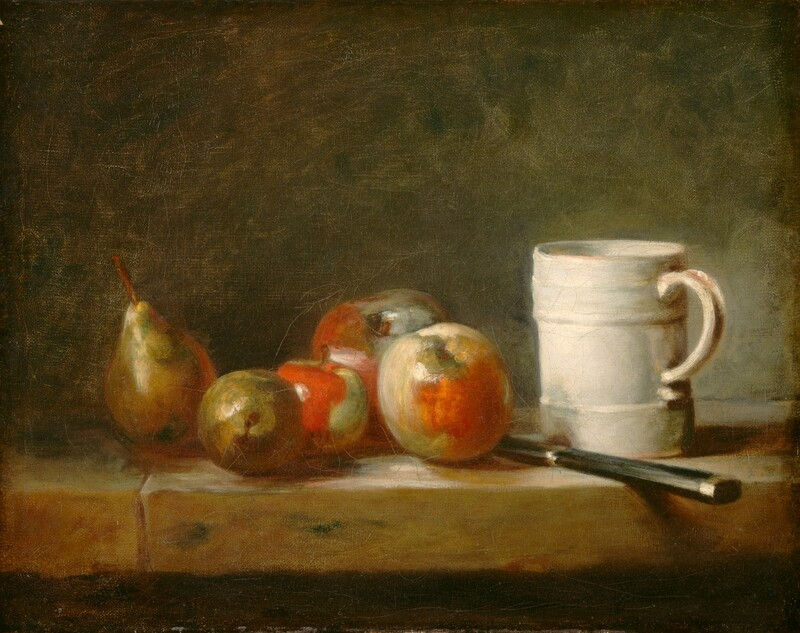
This is one reason abundance can feel composed. It does not require an empty table, nor does it require every small object to be equally clear at every distance. Our essay on Chardin’s ordinary objects considers attention within a different visual register. Set beside de Heem, it reminds us that clarity can be achieved through a modest inventory or through a carefully ordered profusion. What matters is how a painting distributes the viewer’s attention.
Return to the empty place at the table
At the end, look again at the chair. It has become more than an entry point. We now understand it in relation to the food, vessels, cloth, and clock around it. It suggests the possibility of a person joining the arrangement while leaving that person absent. The picture remains open to our own imagined presence.
That is where the landscape comparison becomes useful once more. We have traveled through the scene, following bright paths and encountering obstacles, but we cannot actually occupy it. The objects hold their places beyond the painted surface. Our movement belongs to looking.
Choose a route for one final pass: from the left opening to the silver pitcher, across the lobster, up the tilted plate, and toward the clock. Then let your eye return down the cloth. The banquet has offered a whole circuit of attention. Its richness comes from the relationships that make such a journey possible, and from the small changes that reveal themselves each time we take it.
Written by Havenest Studio


Comments