
The Soft Edge of Memory: Corot, Forest Light, and the Poetry of Transition
Some landscapes announce themselves with a horizon. Corot’s forests arrive differently: first as a veil of leaves, then as a clearing, then as the faint suggestion that the world continues beyond what the eye can hold. His paintings do not ask us to conquer the scene with a single glance. They teach us to stay until edges begin to soften.
Jean-Baptiste-Camille Corot made the forest into a place of transition. Between classical composition and modern observation, between a solid tree trunk and an atmosphere that seems to breathe around it, his landscapes hold the moment when a remembered place is still anchored in the real world.

Jean-Baptiste-Camille Corot, Rocks in the Forest of Fontainebleau, 1860/1865. Oil on canvas. National Gallery of Art, Washington.
Between classical landscape and modern seeing
Corot’s career began while French landscape painting was still negotiating its status. The academic tradition valued the “historic landscape,” a composed scene elevated by a literary or religious subject. Corot understood that tradition, but he gradually loosened its theatrical machinery. The land could remain carefully organized without looking staged.
In Rocks in the Forest of Fontainebleau, the eye meets a shallow arc of sunlit boulders surrounded by dense green growth. The arrangement is simple, almost modest. Yet the paint refuses to make the forest inert. The vegetation is layered, brushed, and breathed into being; the rocks give the picture a grounded rhythm while the haze beyond them keeps the scene open.

Jean-Baptiste-Camille Corot, Forest of Fontainebleau, 1834. Oil on canvas. National Gallery of Art.
Barbizon, the Salon, and the discipline of looking outdoors
Fontainebleau entered Corot’s work within a larger nineteenth-century shift. Around the village of Barbizon, painters treated the forest and surrounding fields as subjects worthy of sustained attention. The group later called the Barbizon School was never a single formal academy, but its artists shared an interest in bringing landscape closer to direct experience. Corot belonged to this history without fitting neatly inside it: he never settled in Fontainebleau, yet its rocks and monumental trees shaped some of his most important early landscapes.
The Salon gave this experiment a complicated public stage. French academic culture still prized finished, composed landscapes, often elevated by historical or biblical subject matter. Corot worked within that system. He used studies made from nature to develop larger mythological and historical canvases for exhibition, even when the freer sensibility of those studies did not immediately receive equal approval. His career therefore moved between two demands: the authority of the Salon and the evidence of a particular place seen in particular light.
His outdoor practice was not a simple matter of carrying a large finished painting into the woods. The plein-air étude served as a concentrated record of sky, earth, water, and atmosphere at a given hour. In 1826, while in Italy, Corot made Waterfall at Terni with a candor and naturalism the Metropolitan Museum of Art describes as characteristic of plein-air technique. He did not exhibit such informal studies, but carried their vigorous sensibility into paintings shown at the Salon.
That distinction clarifies the softness in Rocks in the Forest of Fontainebleau. The painting is neither a mechanical transcription nor a purely invented dream. It is an image processed through two kinds of attention: the quick, bodily encounter outdoors and the slower act of composing in the studio. Corot’s structure is the memory of the first encounter held in place by the second.
The forest as a place of thresholds
Fontainebleau was more than a picturesque destination. For nineteenth-century artists, it became a place where painting could be tested against direct experience: trunks, stones, paths, weather, and the changing density of light. Corot worked from outdoor sketches and studies, then developed larger compositions in the studio. The finished image carries both kinds of attention.
That double origin matters. The forest feels observed, but not trapped by observation. A tree is not reduced to botanical inventory; a clearing is not merely a location. Corot gives the landscape enough structure to be believable and enough uncertainty to feel psychologically available.
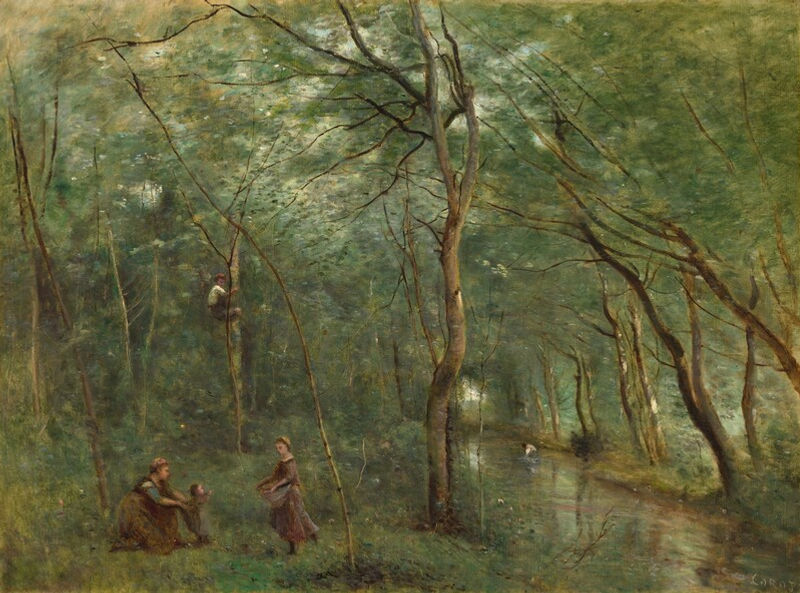
Jean-Baptiste-Camille Corot, The Eel Gatherers, 1860/1865. Oil on canvas. National Gallery of Art.
Corot’s silver-green atmosphere
The famous Corot atmosphere is often described as softness, but softness alone is too vague. Look closely and the paintings are built from decisions about value and distance. Dark trunks hold the foreground. Pale openings pull the eye inward. Greens shift toward blue, gray, brown, or warm earth depending on the light around them.
This is why his haze does not dissolve the landscape. It edits the landscape. It asks which details should remain tactile and which should recede into memory. In River View, the cloudy sky, riverbank, figure, and trees are held together by a restrained palette that makes the scene feel both present and already half-remembered.

Jean-Baptiste-Camille Corot, River View, 1868/1872. Oil on wood. National Gallery of Art.
How softness can still have structure
Corot’s gentleness is not the absence of form. It is form moderated by atmosphere. The compositions depend on diagonals, vertical trunks, bands of water, and carefully placed interruptions: a person, a rock, a path, a distant opening. These elements give the viewer somewhere to rest while allowing the image to remain spacious.
That balance helps explain Corot’s importance to later painters, including artists associated with Impressionism. He did not simply invent modern landscape painting, and it would be misleading to make that claim. His contribution was subtler: he showed how a landscape could be faithful to looking while also carrying the instability of perception.
Styling atmospheric landscape art at home
A Corot-inspired work brings softness to a room without making the room visually empty. It works especially well where natural materials already do some of the talking: warm plaster, linen, aged wood, muted green, and honey-colored light. Let the artwork keep breathing room around it. A crowded wall can turn atmosphere into wallpaper.
For another study in the emotional life of landscape, read “The Weather of Home: John Constable and the Emotional Sky of the English Countryside”. For a broader reflection on choosing art for an interior, continue with “How to Choose Wall Art for a Calm Living Room”.
Research sources
Alex, Holland, and Louis from Havenest Studio
Comments