
The Weather of Home: John Constable and the Emotional Sky of the English Countryside
There are landscapes that describe a place, and landscapes that seem to remember one. John Constable’s paintings belong to the second kind. Their fields, rivers, trees, and farm buildings feel specific enough to locate on a map, yet they are never only topographical records. They carry the emotional pressure of weather: the lift before rain, the brief clearing after a storm, the quiet warmth of a familiar road.
Constable made the English countryside feel intimate without making it small. His native Suffolk became a language of belonging, where a cloud could alter the mood of a whole valley and a stretch of water could hold the memory of childhood. In his work, the sky is not a backdrop. It is the atmosphere through which home becomes visible.

John Constable, Wivenhoe Park, Essex, 1816. Oil on canvas. National Gallery of Art, Washington.
Why Constable painted the sky so seriously
Constable’s clouds are persuasive because they behave like weather rather than decoration. They gather, break apart, darken the fields, and open again over distant water. Their movement gives the landscape a present tense. We are not looking at an eternally agreeable countryside; we are standing inside a particular hour.
He studied these changes with unusual concentration. His outdoor sketches and cloud studies were not casual notes but investigations into structure, moisture, weight, and motion. The brushwork asks us to notice how light travels across land: one field catches it, another recedes, and the same green can feel tender, cool, or almost black depending on what passes overhead.
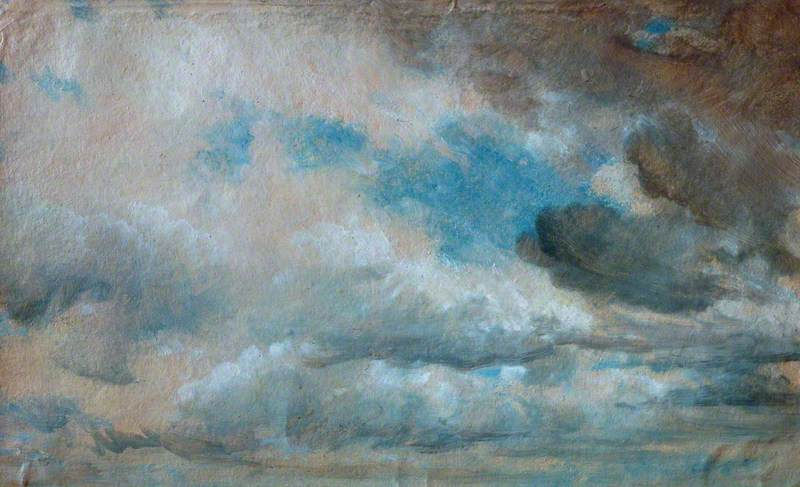
John Constable, Study of Clouds, 1822. Oil on paper. Public-domain artwork reproduction via Wikimedia Commons.
The Stour Valley and the feeling of home
Constable’s attachment to the Stour Valley was personal. Flatford Mill, East Bergholt, Dedham Vale, and the surrounding waterways were tied to his family history and early life. The mill business connected the Constable family to this working landscape for generations, so the river was never simply picturesque. It was a place of labor, routine, weather, and kinship.
That is part of what makes the paintings feel settled. Boats, carts, gates, bridges, and cottages are integrated into the land rather than arranged as theatrical props. In Flatford Mill, the river carries a slow diagonal through the scene, while the buildings and trees create a sense of shelter. The quiet is active: water moves, work continues, and the day keeps changing.
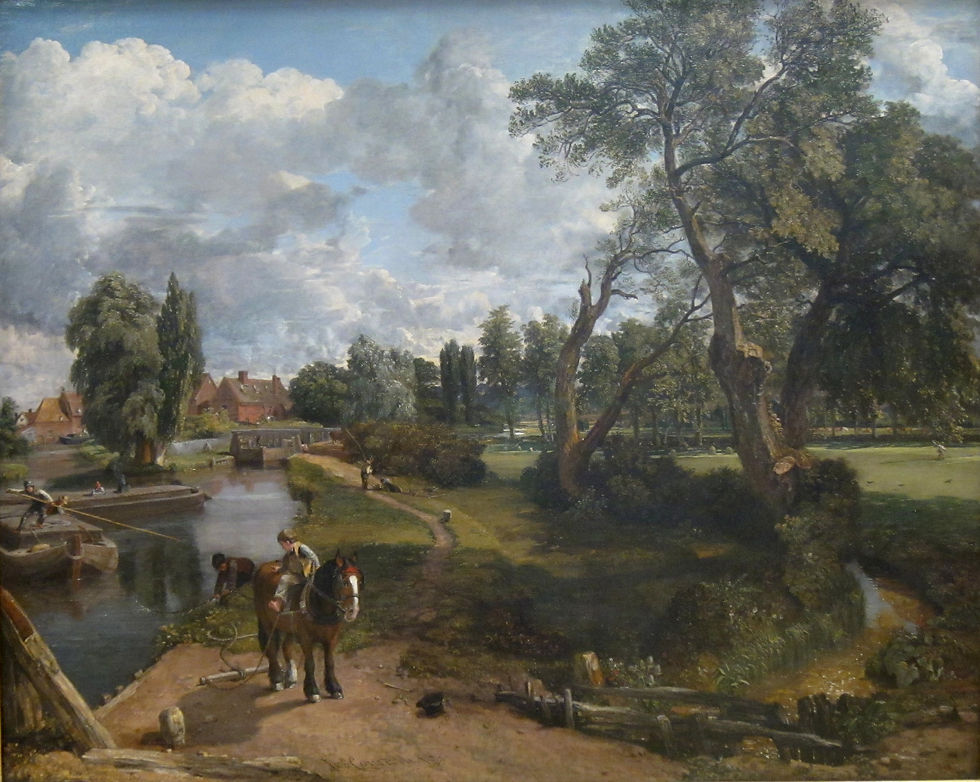
John Constable, Flatford Mill (Scene on a Navigable River), 1816. Tate Britain.
Weather as movement and narrative
In The Hay Wain, a cart pauses in shallow water beneath a sky that seems to be deciding what to do next. The clouds are not merely expressive; they organize the painting’s rhythm. Their shifting light moves the eye from the dark foliage at the left toward the open distance, then back to the small human story at the center.
Constable’s achievement is to make this ordinary scene feel consequential without turning it into a myth. The emotional drama remains low-key. It lives in the changeability of the air, in the relationship between shelter and exposure, and in the recognition that a familiar place is never visually identical from one day to the next.

John Constable, The Hay Wain, 1821. Oil on canvas. The National Gallery, London.
From full-size sketches to living landscapes
Many of Constable’s large exhibition paintings were developed from studies made outdoors and refined later in the studio. This process allowed him to preserve the freshness of observation while composing with memory. He could hold onto the exact sensation of a sky while shaping the final image into a more deliberate emotional whole.
The result is neither a mechanical copy of nature nor an invented fantasy. It is a remembered landscape made convincing through close looking. Small accents — a bright collar, a figure in a boat, a break in the trees — keep the scene grounded, while the broad structure of cloud and land gives it psychological reach.
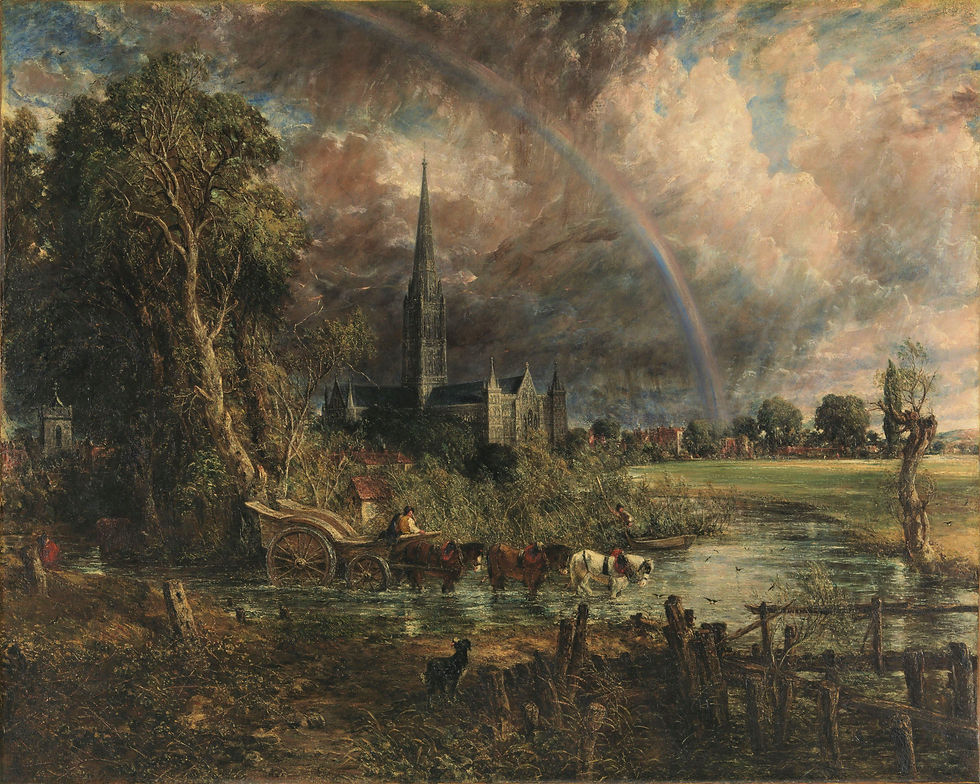
John Constable, Salisbury Cathedral from the Meadows, 1831. Oil on canvas. Tate Britain.
The enduring appeal of English countryside art
Constable continues to speak to anyone who understands that home is partly a visual rhythm: the line of a river, the shape of a familiar tree, the color of fields after rain. His landscapes offer calm, but not emptiness. They remind us that stillness can contain movement, and that comfort is often made from details we have seen many times before.
This is why his work translates so naturally into a contemporary interior. A countryside print can soften a room, but it can also give the room a sense of place. The most successful landscape art does not merely fill a wall; it changes the speed at which we inhabit the space.
For a more dreamlike meditation on imagined landscape, continue with “The Path to Elysia”. For a quieter approach to choosing artwork at home, read “How to Choose Wall Art for a Calm Living Room”.
Research sources
National Gallery of Art — Wivenhoe Park, Essex · The National Gallery, London — The Hay Wain · Tate — John Constable’s Cloud Study · National Gallery, London — John Constable · Wikimedia Commons — Paintings by John Constable
Alex, Holland, and Louis from Havenest Studio
Comments