
A Garden Without a Horizon: Claude Monet and the Art of Looking Again
A pond can be looked at once, named, and left behind. Monet’s pond asks for another visit. Then another. Its surface changes with the hour, the season, the weather, and the angle from which the body stands before it. The longer we look, the less certain the boundary becomes between water, flower, reflection, and sky.
Claude Monet’s garden at Giverny was not simply a backdrop for his late paintings. It became a way of organizing attention: a place he shaped, returned to, and gradually transformed into a lifelong study of perception.
The garden as a studio
In 1893, Monet had a pond dug at Giverny and planted it with water lilies. The garden was cultivated for pleasure, but also for painting. This is an important shift in the story of Impressionism: nature was no longer only something to encounter outside the studio. Monet actively shaped a setting that could generate endless visual problems.
Where should the eye begin? How much of the bridge should appear? What happens when a reflection is as visually assertive as the object reflected? The garden became a living arrangement of color, surface, architecture, and weather. It gave Monet something more demanding than a picturesque view: it gave him a world to keep looking into.

Claude Monet, Bridge over a Pond of Water Lilies, 1899. Oil on canvas. The Metropolitan Museum of Art, New York.
From Sainte-Adresse to Giverny: learning to see
To understand what changed at Giverny, it helps to begin earlier. In Garden at Sainte-Adresse and Regatta at Sainte-Adresse, both painted in 1867, Monet arranged the world in bright, legible bands: terrace, flowers, sea, boats, and sky. These paintings already show his interest in the way light can reorganize ordinary experience. The garden is not an illustration of a place so much as a field of relationships between color, atmosphere, and modern life.
This was Monet’s early Impressionist phase, when the question was how to paint the sensation of a scene as it changes. He worked outdoors, watched skies and water, and allowed visible brushwork to preserve the instability of light. The subject mattered, but the act of seeing it in a particular hour mattered just as much.
Monet moved through Normandy, the coast, Paris, Argenteuil, Vétheuil, and other places before settling at Giverny in 1883. That move did not represent a sudden break with his earlier work. It marked a gradual change from observing many places to cultivating one. Sainte-Adresse offered a view to be encountered; Giverny became an environment he could build, edit, and revisit.

Claude Monet, Garden at Sainte-Adresse, 1867. Oil on canvas. The Metropolitan Museum of Art, New York.
By the time the water-lily paintings became central to his practice, Monet had turned the Impressionist interest in fleeting perception into a sustained method. The early paintings ask how a moment feels. The Giverny paintings ask what a lifetime of moments can do to a single place.
Impressionism and the changing hour
Monet is often reduced to the idea of capturing a fleeting moment. His later garden paintings complicate that description. The image may begin with a particular observation, but it grows through sustained looking. Each brushstroke holds a negotiation between what the eye sees now and what repeated looking has taught it to expect.
This is why Monet repeatedly painted haystacks, poplars, cathedrals, and finally the pond. A series does not merely multiply subjects. It makes time visible. The changing hour becomes part of the composition, and difference becomes a form of structure.
The water-lily pond is therefore both immediate and accumulated. A violet reflection may belong to the present sky, but it also belongs to Monet’s long familiarity with this place. The painting feels luminous because it is attentive to change, not because it pretends change can be stopped.

Claude Monet, Regatta at Sainte-Adresse, 1867. Oil on canvas. The Metropolitan Museum of Art, New York.
When water dissolves the horizon
Water Lilies removes many of the coordinates that traditionally stabilize a landscape. There may be no clear horizon, no distant mountain, no firm division between earth and sky. Instead, the viewer enters a field of floating relationships: petals, ripples, mirrored branches, and passages of color that refuse to settle into one fixed depth.
This almost abstract effect was not a rejection of nature. It emerged from looking at nature with such persistence that representation began to loosen. The pond becomes less a scene to be described than a surface through which perception keeps moving.
The result can feel peaceful, but it is not passive. The eye is constantly asked to adjust. A dark reflection becomes a branch, then a stain of blue; a flower appears to float, then seems to sit inside the sky. Monet’s stillness is active because it keeps perception in motion.
The bridge, reflection, and the art of looking again
The Japanese-style bridge at Giverny gives the later paintings an architectural measure. Its curved structure can anchor the composition, but it can also disappear into foliage and reflection. Monet’s interest in Japanese woodblock prints is visible in the flattened emphasis on surface, the unusual cropping, and the willingness to let a view remain asymmetrical.
Yet the bridge is never only a reference to another culture or a decorative garden feature. It is a device for making the viewer conscious of looking. We see the bridge, then its reflection; we see the water, then the depth suggested beneath it. The painting becomes an exchange between recognition and uncertainty.
Giverny as an artwork in itself
Monet’s garden makes the boundary between life and work unusually porous. He planted, diverted water, built a Japanese-style bridge, and arranged the conditions under which paintings could happen. The garden was never only a motif waiting to be copied. It was an ongoing collaboration between horticulture and painting.
That collaboration gives the Water Lilies series its particular emotional quality. These are not images of escape from the world. They are records of a person learning how much can be discovered by returning to the same world with greater patience.
Seen this way, Giverny is not a retreat from modernity but a laboratory for attention. The world enters through weather, season, memory, labor, and the changing limits of the body. Even the late paintings’ spaciousness carries the trace of practical work: planting, pruning, waiting, and looking.
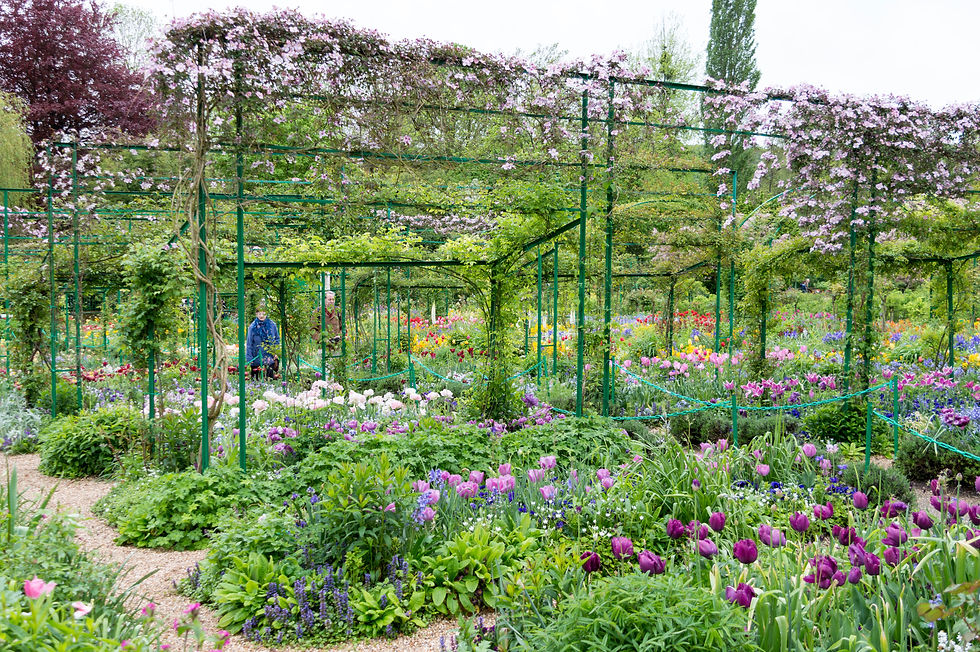
Garden at Fondation Claude Monet, Giverny, photographed by Supercarwaar in 2015. Wikimedia Commons, CC BY-SA 4.0.
Why Monet’s garden paintings remain restorative
A Monet-inspired artwork can change the tempo of a room because it does not insist on one hard focal point. The eye can drift across it, find a flower, lose the flower in its reflection, and return to the larger field. Pale plaster, natural textures, and a view toward greenery allow that visual movement to continue beyond the frame.
The most generous way to live with this kind of image is not to imitate Giverny literally. It is to leave room for the artwork’s surface to breathe. A quiet wall, softened daylight, and a few natural materials can support the same slower rhythm: looking once, then looking again.
For another way of thinking about a landscape as a psychological space, read “The Weather of Home: John Constable and the Emotional Sky of the English Countryside”. For a practical guide to building a composed interior, continue with “How to Choose Wall Art for a Calm Living Room”.
Research sources
Alex, Holland, and Louis from Havenest Studio
Comments