"Circle of Poets": Literary Salon Wall Art for Thoughtful Rooms
Some rooms become memorable because of what they contain. Others are shaped by what seems possible inside them: a long conversation, a page read aloud, or an idea that changes as it passes from one mind to another.
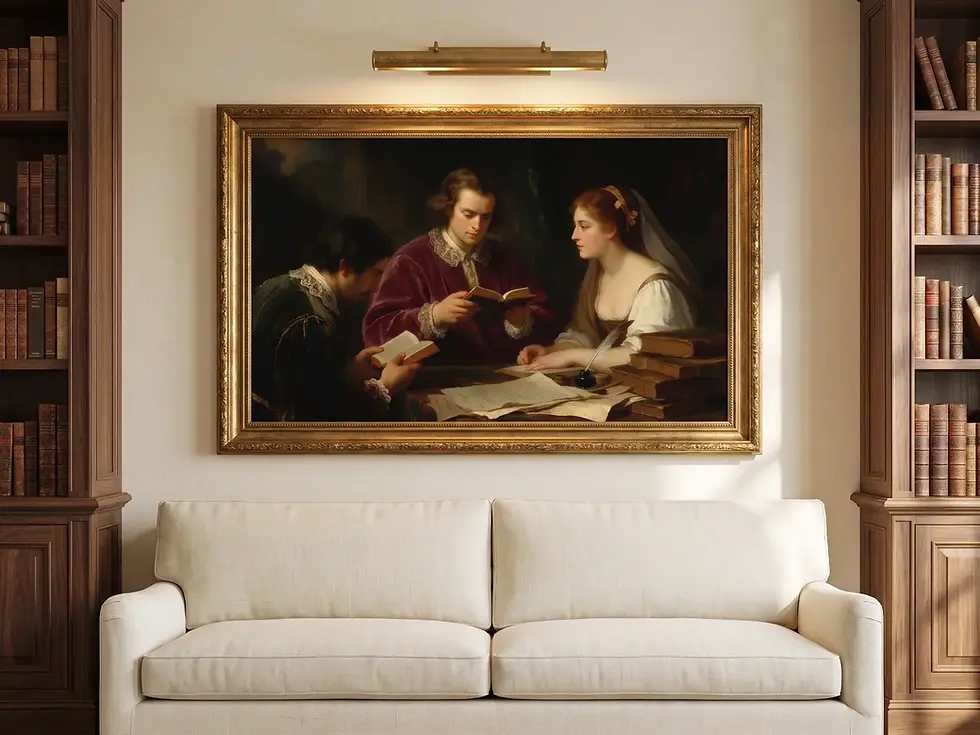
"Circle of Poets" brings that possibility to the wall. Three figures gather around manuscripts and open books, their attention directed toward the shared work rather than toward the viewer. Burgundy velvet, dark green fabric and ivory paper emerge from a deep, shadowed interior.
As literary salon wall art, the piece does not simply decorate a reading room. It suggests that thinking can be communal—that words become richer when they are tested, heard and answered.
In This Journal
A Table Where Ideas Stay Alive
The table in "Circle of Poets" is crowded with evidence of work: loose handwritten pages, open volumes, a dark ink bottle and a pale quill resting near the center. Nothing appears arranged for display. The setting feels active, as if a thought has just been interrupted so another voice can enter.
One figure reads from a small book. Another bends closely over a volume, while the third listens beside a stack of worn books. Their different postures create a quiet rhythm of reading, considering and responding.
The scene suggests a salon without showing performance or applause. Its intimacy comes from concentration. What matters is not who will be praised, but what may be discovered while attention is shared.

Reading the Details in "Circle of Poets"
The composition forms a gentle triangle around the central reader. His burgundy garment carries the strongest color, while the figures on either side draw the eye back toward the table. Their faces are softly illuminated, but the manuscripts receive nearly equal attention.
That balance matters. "Circle of Poets" is not only a group portrait; it is also a portrait of reading itself. Books are held, stacked and opened. Paper spreads across the foreground. The quill and ink bottle remind us that the conversation may eventually return to the page.
The darkness surrounding the figures gives the scene depth without making it severe. Warm skin, lace collars and ivory pages soften the shadows. Burgundy and forest green add richness, while the limited palette keeps the visual story coherent.

Where Literary Salon Wall Art Feels at Home
The wide horizontal composition makes "Circle of Poets" especially suited to walls above a desk, console, sideboard or compact sofa. Its subject naturally belongs near books, but it does not require a dedicated library.
In a home office, the artwork can make practical work feel connected to a longer tradition of thought and craft. In a living room, it introduces narrative depth without dominating conversation. In a bedroom, it works best on a wall where the deep shadows can be seen in warm, gentle light.
Consider these placements:
• Above a writing desk, leaving enough space for a lamp without covering the frame.
• Between two bookcases, where the horizontal format creates a calm visual bridge.
• Above a low console with only a few objects: one vessel, two or three books, and a small lamp.
• Over a reading nook, paired with an armchair and directional lighting.
• On a gallery wall only if the surrounding pieces are quieter and smaller.
Framing Burgundy, Ivory and Ink
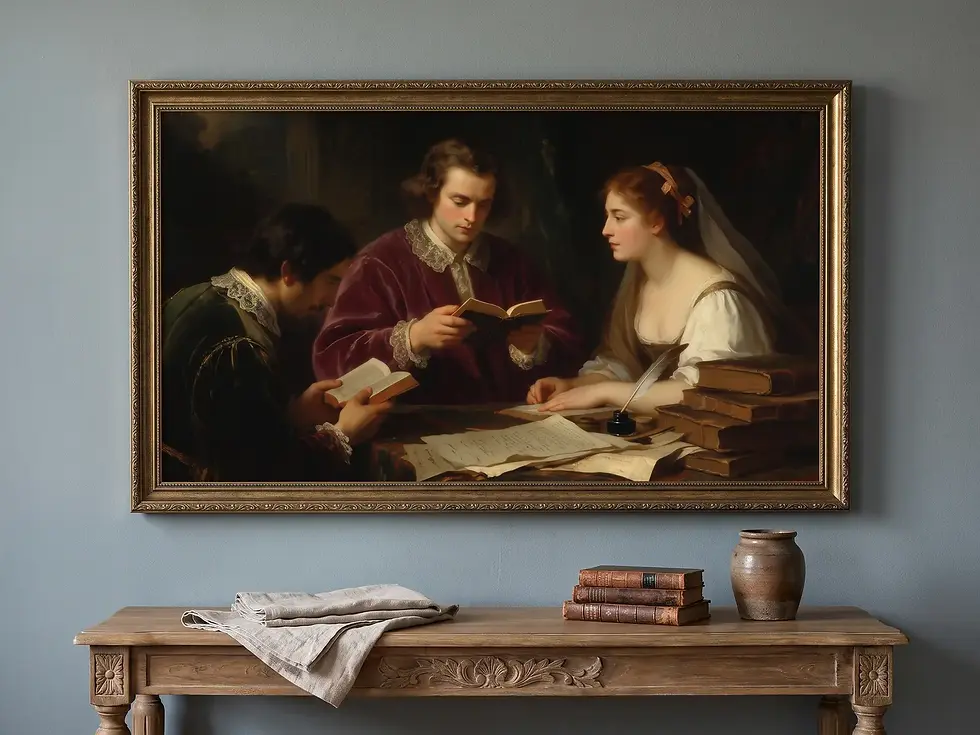
A dark-walnut frame is the most natural choice for a scholarly interior. It connects with bookcases and older furniture while allowing the burgundy clothing and pale pages to remain prominent. Antique brass or softly aged gold adds more definition against a dark wall.
For a lighter or contemporary room, a slim black frame can work beautifully. It repeats the deepest shadows and creates a clean edge without asking the room to imitate a historical salon.
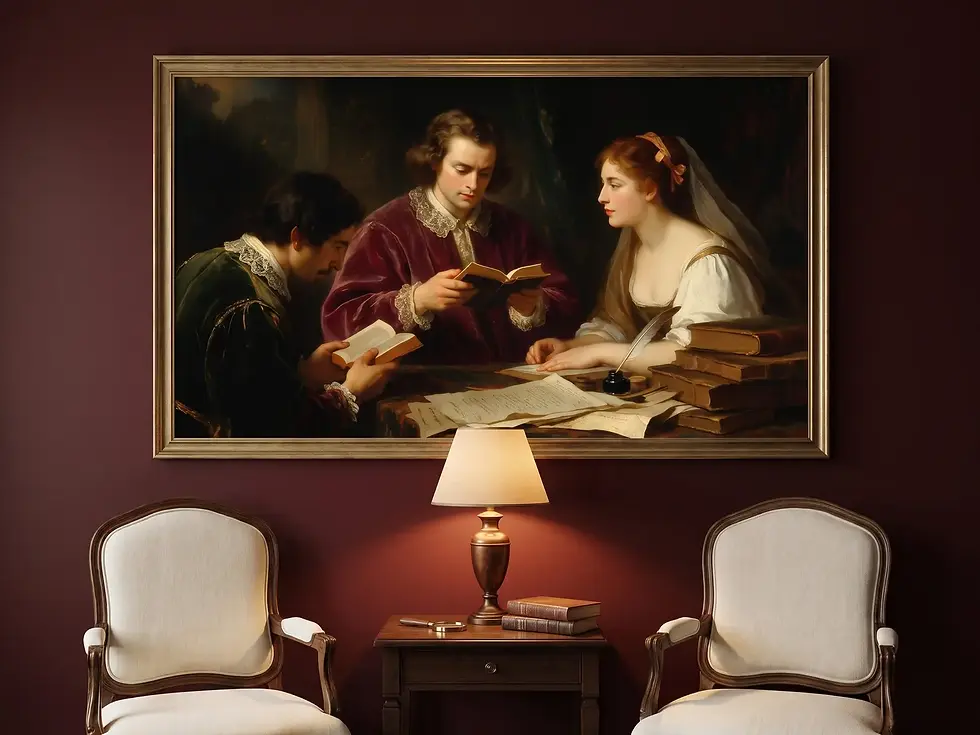
Wall colors can shift the mood. Warm cream brings clarity. Blue-gray emphasizes stillness. Oxblood deepens the burgundy velvet, while muted plum and moss green create a softer, more eclectic interpretation.
Choose one or two echoes rather than matching everything: a burgundy cushion, an ivory linen throw, dark wood or a small brass lamp. The painting should feel collected, not costumed.
Printing "Circle of Poets" with Care
"Circle of Poets" is offered as a digital download, allowing the finished presentation to be shaped around your room. Before printing, test the intended dimensions with paper or painter’s tape and view the outline from the main entrance and seating area.
Matte fine-art paper or cotton rag will usually suit the soft light and dark background, preserving detail without reflective glare. A lightly textured surface can support the old-world feeling. Canvas offers a more painterly presence when the artwork is printed at a larger scale.
A simple pre-print checklist:
• Confirm that the selected file ratio matches the frame or intended print dimensions.
• Choose a high-quality or fine-art print setting rather than a standard document setting.
• Ask for a small proof if deep shadows tend to print too heavily at your chosen printer.
• Use matte or low-reflection glazing opposite windows.
• Leave the finished print flat until it is completely dry before framing.

Making Room for Conversation
A room does not need to be grand to become a place of ideas. It needs attention, a measure of comfort and permission for a conversation to continue beyond its first answer.
"Circle of Poets" carries that invitation. The three figures remain absorbed in the work before them, while the open manuscripts seem to extend their table toward our own lives—our books, unfinished pages and questions still waiting for language.
Placed with warm light and a restrained frame, the artwork can give a room intellectual character without coldness. It reminds us that thought is not always solitary. Sometimes it gathers around a table and becomes visible between people.
Words and visual direction by Havenest.
Comments