Cézanne’s Ginger Jar and Eggplants: Following the Blue Cloth
The fabric reaches the edge before anything else does. Blue folds descend through the foreground, carrying dark patterns into hollows where the table nearly disappears. In Paul Cézanne’s Still Life with a Ginger Jar and Eggplants, the cloth gives us a route through an unusually crowded room.
The painting dates to 1893–94. Its fruit and vessels remain recognizable, yet following their supports is less straightforward than naming them. Begin at the lower left and travel upward: a curved pattern, a lemon, a green rounded form, then a pale jar threaded with diagonal bands. The journey changes direction repeatedly.
This close reading follows those routes. The interest lies in how soft fabric, rigid furniture, woven bindings, and hanging vegetables make different kinds of line, and how the painting brings them into conversation.

Paul Cézanne, Still Life with a Ginger Jar and Eggplants, 1893–94. Oil on canvas. The Metropolitan Museum of Art, Bequest of Stephen C. Clark, 1960. Public-domain image, The Met Open Access. Museum record.
In this article
Begin Where the Table Disappears
Across the bottom, patterned cloth occupies a surprising amount of the picture. Its folds are broad enough to feel like terrain. Some dark motifs stretch vertically; others curl around a bend or disappear into a crease. Pattern describes the material, while distortion tells us that material is folded.
Try distinguishing three things: the printed mark on the cloth, the shadow inside a fold, and the outline where fabric meets another object. They can share almost the same blue. Where they converge, reading becomes slower. The eye must decide whether a dark passage belongs to decoration or depth, and sometimes both seem possible.
Above that busy foreground, a pale cloth supports a plate of fruit at the right. Its brighter ridges turn upward, then spill down again. The two fabrics establish different speeds: a tangled, patterned descent on the left and a broader sweep beneath the fruit. Neither serves as a neutral background.
The Met identifies this as an arrangement built from objects Cézanne used repeatedly, including the corded ginger jar. That documented familiarity makes the painting’s complexity especially interesting: familiar things can generate unfamiliar relationships. See the museum’s account of the painting.
The Jar Gives the Folds Something to Push Against
Near the center, the pale ginger jar has a dark oval mouth and a rounded body crossed by binding. Its firmness interrupts the flowing fabric. A diagonal band continues a direction established below, but the vessel itself resists the cloth’s apparent motion. This exchange creates tension without requiring an event.
Do not confuse this pale corded vessel with the taller green jar behind it. Their colors, surfaces, and openings give them different roles. The green jar makes a relatively broad dark mass; the pale jar provides a complicated central meeting point for diagonals. Naming their differences helps us see how carefully variety has been arranged.
Compare the green ceramic jar in Cézanne’s Still Life with Jar, Cup, and Apples, dated about 1877. There, a cup and a more limited spread of fruit leave the major vessels easier to separate. White cloth travels across the lower portion, but the background pattern remains prominent above.
The comparison makes the later painting’s density more apparent. Here, lines cross several surfaces before we reach open wall. A household container becomes one participant in a much larger web of repetitions. Its identity matters, but its neighbors determine its visual force.
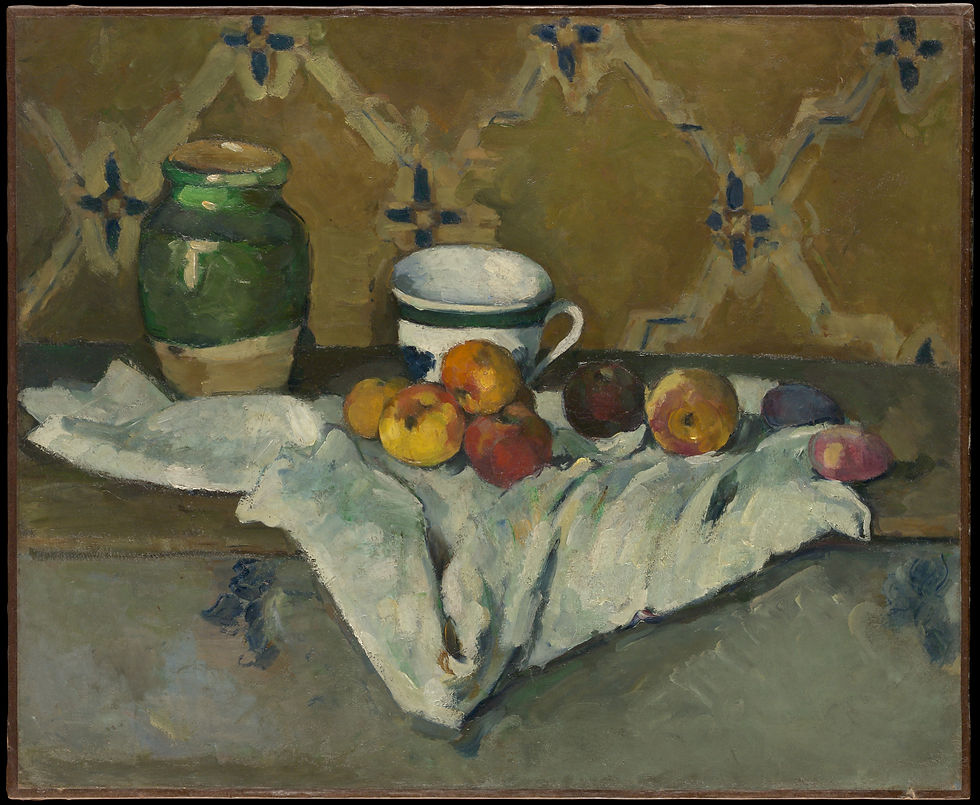
Paul Cézanne, Still Life with Jar, Cup, and Apples, ca. 1877. Oil on canvas. The Metropolitan Museum of Art, H. O. Havemeyer Collection, Bequest of Mrs. H. O. Havemeyer, 1929. Public-domain image, The Met Open Access. Museum record.
Three Eggplants Make a Different Kind of Weight
At the upper right, dark eggplants hang from a forked support. Their placement is unusual enough to interrupt the expected inventory of a tabletop. Most objects below appear to rest on something. These descend into the room, bringing weight into an area that otherwise might remain relatively open.
Their curved bodies answer the round fruit, while their narrow attachment draws attention toward the upright and diagonal lines behind them. The dark shapes also provide a concentrated contrast against the blue wall. Seen this way, they connect the upper background to the crowded lower arrangement rather than functioning as an isolated curiosity.
Cézanne’s Still Life with Apples and a Pot of Primroses, around 1890, offers a related vertical connection. Leaves and flowers rise above a table covered in pale folds. The plant expands upward; the eggplants in our painting descend. Both interrupt a broad background with organic shapes.
These comparisons concern visible structure, not a claim that the paintings share a hidden message. We can describe upward and downward movement with some confidence. A symbolic meaning for the hanging vegetables would require further evidence. Their compositional importance is already substantial without one.

Paul Cézanne, Still Life with Apples and a Pot of Primroses, ca. 1890. Oil on canvas. The Metropolitan Museum of Art, Bequest of Sam A. Lewisohn, 1951. Public-domain image, The Met Open Access. Museum record.
A Few Warm Colors Hold the Center of Attention
Much of the painting belongs to greens and blues. Against that cool field, the yellow and red fruit creates a series of warmer pauses. Their grouping near the right is compact enough to register quickly, even when the surrounding cloth sends the eye along a longer route.
The isolated yellow fruit toward the left does something different. It places a small warm note between larger green and blue forms. Follow a path from that yellow to the warmer cluster on the plate. The movement crosses the pale jar and folded linen, joining parts of the arrangement that might otherwise feel separate.
Warmth alone does not explain the effect. The plate’s rim provides a lighter curve beneath the fruit, and several dark edges sharpen their separation from the cloth. Color, contour, and placement cooperate. A useful exercise is to imagine the fruit as gray: the objects would retain volume, but the sequence of visual invitations would change.
For a broader approach to these relationships, our five questions for reading a still life begins with observation before interpretation. Here, a question as simple as where the warmest colors appear can produce a detailed account of how the composition holds together.
Furniture Establishes a Frame Inside the Frame
The wooden furniture at the upper left introduces horizontal and vertical divisions. Compared with the foreground cloth, its geometry feels restrained. A long upper edge and upright supports establish a structure against which the softer forms can become more conspicuous.
This contrast is easier to appreciate beside Still Life with Apples and Pears, dated about 1891–92. There, fruit and pale plates sit above a broad exposed band of wood. Without a large cloth occupying the foreground, the table’s own surface and front edge carry more of the composition.
Return to the ginger jar painting and notice how much furniture is concealed. We know there must be support, yet fabric and objects prevent us from following one uncomplicated tabletop from side to side. The partial view of furniture at the back gives us enough structure to recognize the setting without resolving every spatial question.
That balance between disclosure and concealment sustains attention. The painting supplies firm lines, then withholds their continuation. Looking becomes an active reconstruction of where one surface might meet another. Our essay on Cézanne’s unsettled still lifes considers the wider implications of that experience.

Paul Cézanne, Still Life with Apples and Pears, ca. 1891–92. Oil on canvas. The Metropolitan Museum of Art, Bequest of Stephen C. Clark, 1960. Public-domain image, The Met Open Access. Museum record.
A Familiar Table Can Be Read in Another Way
Camille Pissarro’s Still Life with Apples and Pitcher, painted in 1872, makes a revealing comparison. A pale pitcher rises behind apples, with a glass to one side and floral wallpaper beyond. Pattern belongs both to the vessel and the room, yet a relatively clear stretch of cloth separates the objects from us.
In Pissarro’s arrangement, my eye moves between a few distinct presences. In Cézanne’s ginger jar painting, it repeatedly catches on the connections between them. That is a response to these particular compositions, not a complete distinction between the two artists. Both make ordinary surfaces worth sustained attention.
The comparison also helps explain why a still life can feel expansive without depicting an outdoor view. Spatial interest comes from the number and variety of paths available to the eye. Cézanne’s cloth creates a long journey inside a confined domestic arrangement. Even the foreground has several different directions of travel.
If you encounter the image on a screen, view the entire composition before enlarging a detail. A close-up makes the patterned fabric fascinating, but loses the relationship that gives it force: the firm jar above, the fruit to the right, and the furniture held farther back.

Camille Pissarro, Still Life with Apples and Pitcher, 1872. Oil on canvas. The Metropolitan Museum of Art, Purchase, Mr. and Mrs. Richard J. Bernhard Gift, by exchange, 1983. Public-domain image, The Met Open Access. Museum record.
Let the Fabric Bring You Back
On a final pass, begin with the eggplants rather than the cloth. Follow their dark curves toward the central vessels, then let a diagonal binding carry you down to the patterned folds. You may reach the foreground by a different route than before. The painting offers several coherent journeys rather than one compulsory sequence.
This is the value of looking for connections. A list of objects remains unchanged, while our experience of the arrangement grows more specific. Blue can describe a wall, shadow a cloth, and cool the side of a jar. A curve can belong to fruit, fabric, or pottery, each with a different weight.
There is a useful companion in Chardin and the dignity of ordinary objects: another invitation to stay with household things long enough to see how a painting gives them presence. Here, the invitation is unusually elaborate, full of overlaps and turns.
For me, the cloth remains the best entrance because it makes attention feel physical. The eye climbs, pauses, bends, and descends. When it returns to the plate of fruit, those familiar objects seem to occupy a room we have actually spent time exploring.
Written by Havenest Studio


Comments