Cézanne’s Apples and Pears: What Holds This Table Together?
Two groups of fruit occupy a tabletop with very little ceremony. Pears gather toward the left; apples rise on the right. White dishes appear behind and beneath them, their pale curves interrupted by the fruit. Without a cascading cloth or a tall bouquet to take charge, the space between these groups becomes unusually important.
In Paul Cézanne’s Still Life with Apples and Pears, dated about 1891–92, the question is not simply why the table looks tilted. It is how a few rounded objects hold an entire painting together when the surrounding geometry never settles into an easy explanation.
This close reading stays with one work. The pears’ unequal sizes, the apples’ warm colors, the dishes, and the visible furniture edges create a specific arrangement whose pleasures are easily lost when we treat every Cézanne still life as the same demonstration of perspective.

Paul Cézanne, Still Life with Apples and Pears, ca. 1891–92. Oil on canvas. The Metropolitan Museum of Art, Bequest of Stephen C. Clark, 1960. Public-domain image, The Met Open Access. Museum record.
In this article
Count the groups before counting the fruit
Begin by looking at the fruit as two clusters. The left group is lower and more yellow-green; the right group rises higher and carries stronger red-orange passages. A small fruit near the middle participates in the space between them. The resulting arrangement is neither perfectly symmetrical nor casually scattered.
This is a useful first step because identifying individual apples and pears can make us miss the larger shapes they form together. Each cluster has an outer contour, an apparent center of weight, and a relationship to the table’s edges. The fruit also overlaps the dishes, so the white ceramics become partial shapes rather than complete explanatory diagrams.
The Met’s account describes the painter’s use of several viewpoints rather than a single consistent perspective. That fact helps explain the spatial tension, but it is not the whole experience. Before searching for departures from a rule, ask how the groups direct your attention. Our five questions for reading a still life offer a way to keep the visible arrangement ahead of a familiar art-historical formula.
The bare tabletop exposes the problem of support
A broad strip of warm tabletop separates the fruit from the lower edge of the painting. Beneath it, a darker horizontal member of the furniture gives the arrangement a second register. On the right, a vertical edge and surrounding darker forms complicate the apparent boundary of the scene. These lines establish support while also making that support worth questioning.
Imagine covering most of the table with a white cloth. Folds would explain or conceal some of the uneven transitions. Here, the comparatively exposed surface leaves the geometry available for inspection. The table feels substantial, but its edges do not deliver the effortless certainty we might expect from a simple domestic object.
Compare Still Life with Jar, Cup, and Apples, dated about 1877. In that work, cloth hangs across the front, while wallpaper adds pattern behind the objects. The additional textures change where the eye can rest and which boundaries remain legible. Apples and Pears strips away much of that cushioning. Its plainness intensifies the encounter between fruit and supporting plane, making a modest table bear a surprisingly large compositional responsibility.
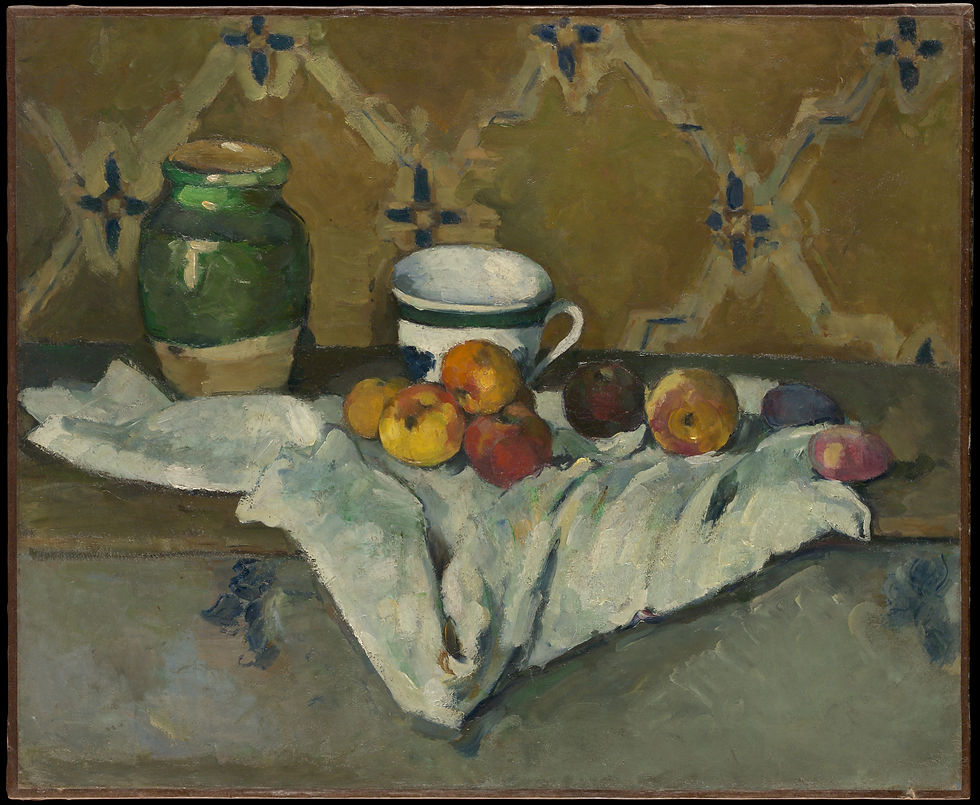
Paul Cézanne, Still Life with Jar, Cup, and Apples, ca. 1877. Oil on canvas. The Metropolitan Museum of Art, H. O. Havemeyer Collection, Bequest of Mrs. H. O. Havemeyer, 1929. Public-domain image, The Met Open Access. Museum record.
White dishes connect things they cannot fully explain
The dishes should help locate the fruit. A rim describes a surface; a surface tells us where an object sits. Yet the pale shapes are partly obscured, and their curves feel different from the strong straight edges of the furniture. Instead of resolving the scene completely, they introduce another system of direction.
Notice how little white is needed to change the arrangement. A narrow crescent behind a pear separates it from the background. A pale curve between warm fruit makes the adjacent colors appear denser. The dishes operate as small reservoirs of brightness within a painting whose tabletop and fruit are closely related in warmth.
In Pissarro’s Still Life with Apples and Pitcher, a plate also gathers apples, but a tall decorated pitcher and patterned wallpaper establish a more immediately domestic setting. The comparison clarifies what Cézanne withholds. His fruit is supported by dishes, yet it is not absorbed into a richly described room. The objects retain a strong independence, as though their relation to one another matters more than the household to which they might belong.
Try covering the right cluster with a hand held in front of the reproduction, then cover the left. Each remaining group seems to occupy a different proportion of the table. When both are visible again, their unequal heights and colors create a reciprocal adjustment. This simple exercise makes balance perceptible without requiring a mathematical diagram or assuming that the artist followed a fixed compositional formula.

Camille Pissarro, Still Life with Apples and Pitcher, 1872. Oil on canvas. The Metropolitan Museum of Art, Purchase, Mr. and Mrs. Richard J. Bernhard Gift, by exchange, 1983. Public-domain image, The Met Open Access. Museum record.
Color gives the fruit weight without making it uniform
The apples are not filled with one stable red. Warmer and cooler passages turn across their surfaces, while yellows appear beside greens and deeper marks. These transitions help the fruit feel rounded, but they also keep the brushwork active. We see a body and the colored decisions through which that body has been made.
The pears offer a different contour: broader lower forms taper toward smaller tops. Their irregularity prevents the group from becoming a row of identical units. Similar color does not erase individual shape, and the differences between those shapes become more compelling because the surrounding setting is restrained.
Manet’s Strawberries makes an instructive contrast. Its fruit accumulates into a red mound, with small bright marks and looser edges helping the berries cohere. Cézanne’s larger individual forms give the eye more distinct bodies to negotiate. Both paintings construct edible things out of marks, yet they distribute attention differently: Manet’s basket encourages a reading of the mass, while Apples and Pears repeatedly separates one rounded presence from its neighbor.

Edouard Manet, Strawberries, ca. 1882. Oil on canvas. The Metropolitan Museum of Art, Gift of Mr. and Mrs. Nate B. Spingold, 1956. Public-domain image, The Met Open Access. Museum record.
A flowering plant would change the whole argument
The absence of a tall object is easy to overlook. Nothing rises far above the fruit to dominate the composition. The background remains largely a field of cooler color and architectural lines. This low arrangement allows differences of only a few inches within the fruit groups to feel consequential.
Compare Still Life with Apples and a Pot of Primroses. There, the plant lifts the eye toward the upper right and a broad white cloth spreads across the lower area. Flowers, leaves, fruit, and fabric create several competing rhythms. The composition develops through a more extensive network of heights, folds, and colored intervals.
Apples and Pears places a tighter demand on each object. A single taller pear or forward apple must carry more of the variation that a bouquet or folded cloth might otherwise supply. This is why the painting deserves attention beyond the general observation that Cézanne unsettles perspective. Its economy is specific. The work asks how much movement and solidity can be generated by two kinds of fruit, a few ceramics, and the furniture that holds them.

Paul Cézanne, Still Life with Apples and a Pot of Primroses, ca. 1890. Oil on canvas. The Metropolitan Museum of Art, Bequest of Sam A. Lewisohn, 1951. Public-domain image, The Met Open Access. Museum record.
Several viewpoints need not be a mistake to correct
The museum identifies views from above, from the side, and straight on within the picture. Rather than trying to force those positions into a single camera-like arrangement, allow your eye to move between them. You may feel closer to the upper surfaces of the dishes while meeting the fruit more directly from the front.
That movement resembles the way sustained attention gathers information, although it would be too strong to claim that this painting records an exact sequence of bodily positions. A canvas is a constructed surface, not a transcript of an eye’s journey. What matters here is the coexistence of views and the relationships they produce.
Our broader essay on why Cézanne’s still lifes refuse to sit still considers that spatial restlessness across several works. This painting offers a concentrated case: the objects remain firmly present even when their shared space resists an easy diagram. Solidity and certainty are not identical. A pear can feel convincingly heavy while the table beneath it asks us to keep looking. That tension is a source of pleasure rather than a defect awaiting correction.
Try looking at the space that contains no fruit
For a final pass, concentrate on the intervals. Look between the two groups, above the lower table edge, and around the pale dishes. These apparently secondary spaces regulate the fruit’s proximity. If every gap were filled, the objects would lose the room they need to assert their individual weight.
This exercise also changes the pace of viewing. Instead of moving from apple to pear as though completing an inventory, we begin to notice pressures and pauses across the surface. The empty table is not inactive. It holds distance, and distance permits relationships to become visible. A few ordinary things can occupy an entire picture because the spaces around them have been considered with equal seriousness.
Readers interested in the attention granted to familiar objects may continue with Chardin and the dignity of ordinary objects. Then return to Cézanne’s bare table and its two clusters. There is no need to make them settle into a final diagram. Their balance is something we experience repeatedly, with each return revealing a slightly different answer to the question of what holds them together.
Written by Havenest Studio


Comments