When "I’m Home" Feels Unfamiliar: "A Woman at the Edge of the Sea"
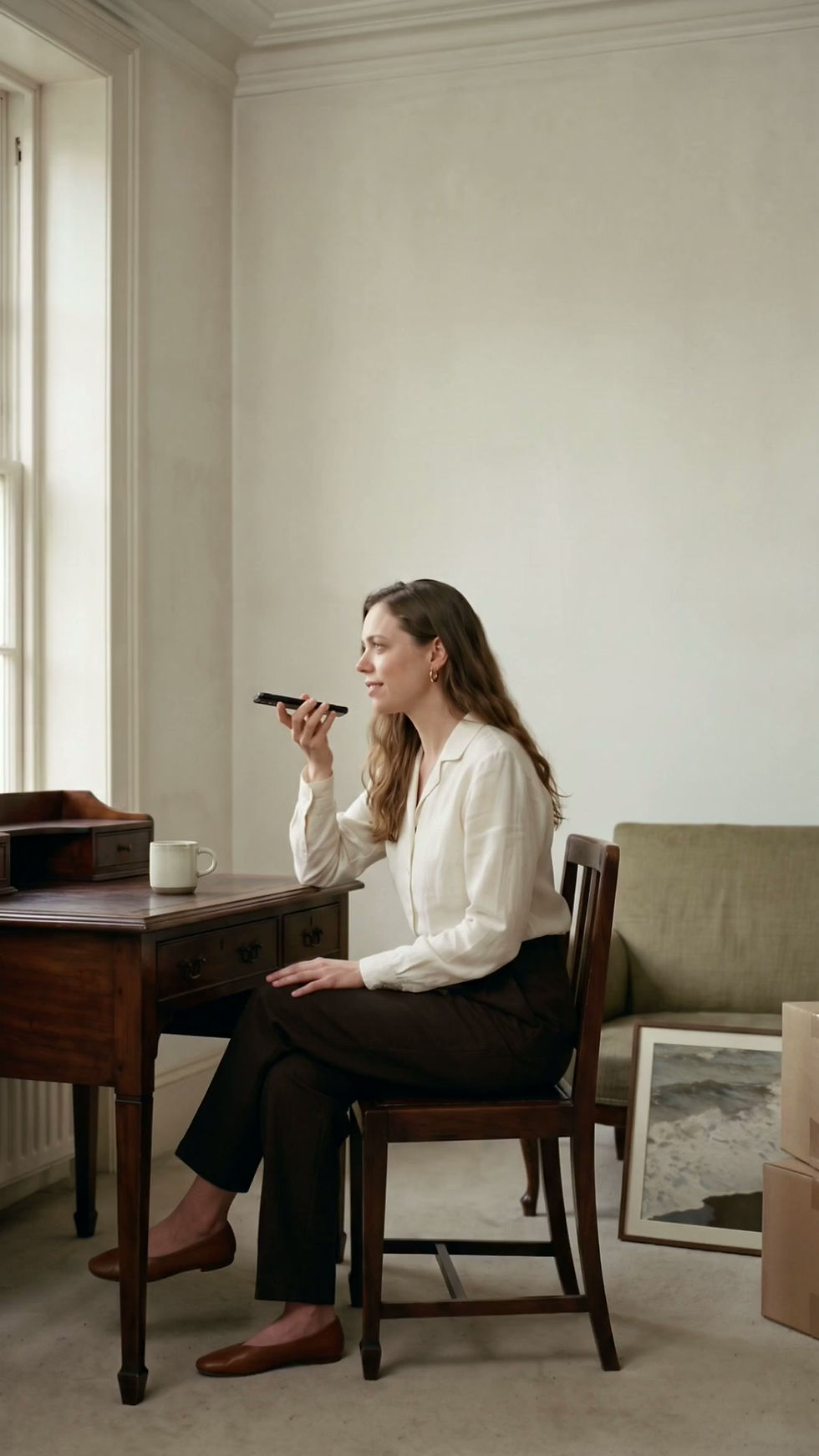
She sits at a wooden desk in a room with the basic grammar of a home: a chair, a cup, a window, a muted green settee. Boxes wait on the floor. A framed picture leans against the wall. She raises her phone and says, “I’m home.”
Then the sentence falters. In Havenest’s short film, the line appears again as something she cannot yet trust. The accompanying social story tells us she deletes it. The room has an address, but belonging has not caught up. That gap—between arriving somewhere and recognizing it as yours—is where "A Woman at the Edge of the Sea" begins to matter.


In This Article
When the Words Do Not Feel True
The most affecting moment is not a dramatic departure or reunion. It is the small pause after a familiar phrase. “I’m home” ought to settle the matter, yet the woman’s expression and the half-unpacked room resist that certainty. Her coat is gone and her cup is on the desk, but the walls have not learned her yet.
A new room can be clean and useful while still feeling borrowed. Furniture establishes function; habits establish belonging. Until those habits form, the room waits for evidence: the book left open, the light switched on at dusk, the picture chosen for recognition rather than efficiency.
The film does not explain where she came from or why the sea image stops her. It should not. Those blank spaces let the scene remain generous. We can read the boxes as a recent move and the unsent message as uncertainty, but we are not asked to mistake that reading for a documented biography. What we see is enough: a person, a room in transition, and an artwork whose surf carries more movement than anything around it.
A Room Waiting for a Memory
Before the picture is placed, the walls are pale and tall. Daylight falls through a narrow window onto dark wood, soft upholstery, and cardboard. Nothing clashes, but nothing quite gathers the room together. The framed coastal work near the desk seems almost like another unopened box.
In this imagined reading, the woman is testing which part of her former life can speak in the new one. The artwork is not a literal record of the room she left. It is a field of sensation: pale water, a dark shore, a solitary body held near something larger. It carries memory without claiming to reproduce one.
A home does not become personal only through photographs or inherited objects. An image we have never lived inside can still give form to a feeling we recognize. The picture’s sea is not “her” sea in any factual sense, yet its pull can stand for distance or return. The artwork gives uncertainty a place to rest.
The Sea as a Place to Return
The film brings the artwork close before it places it on the wall. On the laptop, the surf spreads across the screen. On paper, the same image lies beneath her hands. In a small frame, it becomes an object she can lift and turn. Each step reduces distance: from digital view, to printed surface, to something held.
The sea is especially suited to this movement between distance and intimacy. From afar, it becomes atmosphere—a broad sweep of foam and darker water. Up close, its edges are restless. The coast is both boundary and passage, a line where two conditions continually meet and remake one another. That is an interpretation drawn from the visible composition, not a claim about how the work was made.
For the woman in the film, the shore can be read as a visual counterpart to transition. She is inside a room but not fully settled; the figure in "A Woman at the Edge of the Sea" stands on land while facing water. Neither is simply lost. Both occupy the charged space before certainty.
Belonging does not always arrive as a revelation. It can begin with repetition: looking at the same horizon in morning light, passing it on the way to the desk, noticing how the pale surf changes toward evening. A picture becomes part of a home through repeated encounters.

Reading the Figure at the Water’s Edge
The composition is seen from above, so the shoreline cuts diagonally through the image. White surf occupies much of the field, gathering into irregular bands and broken edges. Darker sand holds the lower side. A small figure stands where the two masses approach, visible because the body is isolated against that broad contrast.
Scale does much of the emotional work. The person is not the largest element, yet the eye finds the figure quickly and returns. The surrounding water makes solitude visible without making it empty. We do not know whether the figure is waiting, remembering, watching, or simply stopping. The scene keeps that question open.
The palette also resists postcard brightness. Cream, gray-green, brown, and softened black keep the image grounded. Foam supplies energy, while the limited color range prevents the movement from becoming noisy. It is an artwork about the sea that does not need blue to announce itself.
This openness belongs to the narrative art explored in Havenest’s essay on Romanticism vintage art and the stories viewers bring to it. A solitary figure before water can hold several emotional truths at once. A strong reading lets visible details—the diagonal shore, the small body, the advancing foam—remain active without closing the story.

One Image, Two Ways of Living With It
Near the end of the film, the woman holds a smaller framed version of "A Woman at the Edge of the Sea" in front of a larger treatment already hanging on the wall. This is not presented as a measurement guide, and no dimensions need to be invented. The comparison is about relationship.
At the smaller scale, the work feels private. Near the desk, the figure and water can be studied from arm’s length. The frame gives the scene a clear edge, like a page from a visual diary encountered during an ordinary task.
At the larger scale, the surf becomes environmental. The diagonal movement stretches across the wall, and the solitary figure remains small within it. Seen above the settee, the image helps the sparse furniture feel connected: dark wood answers the shore, pale walls continue the foam, and the green upholstery draws out the cooler notes in the water.
Neither treatment is inherently better. The smaller one emphasizes closeness; the larger one emphasizes immersion. Before choosing between them, it helps to decide where the viewing will happen. A desk rewards detail at short distance. A wall seen from across a room can support a broader gesture. Havenest’s guide to framing printable wall art offers a practical next step once that relationship is clear.
Letting Coastal Art Shape the Room
The film’s room works because it avoids a themed seaside interior. No anchors, stripes, or shells repeat the subject. Instead, the artwork’s colors guide the materials: warm brown wood, off-white walls, olive upholstery, and soft daylight.
Begin with the picture’s tonal structure rather than its label. The dark shore can relate to walnut or warm black; the foam to plaster, linen, or an unbleached mat; the gray-green water to upholstery or one textile. One or two relationships are enough.
Leave clear wall around the frame so the shoreline remains legible. If the image sits above a low piece of furniture, keep nearby objects below its busiest band of surf. Glare matters too: a side wall or filtered window light may preserve the darker sand and small figure better than direct reflection. For a wider room approach, Havenest’s coastal home decor guide explains how horizons, natural materials, and breathing room can suggest the coast without turning the home into a motif.
Readers who recognize this particular story can view "A Woman at the Edge of the Sea" on Etsy. The invitation is simple: choose the scale and placement that allow the scene to meet your actual room, not an imagined perfect one.

The Story and Stillness We Carry Inward
By the final frames, the furniture has barely changed. The desk is still dark wood. The settee is still green. The room remains lightly furnished. What changes is the relationship among those things. The artwork has moved from the floor to the desk, into a frame, and onto the wall. It has been looked at, handled, compared, and placed.
That sequence makes the title “I’m Home” feel less like a declaration and more like a practice. A room becomes ours through small acts of attention. We decide where to sit. We learn the afternoon light. We choose which image deserves the wall we will see every day.
"A Woman at the Edge of the Sea" does not tell us what happened before the figure reached the shore, or what the woman in the room will say after she lowers her phone. Its stillness protects those unanswered parts. The sea moves; the figure remains; the room waits; the picture holds.
Perhaps home begins there—not when every box is gone, but when one chosen image can carry both where we have been and how we hope to live now. Return to the artwork on Etsy when you are ready to consider which version of that horizon belongs with you.
Words and visual direction by Havenest.


Comments