
The Human Moment Before the Battle: Reading Supper Before the Battle
A battle painting usually wants to show us the moment when history becomes visible: the charge, the smoke, the raised sword, the flag caught in a violent wind. Supper Before the Battle turns its attention elsewhere. It pauses beside the fire, where a young officer is still close enough to the ordinary world to eat.
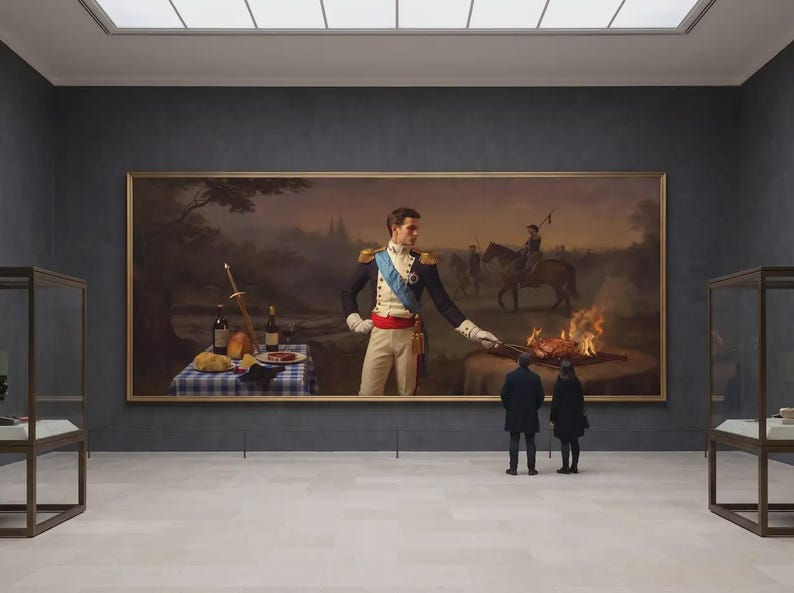
The scene is held in suspension. A checked tablecloth, a glass of wine, a roast, and a small fire occupy the foreground. Behind them, mounted figures move through the dusk, while a distant church anchors the horizon. The battle has not begun, and that is precisely where the painting finds its emotional force.
Supper Before the Battle is an original Havenest artwork inspired by the atmosphere of historical military painting. It is not presented as a documented portrait of a named officer or a specific campaign. Instead, it uses the visual language of military history to ask a more intimate question: what does a person feel when the next morning already belongs to war? For a related reading of emotionally charged historical imagery, see When Reason Was No Longer Enough: The Emotional World of Romanticism.
A painting of the threshold
The most important event in this image is an absence. Nothing is exploding. No horse is rearing in panic. No body has fallen. The officer seems to turn toward the warmth of the fire, caught between the role he must perform and the body that still needs food, rest, and human company.
That threshold gives the artwork a different rhythm from a conventional battle scene. The eye moves from the bright red of the belt and the blue sash, down to the table, then outward through the open land. The composition does not trap the figure inside a heroic emblem. It leaves him exposed to the weather, the distance, and the uncertainty beyond the camp.
Supper Before the Battle — original vintage-style artwork by Havenest.
Why the supper matters
Food may look like a small detail in a military image, but it is never merely decorative. The National Army Museum notes that armies depend on reliable food and plentiful supplies, especially during campaigns. In the late eighteenth and early nineteenth centuries, British soldiers were commonly given two meals a day, with simple provisions such as salted pork or boiled beef and bread. Rations could also include wine or spirits, and the development of preserved food changed how armies moved and supplied themselves.
This practical history makes the table in Supper Before the Battle feel more substantial. The meal is not a sentimental prop placed in front of a handsome officer. It is part of the machinery that allows an army to exist. Yet the painting quietly reverses that machinery: instead of showing food as logistics, it shows food as experience. Someone is about to lift a glass. Someone has prepared a meal. For a few minutes, the human being is visible inside the institution.
The National Army Museum’s account of soldiers eating in camp also reminds us that campaign life was structured around routines that continued under pressure. Cooking, serving, waiting, and sharing were forms of order. The campfire became a small architecture of survival: warmth in the cold, light in the dark, and a reason to sit beside another person before the road began again.

The painting’s central figure stands between military ceremony and an ordinary evening meal.
Uniform and table: two vocabularies in one frame
The officer’s uniform carries the language of command. The sash, epaulettes, belt, and upright posture announce rank, discipline, and public identity. The table speaks differently. Its cloth is checked rather than ceremonial. The meal is arranged for use, not display. The objects are intimate, tactile, and temporary.
Their meeting is the painting’s central tension. The officer is not stripped of his authority, but neither is he allowed to become only a symbol of it. Military history often turns people into ranks, uniforms, and victories. This image gives those signs back to a person who is still capable of hunger, hesitation, and attention.
That is why the work can feel romantic without becoming theatrical. Its emotion comes from the collision of incompatible truths: the figure is prepared for violence, yet he is seated beside supper; he belongs to a disciplined formation, yet the open landscape makes him solitary; he carries the colors of ceremony, yet the fire reduces everything to warmth and shadow.
A panoramic art print designed to let the landscape carry part of the story.
The landscape keeps the story open
The distant riders are important because they are not explained. We do not know whether they are companions, scouts, messengers, or the first signs of an approaching column. The church in the distance does not resolve the story either. It offers a vertical point of orientation, but not a conclusion.
This restraint allows the viewer to enter the scene. A named battle would close the imaginative field around a particular date and political cause. An unnamed horizon does the opposite. It turns the painting into a vessel for many kinds of waiting: the night before departure, the moment before a difficult conversation, the last ordinary meal before a life changes shape.
The wide format strengthens that openness. Instead of compressing the composition into a portrait or a square historical vignette, the panorama lets the officer remain small within the world around him. The land is not background decoration. It is the space that measures his vulnerability.

Warm ember tones bring a small human pause into the room.
A Romantic tension between ceremony and vulnerability
The visual mood belongs to a long Romantic tradition in which landscape carries psychological pressure. Darkness, distance, firelight, and weather do not simply describe a location; they make the inner state of the figure legible without giving it a speech. The scene suggests uncertainty, but it does not dictate whether the officer is brave, afraid, resigned, or simply tired.
That ambiguity matters. A more conventional heroic image might tell us how to admire its subject. Supper Before the Battle asks us to stay with him before admiration begins. The pause is not weakness. It is the condition that makes courage, fear, duty, and loss recognizable as human experiences rather than abstract words.
Havenest often approaches historical-looking imagery through this emotional doorway: not as a reconstruction claiming perfect documentary accuracy, but as a story-rich image that gives a room something to wonder about. You can continue with Circle of Poets: When Literary Art Becomes a Gathering Place for another example of art built around atmosphere, character, and implied narrative.

The artwork’s old-world palette pairs naturally with dining rooms, studies, and libraries.
How the artwork lives in a room
Because the composition is panoramic, it works especially well where a long horizontal line can settle into the architecture: above a dining table, along a library wall, over a sideboard, or in a study with shelves and dark wood. Its earthy palette of umber, charcoal, cream, muted blue, red, and ember-gold can sit comfortably beside walnut, linen, aged brass, leather, and warm neutral paint.
The image does not need a room filled with military objects around it. In fact, a quieter setting gives the painting more space to breathe. Pair it with simple ceramics, a restrained frame, or a single lamp with warm light. The goal is not to decorate a room as a battlefield. It is to create a room where the contrast between public history and private life can be felt.
The listing includes a high-resolution digital download with an original panoramic ratio of approximately 7:3, alongside 2:1, 16:9, and 3:2 versions for different printing needs. The master file is supplied at approximately 22,000 × 9,429 pixels, allowing the work to hold its presence across a wide range of large-format applications. The product is digital only; no physical frame or print is shipped.
A small meal before a large unknown
The power of Supper Before the Battle does not come from showing us the battle. It comes from protecting the last fragile moment before it arrives. The fire is still burning. The food is still warm. The uniform still looks composed. Somewhere beyond the edge of the frame, history is gathering speed, but here, for a little longer, a person can sit down.
That is the kind of historical romance this artwork offers: not nostalgia for war, and not a polished fantasy of command, but an attention to the ordinary human rituals that survive inside extraordinary circumstances. A supper. A glass. A turn of the head. The brief knowledge that tomorrow will ask for something different.
If this is the kind of artwork that belongs in your home, you can view Supper Before the Battle on Etsy. It is available as a personal-use digital download for printing at home, through a local print shop, or with a professional canvas printer.
Research sources
Interpretive observations in this article are based on the artwork’s visible composition and are not presented as documented artist intention. For more Havenest art stories, visit the Havenest Wall Art journal.
Comments