"The Emerald Heir": A Portrait of Inheritance, Silence, and Becoming
Updated: Aug 26
Some portraits introduce themselves with a name. Others begin with a question.
In "The Emerald Heir," a young figure stands before a field of stained glass, dressed in emerald velvet, white ruffles, and a black ribbon tied close at the throat. The pose is composed, almost ceremonial. Yet the gaze carries a quieter tension: the feeling of someone who has inherited a role before deciding whether it truly belongs to them.
The story below is an imagined narrative inspired by the artwork's visible details. It is not a claim about the subject's identity, the artist's intention, or the portrait's historical provenance. It is simply one possible doorway into the mood the image creates.

Original artwork: "The Emerald Heir."
In This Story
Before the Door Opens
The house had been awake since before dawn. Somewhere below, silver was being counted, flowers were being arranged, and a fire was coaxed into life beneath a mantel carved with names no one living could remember. The corridors carried every small sound upward: a latch closing, a chair drawn back, the soft verdict of footsteps on stone.
At the end of the eastern gallery, the heir waited alone.
No crown rested nearby. No document lay open for a signature. The ceremony awaiting them was simpler and therefore harder: they would enter the great room, stand beneath the family crest, and receive a hundred practiced expressions from people who believed they already knew the person before them.
The green coat had been chosen by someone else. It fit perfectly. That was part of the trouble.
A servant had said the color made the heir look certain. An aunt had said it recalled spring on the old estate. The tailor had spoken of lineage, tradition, and the dignity of velvet. No one had asked what it felt like to wear a history cut to another person's measurements.
Beyond the door, conversation gathered like weather. The heir turned instead toward the window, where morning passed through colored glass and broke itself into blue, ruby, and green.
The Weight of Green

Green had always meant two things in the house. To the gardeners, it meant patience: hedges trained over decades, seeds sleeping beneath winter soil, moss returning to stones no matter how often it was brushed away. To the family, green meant continuity. It appeared in seals, upholstery, ribbons, and the oldest painted rooms.
But standing there, the heir discovered a third meaning. Green could be unfinishedness.
The velvet sleeve caught the light when they lifted a hand. For a moment the fabric did not look like an emblem of authority. It looked like a field before planting, a page before the first sentence, a life not yet decided. Perhaps inheritance was not a finished script after all. Perhaps it was material: heavy, costly, beautifully made, and still capable of being recut.
The heir remembered a lesson from childhood. A tutor had placed a polished stone in one palm and a seed in the other. The stone, he said, would remain itself. The seed would be changed by everything it met: darkness, water, weather, time. At twelve, the heir had admired the stone. Now, facing the door, they understood the courage of the seed.
They adjusted the black ribbon at the throat. The gesture was small, but it belonged entirely to them.
What the Stained Glass Keeps

The window behind the heir had survived three generations of renovations. Its makers were unnamed in the family records, though their decisions remained everywhere: which red should burn brightest, where blue should cool the pattern, how a lead line could turn fragility into strength.
Light did not pass through the glass unchanged. That was its gift.
The heir studied the colored shapes and imagined each pane holding a version of the future. In one, duty became obedience and the years narrowed into rooms like this one. In another, refusal became exile. In a third, less dramatic and more difficult, tradition and selfhood learned to share the same house.
There would be no single brave speech that settled everything. Real change rarely arrived with the timing of theatre. It would live in choices repeated quietly: whose counsel to hear, which customs to keep, what doors to open, and when to say that an old answer was no longer enough.
A bell sounded below.
The heir did not move at once. They watched the stained glass lay its colors across the floor. Then they stepped forward, not out of certainty, but with the steadier knowledge that uncertainty could be carried. The future did not have to be inherited whole.
A Portrait About Becoming
"The Emerald Heir" feels compelling because it lets composure and vulnerability occupy the same frame. The formal clothing suggests expectation, while the youthful face keeps the image open. We can read confidence there, but also hesitation; privilege, but also pressure; beauty, but also the private work of becoming a person beneath a title.
The stained glass deepens that tension. It creates a setting that feels ceremonial without fixing the scene to a documented event. Color becomes emotional architecture: emerald for growth and inheritance, blue for inwardness, red for the urgency of choice. This interpretation is imaginative rather than historical, but it offers a way to linger with the portrait instead of only passing by it.
A portrait like this can change the emotional temperature of a room. It brings presence without spectacle. The subject does not perform for the viewer; the stillness asks the viewer to come closer. That makes the piece especially suited to spaces built around reading, conversation, reflection, and collected objects.
Bringing "The Emerald Heir" Home
In a library or reading room, let the portrait hold its own wall above a writing desk, narrow console, or low bookcase. Deep walnut, dark oak, aged brass, and shaded lamps echo its old-world mood, while cream paper, pale linen, or a restrained blue-gray wall prevents the composition from becoming too heavy.
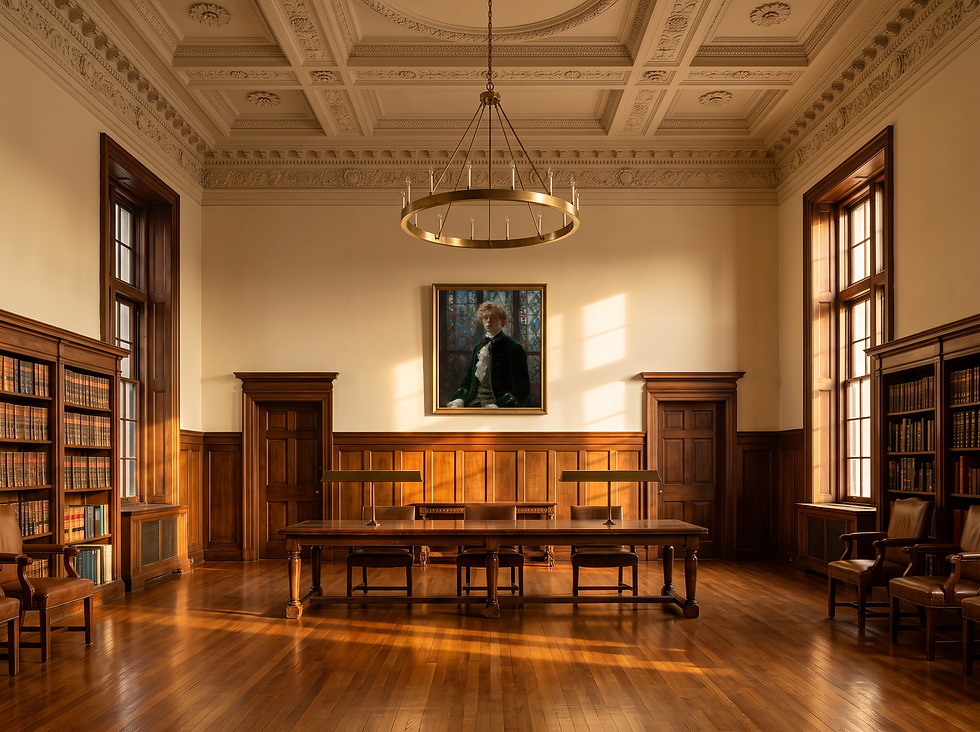
For a more traditional arrangement, surround the artwork with books, ceramics, and objects that look gathered rather than purchased as a set. The portrait already carries strong color, so the room does not need many competing accents. Repeat emerald once or twice—in a cushion, a small glass vessel, or the spine of a book—and allow the stained-glass blues and reds to remain special.
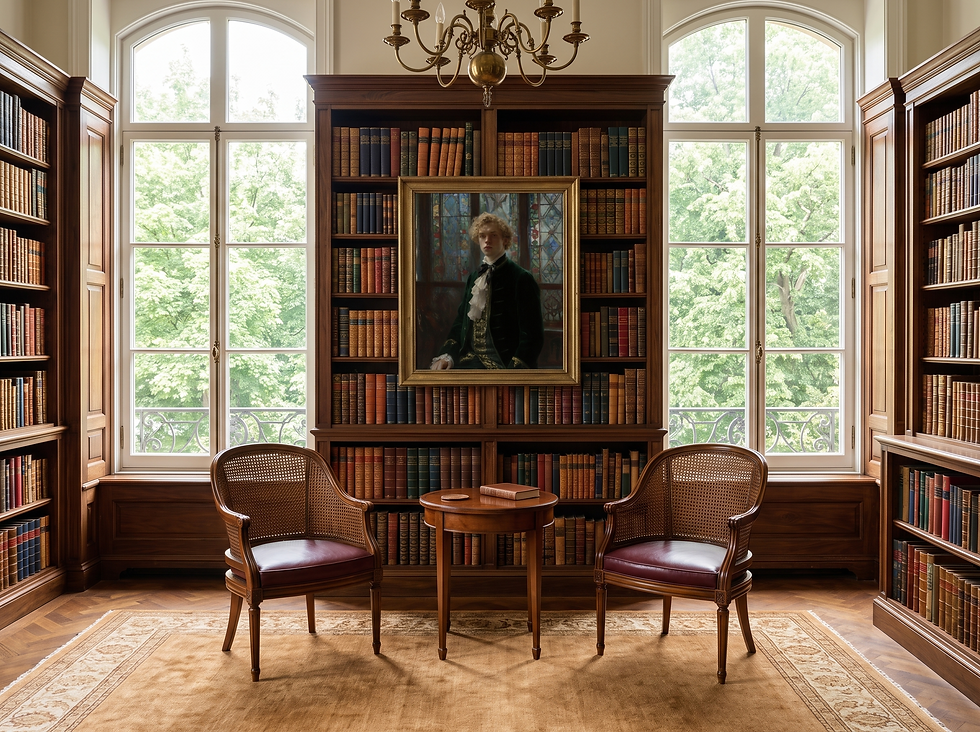
The work can also live beautifully in an eclectic room. Plum walls, green velvet, patterned textiles, and vintage wood create a layered setting, but balance is essential. Give the portrait breathing room and keep the frame profile simple enough that the face remains the first thing the eye discovers.
If you are shaping a broader gallery wall, Havenest's vintage art styling guide offers a useful starting point. You can also browse the Havenest Art Curation journal for more artwork-led rooms and stories.
Print, Frame, and Live With It
Because this is printable wall art, the final atmosphere depends on paper, scale, and framing. Matte fine-art paper softens glare and supports the velvety greens; lightly textured stock can add a tactile, archival feeling. If you prefer cleaner detail and sharper stained-glass color, a smooth heavyweight matte paper is a strong choice.
Before ordering a print, compare the options in this guide to choosing paper for printable wall art. For another example of story-led vintage art, read "Bread for the People".
A dark wood or antiqued gold frame will emphasize the portrait's historical character. Black creates a more graphic edge; a narrow warm-wood frame feels quieter and contemporary. Add a generous ivory mat for a smaller print, or let a larger print sit closer to the frame when you want the figure to feel immediate.
Most of all, place the artwork where its gaze can participate in the room. Across from a reading chair, near a desk, or at the turn of a hallway, "The Emerald Heir" rewards repeated encounters. On one day it may seem assured; on another, questioning. That change is not inconsistency. It is what makes a portrait continue to live.
Explore the printable artwork "The Emerald Heir" on Etsy and choose the size that fits your space.
Words and visual direction by Havenest.
Comments