Bread for the People: The Queen Who Opened the Granary
The winter had not yet arrived, but the fear of it already lived in every doorway.
After a failed harvest, the price of grain rose before the leaves had finished falling. Bakers cut their loaves smaller. Mothers learned how to make soup from almost nothing. In the market, people touched coins inside their pockets and put them back without buying. Hunger did not announce itself with drama at first. It entered softly, through thinner meals, longer silences, and children asking for bread twice.
Inside the palace, the royal granary remained full. Its doors were barred, its ledgers signed, its stores counted by men who understood numbers better than faces. To the council, those sacks of wheat were not food yet. They were strategy. Insurance. Protection against a longer winter.
But this is where the story inside Bread for the People begins: not with abundance, but with the question of what abundance is for.

In this article
01. A failed harvest and a locked granary
02. The queen’s decision
03. Bread given by hand
04. Dignity in the street
05. The inspiration behind the artwork
06. Why this vintage wall art belongs in a home
A Failed Harvest and a Locked Granary
By the time the first frost touched the roofs, the city had begun to divide itself into two worlds. In one, fires were lit early, tables remained polished, and servants still carried silver trays through candlelit corridors. In the other, bread became an object people counted before they ate.
The queen heard the reports in a chamber lined with portraits of rulers who had survived wars, treaties, betrayals, and famines. Around her stood scholars, ministers, estate holders, and military men. Each had a reason to wait. Each reason sounded responsible.
If the winter became severe, the palace would need its stores. If the roads froze, new grain might not arrive. If the people grew desperate, the crown would need leverage. The advice came dressed as wisdom: keep the granary closed. Protect the throne first. Charity could come later, when it was safer.
The queen listened. She did not interrupt. Perhaps that is why the room mistook her silence for agreement.
Outside the palace gates, the city waited without knowing it was being discussed.
The Queen’s Decision
At dawn, before the court had fully gathered and before the official announcement could be shaped into ceremony, the queen gave an order that unsettled everyone who heard it.
Open the granary.
Not a symbolic cart. Not a display for one neighborhood. Not a handful of loaves thrown from a balcony to prove the crown had a heart. The granary was to be opened, counted, carried, and distributed. The scholars were ordered to bring their ledgers. The officials were told to write down every household. The guards were sent not to control the crowd, but to protect the food until it reached the people it was meant for.
This was not a token gesture. It wasn't a spectacle for a single neighborhood. It wasn't a few loaves tossed from a balcony to show the crown's compassion. The granary was to be unlocked, the contents inventoried, transported, and shared. Scholars were instructed to bring their records. Officials were tasked with documenting every household. The guards were dispatched not to manage the crowd, but to safeguard the food until it was delivered to those intended to receive it.
This was not mercy as performance. It was mercy made practical.
Some ministers objected. A ruler, they argued, should not appear in the street among hunger and disorder. A queen should be seen from above, framed by stone, velvet, and distance. Compassion was acceptable, but proximity was dangerous.
She answered by removing the distance.
Bread Given by Hand

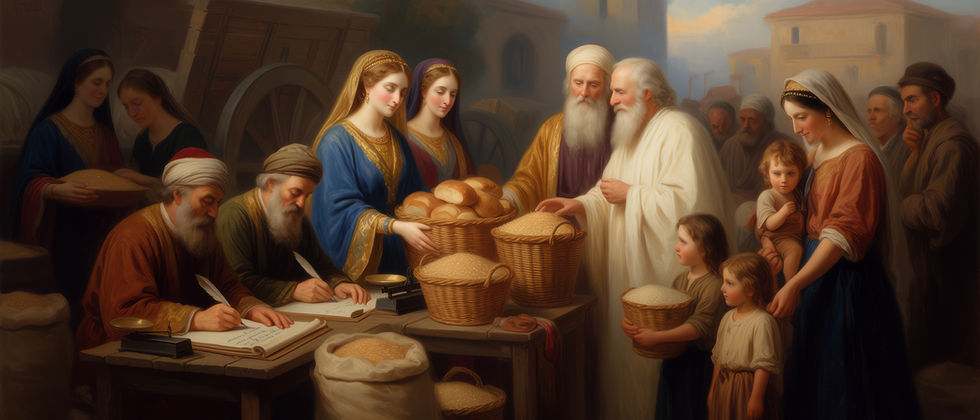
In the painting, this is the moment we are invited to imagine: the queen standing among the people, not above them. The air is cool. The street is crowded but not chaotic. Baskets of grain sit near the officials. Loaves are stacked with the plain beauty of things that matter.
The first bread is not handed to a noble family or a priest or a favored merchant. It is given to those who need it most. A mother. An old man. A child whose hunger has made him too serious for his age. Behind them, others wait with the fatigue of people who have learned not to expect tenderness from power.
The queen does not wear her authority like armor. She bends slightly. Her hand extends. The bread passes from one life to another.
That gesture is the center of the artwork. Everything else — the garments, the stone street, the officials, the gathered crowd — exists to hold that exchange in place. A loaf of bread becomes the visual language of survival. A royal order becomes human when it touches a human hand.
This is what makes Bread for the People more than historical decor. As vintage wall art, it carries the feeling of an old-world scene, but its emotional force remains immediate. It asks a question every age understands: what should power do when people are hungry?
Dignity in the Street
The most moving part of the story is not simply that the queen gives bread. It is how the people receive it.
They do not collapse into worship. They do not kneel as if their hunger has made them smaller. The queen does not sit on a throne. She does not perform pity from a safe height. In this brief meeting, rank does not disappear, but something older than rank rises to the surface.
Need makes them equal. Bread makes that equality visible.
The officials beside her continue their work. Names are written. Families are counted. Grain is weighed. The relief is not allowed to become a single beautiful morning that the palace can later remember with pride. It becomes a system. A promise with structure. Compassion, if it is real, must survive beyond the first gesture.
That detail matters. It gives the imagined scene moral weight. The queen is not only generous; she is responsible. She understands that hunger cannot be solved by emotion alone. Bread must reach the right hands today, and again tomorrow, and again when the snow comes.
The Inspiration Behind the Artwork

"Bread for the People" feels inspired by the emotional world of Romanticism, where atmosphere, humanity, and moral tension matter as much as historical accuracy. The painting does not need to document a real queen or a named famine to feel true. Its truth belongs to feeling: the fear of scarcity, the courage to share, the grace of meeting suffering directly.
There is also something deeply old-world in its imagination. The palace, the granary, the public square, the gathered citizens — these belong to a visual language we associate with European vintage art and historical painting. But the heart of the work is not nostalgia. It is recognition.
We recognize the argument between self-protection and generosity. We recognize the temptation to keep the doors closed. We recognize the rare beauty of someone powerful choosing to step closer instead of retreating behind protocol.
That is why the artwork has such a strong place within a Havenest collection. It is not decorative because it is ornate. It is decorative because it gives a room emotional depth. It brings story, warmth, and a sense of human consequence to the wall.
Why This Vintage Wall Art Belongs in a Home

A home is not only shaped by furniture, color, and light. It is shaped by the stories we allow to live there. Some pieces make a space feel polished. Others make it feel inhabited by memory.
Bread for the People belongs to the second kind. It can bring depth to a dining room, where bread and gathering already carry meaning. It can soften an entryway with a note of welcome. It can sit above a console, near books and candlelight, and give the room the feeling of a story paused mid-sentence.
As vintage wall art, it works beautifully in interiors that love patina, layered neutrals, antique frames, old books, linen, ceramic vessels, and warm wood. But the reason to choose it is not only aesthetic. The reason is emotional. This is a piece about what it means to have enough — and what it means to share from that place.
In a world often obsessed with display, this artwork remembers service. In a room full of beautiful things, it asks for something deeper than beauty: tenderness with backbone.
CTA Box: Bring home a piece that remembers what kindness can look like — discover Havenest vintage wall art at https://havenest.etsy.com/
A Gentle Styling Note

This story-led piece does not need a complicated setting. Let it breathe with materials that feel natural, aged, and sincere.
Choose antique gold, walnut, dark wood, or a slim black frame.
Pair it with linen, ceramics, old books, bread boards, brass, or woven textures.
Place it where gathering happens: a dining room, kitchen nook, entryway, or reading corner.
Avoid overly glossy styling; the artwork carries more grace when the room feels lived-in.
Bread for the People is a painting about a door opening.
A granary door. A palace door. Perhaps even the small guarded door inside the human heart that decides whether safety means keeping everything, or sharing before fear has the final word.
The queen in this story does not become powerful because she owns the bread. She becomes unforgettable because she gives it with her own hands. And the people do not become worthy because she chooses them. They were worthy before she arrived.
That is the grace of the scene. Bread is passed. Names are written. Hunger is met without humiliation. For one morning in the street, power remembers its highest purpose: to protect life.
Find vintage wall art with story, warmth, and soul at https://havenest.etsy.com/
Comments