
Flowers at the Edge of Time: Rachel Ruysch and the Drama of the Botanical Still Life
Rachel Ruysch’s bouquets contain a small impossibility. Roses, tulips, poppies, morning glories, insects, fruit, and leaves appear together with such confidence that the arrangement feels freshly gathered. Yet the flowers do not belong to one season. The bouquet is assembled from time.
That tension gives Ruysch’s still lifes their drama. They are beautiful because they are precise, but they are moving because precision cannot stop a petal from opening, browning, or falling. Beneath the abundance is a quiet argument about beauty and duration.
A bouquet that could never exist in one season
The Rijksmuseum notes that Ruysch’s floral arrangements bring together species that flower at different times, making the bouquet difficult to assemble in ordinary life. This is not a failure of realism. It is the point at which observation becomes composition.
Ruysch studied living and prepared flowers closely, then arranged them according to the demands of the picture. A stem can bend toward an opening in the darkness; a pale blossom can interrupt a mass of red; a butterfly can create a small, alert movement near the edge. The bouquet is invented, but every invention is disciplined by looking.
Botanical knowledge and painterly invention
Ruysch grew up in a household where art and science were closely intertwined. Her father, Frederik Ruysch, was a professor of anatomy and botany in Amsterdam, taught at the Hortus Botanicus, and assembled botanical, zoological, and anatomical specimens. The Rijksmuseum records that she studied flora and fauna in his collection, visited the Hortus Botanicus, consulted botanical books and prints, and made drawings as preliminary studies for her paintings.
But botanical accuracy does not make the paintings dry. Ruysch uses knowledge to intensify wonder. The more specifically a flower is seen, the more fragile its presence becomes.
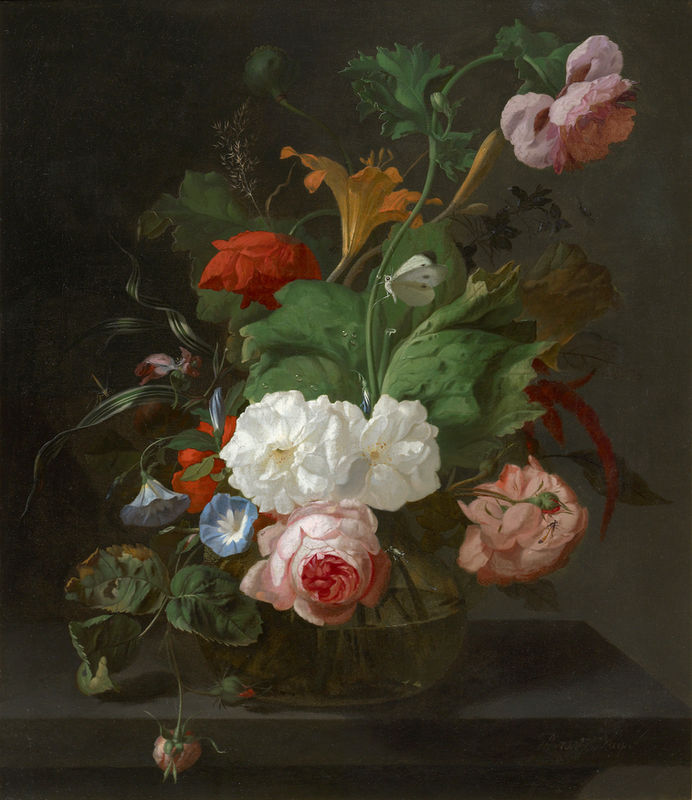
Rachel Ruysch, Flowers in a Glass Vase, circa 1700. Oil on canvas. Mauritshuis. Public-domain artwork reproduction via Wikimedia Commons.
Beauty, luxury, and vanitas
Ruysch’s bouquets belong to a culture that valued flower painting as a display of refinement, knowledge, and wealth. The Metropolitan Museum of Art places her work within a Northern European still-life tradition where imported fruits, porcelain, glass, and flowers made abundance visible to collectors. Exotic or difficult-to-grow flowers could signal access to collections, gardens, and global trade. The polished surface of the painting made abundance portable.
At the same time, the arrangement carries the logic of vanitas. In its entry for Vase with Flowers, the Mauritshuis describes a bouquet already past its best: flowers droop and fade, while a wilted opium poppy has been cut from the center. The empty space gives the composition depth, but it also makes change visible. A flower can be most beautiful at the precise moment it begins to disappear. Luxury and mortality share the same table.

Rachel Ruysch, Flowers in a Terracotta Vase, and Fruit, on a Stone Parapet, circa 1700. Oil on canvas. Fitzwilliam Museum. Public-domain artwork reproduction via Wikimedia Commons.
Why Ruysch’s flowers feel alive
The liveliness comes from irregularity. No two blossoms open in exactly the same direction. The bouquet rises, leans, and spills rather than settling into a perfectly symmetrical emblem. Dark backgrounds sharpen the contrast, but they also create the sense that the flowers are emerging into view at different speeds.
Ruysch understood that the eye does not experience a bouquet all at once. We move from a bright bloom to a curled leaf, from a butterfly to the shadow beneath a petal. The painting rewards this wandering attention. Its richness is sequential.
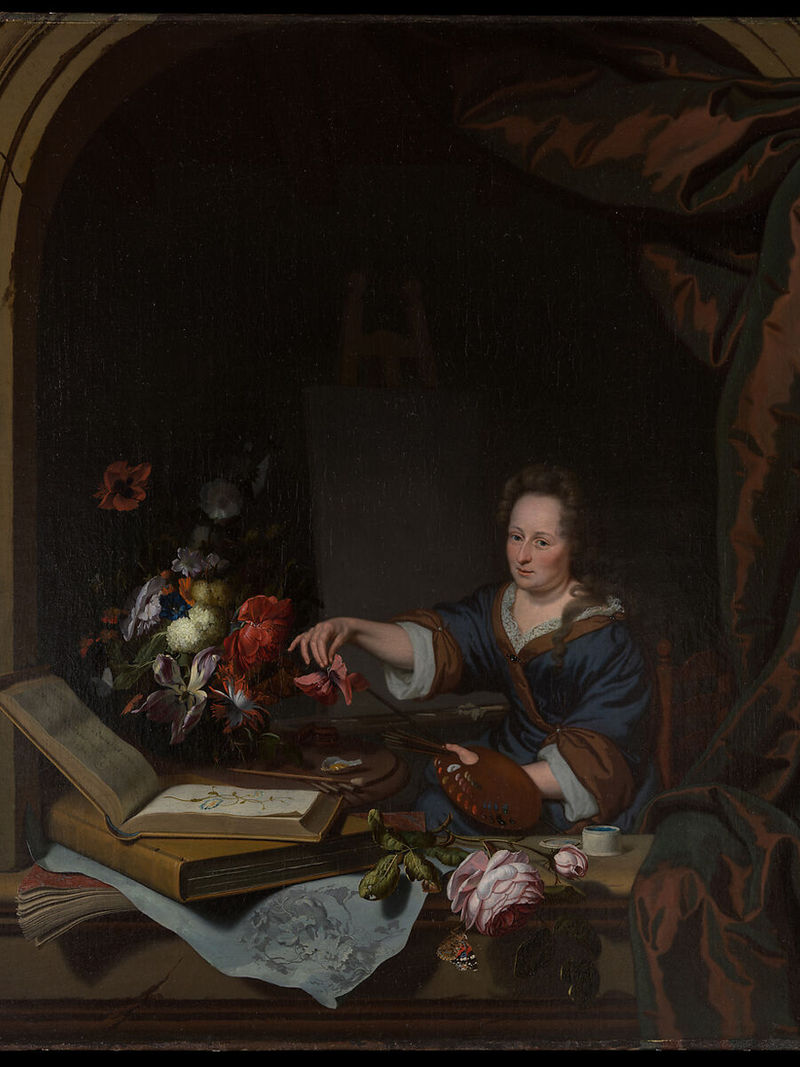
Rachel Ruysch, 1692, in collaboration with Michiel van Musscher. Oil on canvas. The Metropolitan Museum of Art, New York.
A woman painter who refused to disappear
Ruysch’s success was unusually visible in her own lifetime. The Metropolitan Museum of Art records that her career attracted royal patronage, high prices, and sustained praise across more than six decades. She was appointed court painter to the Elector Palatine and continued working after marriage and motherhood.
Her story matters because the paintings have sometimes been treated as anonymous decoration: beautiful surfaces detached from the person who made them. Looking carefully restores the artist’s agency. These flowers are not passive ornaments. They are evidence of a painter who built authority through knowledge, precision, and a style instantly recognizable as her own.
Her professional authority was not measured by prices alone. The Rijksmuseum notes that in 1701 Ruysch became the first woman admitted to Confrerie Pictura in The Hague, where one of her floral still lifes was praised as the most beautiful work on display. In 1708, Johann Wilhelm, Elector Palatine, appointed her court painter; she remained in Amsterdam and sent the court one painting each year. Her career had room for domestic life and international patronage, a balance that makes the word “decorative” feel far too small.
Bringing Baroque botanical drama into contemporary rooms
Ruysch’s work can anchor a dining room, study, or moody bedroom because it combines darkness with concentrated color. Let the surrounding space stay restrained: antique wood, olive or warm plaster walls, and a small amount of reflective light are enough. The painting already contains its own abundance.
For another perspective on how artists make stillness visible, read “The Painters Who Made Stillness Visible”. To think about the relationship between artwork and room, continue with “How to Choose Wall Art for a Calm Living Room”.
Research sources
Alex, Holland, and Louis from Havenest Studio
Comments