When Mountains Meet the Sea: Hokusai, Hiroshige, and the Japanese Landscape
A mountain and the sea seem to belong to opposite kinds of time. The mountain appears to hold still; the sea is always arriving, breaking, withdrawing, and beginning again. Yet in Japanese landscape prints, they are often placed in the same visual conversation. One gives the horizon a fixed point. The other keeps the world in motion.
Hokusai and Hiroshige understood that landscape becomes emotionally powerful through relationships: a distant peak and a passing wave, a small boat and an enormous sky, a traveler and a shoreline that continues beyond the frame.
This essay follows that relationship through Hokusai's Thirty-six Views of Mount Fuji and Hiroshige's coastal landscapes. It asks why Fuji can become a tiny triangle, why the sea can feel almost architectural, and how a woodblock print turns geography into a meditation on scale, movement, and attention.
Fuji Is a Mountain, a Measure, and a Memory
Mount Fuji is the quiet constant behind much of this visual world. The Metropolitan Museum of Art describes Hokusai's Thirty-six Views of Mount Fuji as a series devoted to Japan's most sacred mountain. But Hokusai does not give us one final Fuji. He lets it appear from different distances, seasons, weather conditions, and social situations.
In one image, Fuji dominates the horizon. In another, it is partly hidden by cloud. In another, it becomes so small that the surrounding activity seems to make a joke of its grandeur. This variety is the point. A mountain is not experienced only as height. It is experienced through changing relations: what stands between us and it, and what we are doing when we happen to see it.
That idea continues the questions explored in Japan at Sunset: Hiroshige and the Art of Vanishing Light where light changes the emotional status of a place. Here, distance and scale perform a similar transformation.
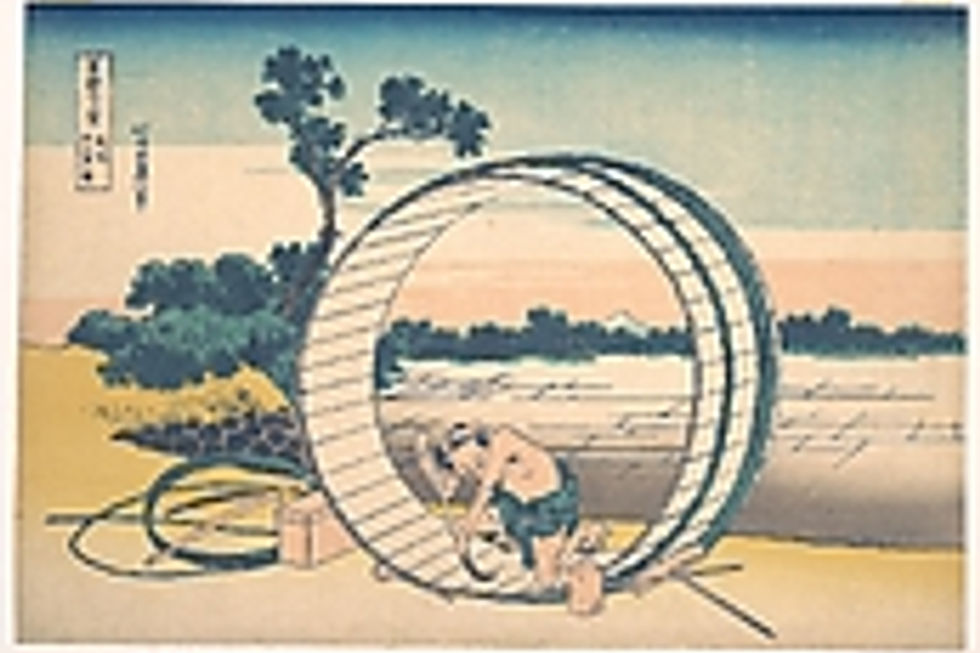
Katsushika Hokusai, Fujimigahara in Owari Province (Bishū Fujimigahara) - View source
The Great Wave: When the Sea Takes the Foreground
In Under the Wave off Kanagawa, commonly called The Great Wave, Hokusai makes the sea the immediate event. A curling wave rises across the image like a living wall, its white crest breaking above three narrow boats. Fuji appears low in the hollow of the wave, small but unmistakable.
The composition refuses a simple opposition between nature and human beings. The boats are fragile, but they are also moving with purpose. The wave is enormous, but it is constructed with deliberate line, color, and rhythm. The scene feels dangerous because every form is in motion, yet the print itself is intensely controlled.
The Met's technical study explains that the famous blue depends on both indigo and imported Prussian blue, including passages printed more than once to deepen the color. The saturated blue helps the sea become material: not a transparent space behind the boats, but a dense force with its own surface and weight.

Katsushika Hokusai, Fine Wind, Clear Morning, also known as Red Fuji - View source
Fuji is not simply the subject that the wave overwhelms. It is the still measure that allows the wave's scale to become legible. Without the mountain, the sea would be dramatic. With it, the image becomes a question about how something ancient and apparently immovable can occupy the same world as a single instant of danger.
A Small Mountain Can Hold a Large World
Hokusai's Umezawa Manor in Sagami Province offers the opposite emotional register. The Met describes its undulating hills, soft clouds, and blue waters as an image of tranquillity, almost without human reference. The sea is calmer here, but the print is not empty. Its emptiness is carefully organized.

Katsushika Hokusai, Umezawa Manor in Sagami Province - View source
The low bands of land and water lead the eye toward Fuji, whose pale triangular form is almost absorbed into the atmosphere. This is a mountain seen through distance rather than approached as an object. It becomes a measure of the air between the viewer and the horizon.
The effect is intimate despite the panoramic setting. Because there are so few human figures, the viewer becomes the traveler. We are not watching someone else's encounter with the landscape; we are placed inside the interval of looking. The mountain does not demand attention. It waits for it.
Weather Is the Third Element
Between mountain and sea, weather creates a third space. Snow, mist, wind, and rain alter the relationship without changing the geography. The same Fuji can feel close in clear air, distant in haze, or almost imagined beneath a storm.
In Morning after the Snow at Koishikawa in Edo, a small group looks out from an elevated teahouse after a snowstorm. The Met identifies the snowy Fuji beyond the Edo River. The scene is social as well as scenic: people gather, pause, and share a view.
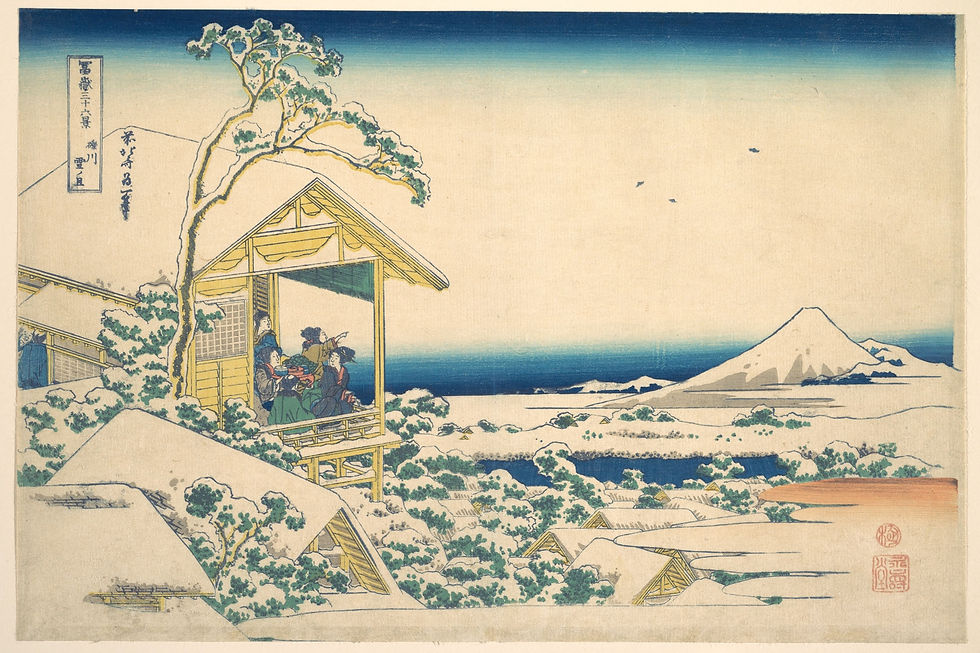
Katsushika Hokusai, Morning after the Snow at Koishikawa in Edo - View source
The mountain's distance gives the figures a reason to look outward, while the teahouse gives the viewer a place from which to look. Landscape is not an escape from ordinary life. It is an activity within ordinary life: something encountered while resting, traveling, working, or waiting for the weather to clear.
This is one of Hokusai's most perceptive ideas. Landscape is not a passive backdrop to human experience. It shapes behavior. It creates pauses. It organizes people around a shared horizon, even when the mountain itself remains unreachable.
Hiroshige and the Sea as a Road
Hiroshige approaches the relationship differently. In coastal scenes, the sea often functions as a route rather than a spectacle. It connects stations, villages, boats, and travelers. The shoreline is not an ending; it is a line of movement.
In The Hoda Coast, from Hiroshige's own Thirty-six Views of Mount Fuji, figures move along the shore while Fuji rises beyond the water. The composition joins three scales: the bodily scale of walking, the horizontal scale of the coast, and the distant vertical scale of the mountain.

Utagawa Hiroshige, The Hoda Coast, from Thirty-six Views of Mount Fuji - View source
The sea is therefore not simply vast or threatening. It is lived space. People cross it, work beside it, travel along it, and measure their journeys against it. Hiroshige's landscape is attentive to the human geography of a view: the roads, coastlines, and small movements that make a place inhabitable.
The mountain and sea belong together because the sea gives the traveler a path while Fuji gives the path a destination that may remain distant. Between them is the experience of moving through the world.
Ejiri: Wind Makes the Landscape Visible
In Hokusai's Ejiri in Suruga Province, the relationship between land, air, and distance becomes almost comic. The wind catches the travelers' clothing and sends papers flying. The figures bend and struggle while Fuji remains calm in the background.

Katsushika Hokusai, Ejiri in Suruga Province - View source
The mountain is stable, but the world around it is not. Hokusai turns invisible air into visible action through diagonal lines, lifted garments, and scattered sheets. The landscape is not only what can be seen; it is also what can be felt against the body.
The sea often makes movement visible through waves and boats. Wind makes movement visible through people. In both cases, nature is understood relationally. We recognize the force because it changes something else. There is humor in the travelers' predicament, and humor keeps the scene human-sized.
The Woodblock Print Makes Distance Portable
The connection between mountain and sea also belongs to the history of ukiyo-e. The Met explains that landscape prints brought famous places and travel routes to a broad audience. A view could be collected, carried home, and encountered repeatedly in an interior far from the original site.
This portability changes how we understand the image. The print is not simply a substitute for geography. It is a rehearsal of looking. It teaches the viewer how to move between foreground and distance, between a wave's edge and a mountain's silhouette, between the lives of small figures and the scale of the world around them.
That is why these works continue to feel alive. They do not offer one final meaning for nature. They offer a visual method: place something immense beside something vulnerable, then let the viewer decide where attention should rest.
Why Mountains and Sea Still Belong Together
The enduring power of these landscapes comes from their refusal to separate stillness from movement. Fuji is not simply permanence, and the sea is not simply change. The mountain is seen through weather, distance, labor, travel, and memory. The sea is given shape by boats, shores, storms, and the horizon it shares with Fuji.
In a room, this kind of image can create a similar balance. A mountain gives the eye a point of rest. Water carries the gaze across the frame. A small figure or boat restores human scale. The composition becomes a conversation between grounding and release: between the desire to remain and the knowledge that everything is moving.
The broader story of landscape art continues in The French Landscape: How Forests, Fields, and Light Became Art where forests and fields become subjects through a different history of looking. Hokusai and Hiroshige remind us that a landscape does not need to be still to offer rest. Sometimes rest comes from watching the world move in a form large enough to hold us.
Research Sources
The Metropolitan Museum of Art - Umezawa Manor in Sagami Province and Morning after the Snow at Koishikawa in Edo.
Interpretive observations are based on the visible composition of the prints and are not presented as documented statements of artist intention.
Comments