Large Horizontal Wall Art Above a Sofa: A Calm, Practical Guide
Large horizontal wall art above a sofa solves a real visual problem: it gives a long piece of furniture an equally confident counterpart. Done well, the artwork and sofa read as one composition. Done poorly, even an expensive print can appear stranded near the ceiling—or reduced to a postage stamp floating over three seats.
The quick answer is to begin with proportion, then correct by eye. A useful starting point is artwork measuring roughly two-thirds to three-quarters of the sofa’s width, with the bottom of the frame about 6 to 10 inches above the sofa back. Those numbers create connection, but they are not a substitute for looking at the actual wall.
This guide explains how to measure, choose a horizontal composition, select a frame and prepare a printable landscape so the artwork remains the focus. The sofa provides the anchor. It does not get to audition for the leading role.
In This Article
Start With Proportion, Not Wall Size
The full wall is rarely the right reference point. The sofa defines the visual zone, so measure the furniture first. Artwork sized only against a wide wall often ends up disconnected from the seating beneath it.
For a single horizontal piece, designers commonly begin around two-thirds of the sofa width; some extend toward three-quarters when the wall and frame can carry more presence. Veranda’s designer guidance similarly recommends that art above a sofa span at least about two-thirds of the furniture below.
Treat the result as a range, not a law. A dark, heavy frame makes an artwork feel larger. A pale unframed canvas feels lighter. Deep sofa arms, a chaise or an off-center sectional can also shift the visual center. The measurement gives you a credible first draft; the room edits it.

Measure the Sofa and Calculate a Useful Range
Measure the total visible width of the sofa from the outside edge of one arm to the other. Multiply that number by 0.66 for the quieter end of the range and by 0.75 for a more expansive result.
A 72-inch sofa suggests artwork approximately 48 to 54 inches wide. An 84-inch sofa points toward roughly 55 to 63 inches. A 96-inch sofa can usually support a piece around 63 to 72 inches wide. Include the frame in the final dimension; a substantial moulding can add several inches.
Before ordering, tape a paper rectangle to the wall or mark the four corners with low-tack painter’s tape. Stand at the room entrance, then sit on the sofa. A successful size feels connected from both viewpoints. If the piece disappears when you step back, move toward the larger end.
Do not automatically center the artwork on the wall. Center it over the part of the sofa that reads as the main seating zone. With a sectional, that may be the longest uninterrupted run rather than the wall’s midpoint.

Hang the Artwork Close Enough to Belong
Height is where otherwise thoughtful rooms often lose their nerve. When a frame climbs too far above the sofa, the two elements stop speaking. The blank strip between them becomes louder than the art.
A gap of roughly 6 to 10 inches between the sofa back and the bottom of the frame is a practical starting point. Recent placement guidance from Better Homes & Gardens also recommends keeping artwork near furniture rather than letting it float, while using eye level as a secondary check.
Adjust for the real sofa. A low, sculptural sofa may tolerate more air. A tall back may need a slightly tighter gap. If people regularly rest their heads against the wall, leave enough clearance for comfort. The final position should look anchored without feeling pressed down.
For very tall ceilings, resist the urge to chase the architecture upward. The artwork belongs to the seating composition, not the empty volume above it. A larger piece is usually a better answer than hanging a smaller piece higher.
Choose a Composition That Carries the Width
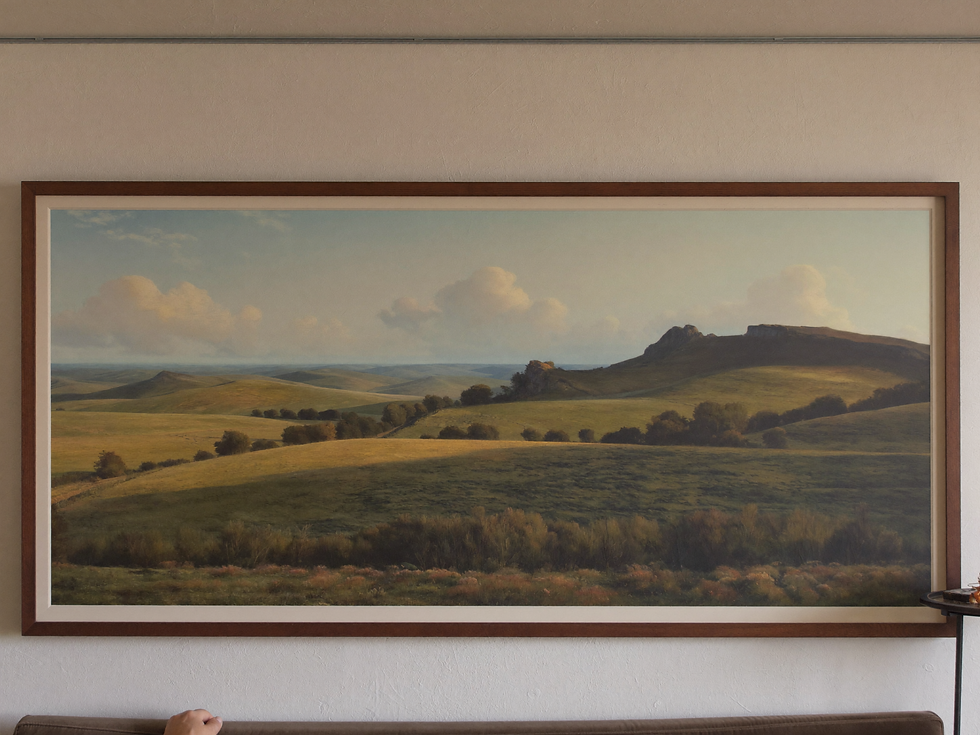
A horizontal format is useful because it echoes the sofa, but orientation alone does not guarantee balance. The internal movement of the image must carry the width. Look for a horizon, river, ridge, tree line or sequence of forms that allows the eye to travel across the work.
Vintage landscapes are especially effective here. Their tonal transitions tend to be gradual, and their distance gives a large seating wall room to breathe. A meadow creates softness; a countryside path adds narrative; a coastal horizon offers the cleanest sense of expansion.
Avoid choosing solely by palette. If the painting exactly repeats every upholstery and rug color, it may vanish into the scheme. One deeper tree line, a warm area of earth or a cool opening in the sky can give the composition enough contrast to remain visible.
The artwork should also withstand close attention. A large print magnifies weak texture and artificial detail. Look at the file at high zoom before printing. Brushwork, foliage and cloud transitions should feel intentional rather than mechanically sharpened.
Looking for a horizontal image with quiet movement? Explore Havenest printable wall art and choose the landscape before choosing the frame.

Match the Frame to the Visual Weight
A frame changes both the final measurement and the apparent weight of a large horizontal artwork. Slim wood frames keep the emphasis on the image and suit landscapes with warm earth tones. Matte black creates a firmer edge for pale art. Aged gold can be beautiful with vintage work, provided the moulding does not overpower a quiet composition.
Matting introduces another decision. A generous off-white mat gives the image a collected, works-on-paper feeling, but it also increases the outside dimension. Full-bleed framing or canvas makes the landscape feel larger and more atmospheric.
For glazed pieces, low-reflection acrylic or glass helps preserve subtle skies and dark foreground detail. Across from a window, standard glazing can turn the artwork into a mirror for half the day. Test the light at morning, afternoon and evening before committing.
If the room already includes strong timber grain or ornate furniture, let the frame become quieter. If the architecture is very plain, a frame with restrained character may provide the finish the wall needs.

Prepare a Digital File for a Large Print
Printable art gives you control over the final size, which is particularly useful above a sofa. Begin with the aspect ratio supplied with the file. Do not stretch a standard image into a panoramic shape; cropping or using the correct wide-format file preserves the composition.
At large sizes, resolution and print method matter. Confirm that the file has enough pixel dimensions for the intended output and use the correct ratio folder. A professional print shop can advise on the relationship between file dimensions, viewing distance and material.
Matte fine-art paper preserves soft tonal detail. Cotton rag adds a tactile, archival character. Canvas can support a painterly image and avoids glazing, though it changes the surface and edge treatment. Request a small proof when color is critical; screens are illuminated, while paper depends on reflected light.
Export or upload the correct aspect-ratio file without stretching it.
Confirm the final outside dimensions after adding the mat and frame.
Ask the printer whether borders or bleed are required.
Review dark areas carefully so shadow detail does not close up.
Choose a finish based on the artwork, not simply the cheapest large-format option.
If the larger room is moving toward a softer material palette, the guide to quiet luxury home decor explains how art, timber, linen and light can work together without turning the space into a showroom.
Check the Wall Before You Hang
Do one final check before drilling. Mark the full outer frame size, not just the printed image. Confirm the midpoint over the sofa, the distance above the back and the relationship to nearby lamps, windows or shelving.
Is the artwork approximately two-thirds to three-quarters of the sofa width?
Does it remain visually connected at a gap of about 6 to 10 inches?
Is the center aligned with the main seating zone rather than blindly centered on the wall?
Can the image be seen without disruptive glare during the brightest part of the day?
Does the painting still hold attention when every decor object is mentally removed?
That last question matters most. Correct measurements can make a wall look resolved, but they cannot make an indifferent image meaningful. Let proportion support the artwork; do not ask proportion to replace it.
Large horizontal wall art above a sofa works because it brings two long forms into conversation. The furniture anchors daily life. The landscape opens distance above it. Between them, the wall gains structure without losing air.
Browse Havenest printable landscape art and choose a piece with enough presence to hold the wall—and enough depth to outlast the measurements.


Comments