How to Make a Small Room Feel More Collected
Small rooms are often given the wrong advice.
We are told to make everything pale, keep every piece of furniture tiny, remove almost every object, and avoid anything with visual weight. The result may be tidy, but it can also feel temporary—as if the room is waiting to become a real room once there is more space.
A collected interior works differently. It does not depend on square footage. It depends on relationships: one material answering another across the room, an older piece beside something new, art with enough scale to hold a wall, books that look read, and a lamp that creates a pool of light after sunset.
The goal is not to fit more into a small room.
It is to make what is already there feel connected.
Contents
A collected room is edited, not empty
A collected room contains evidence of choice. A cluttered room contains too many competing decisions.
That distinction becomes especially visible in a compact space because every object carries more visual influence. A chair placed ten inches to the left can change the path through the room. Three small frames can make a wall feel busier than one generous painting. A table crowded with decorative objects can erase the beauty of the table itself.
The answer is not minimalism for its own sake. It is hierarchy.
Choose what deserves attention, then let the quieter elements support it. A favorite painting, an old wooden stool, a beautiful lamp, a stack of books, or a handmade ceramic bowl can form a small constellation of meaningful objects. They do not need to match. They need to acknowledge one another through color, material, proportion, or mood.
Collected rooms often feel calm because the eye understands where to go.
Before buying anything new, stand at the doorway and ask three questions:
What do I notice first?
What deserves to be noticed first?
Which object is interrupting that relationship?
Sometimes the most effective decorating decision is simply moving one object away.

Give the room one visual anchor
Small rooms become restless when everything is equally small. A tiny sofa, tiny rug, tiny art, tiny lamp, and tiny side tables do not necessarily create spaciousness. They can divide the room into visual fragments.
Designers often recommend mixing scales rather than shrinking every piece; Architectural Digest notes that one standard-size seating piece or a bold artwork can give a compact room more confidence. The useful lesson is not “go oversized everywhere.” It is to choose one element with enough presence to organize the rest.
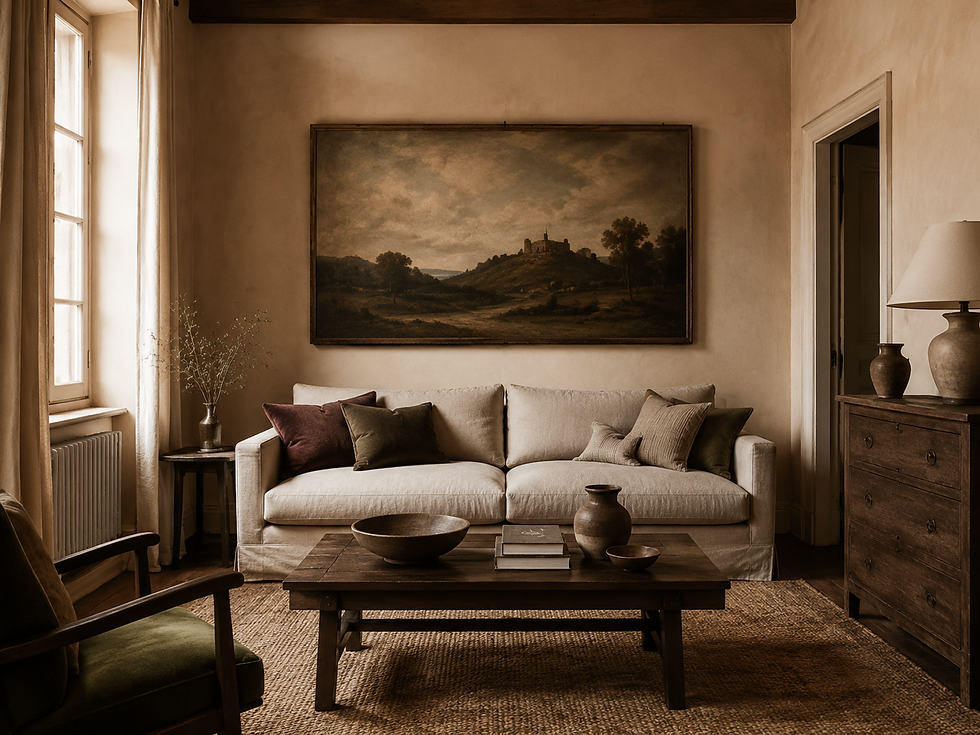
Wall art is particularly effective because it adds visual weight without taking floor space. A medium-large landscape above a sofa can establish a horizon. A portrait above a narrow console can give an overlooked wall a center. A rug large enough to touch the main furniture can make separate pieces read as one zone rather than several floating islands.
Think of the anchor as punctuation.
Once the room has a convincing full stop, the smaller details can lower their voices.
If art will be the anchor, choose it for mood before matching it to cushions. Our guide to choosing wall art for a calm living room offers a practical way to consider palette, scale, and subject without turning the room into a color-matching exercise.
Repeat a material, then allow a little history
A collected room rarely looks as if every piece arrived on the same delivery truck.
Matching furniture sets can make a small room feel dense because the repetition is too literal. A softer approach is to repeat materials rather than exact objects. A walnut picture frame can relate to a darker side table without matching it. Linen curtains can answer the texture of a cushion. A brass lamp can pick up the warmth of an antique frame.
These echoes create continuity while allowing each object to retain its character.
Start with a compact material vocabulary—perhaps warm wood, linen, wool, ceramic, and one metal. Let those materials appear in different forms around the room. Five materials are enough to create richness; fifteen can become a committee meeting with no chairperson.
Then add a little age.
One or two pieces with patina can give the room visual memory: a vintage stool, an old frame, a weathered wooden box, a secondhand table, or a brass lamp whose surface has softened over time. Placed beside something cleaner and newer, those imperfect surfaces suggest that the room developed rather than arrived fully styled.
If everything is old, the space may feel themed. If everything is new, it can feel recently staged. The interest lives in the conversation between them.
Collected style is less about accumulating history than allowing a little history to remain visible.

Use the wall height before filling the floor
When floor area is limited, horizontal clutter gathers quickly. Every decorative impulse lands on the coffee table, console, bedside table, or shelf until the room feels crowded at waist height and strangely unfinished above it.
Use the vertical plane first.
Curtains hung closer to the ceiling lengthen the line of the wall. A tall narrow artwork can bring dignity to an awkward strip of space. A slim bookcase, a floor lamp, or one vertical branch arrangement can draw the eye upward without obstructing movement.
Architectural Digest’s guide to vertical design makes the same essential point: ceiling details, elongated drapery, built-ins, and upward-directed light can change how the eye reads a compact room.
Vertical layering also gives surfaces permission to stay clear. A console holding one lamp and one bowl can feel far richer when a strong painting hangs above it than when six small accessories compete beneath a timid print.
Do not fill every tall wall, however. Height works best when it is balanced with one quieter plane. The eye needs somewhere to complete the upward movement and rest.

Build depth with light, not more objects
One overhead light can flatten a small room. It illuminates everything at once and often leaves the corners visually dead.
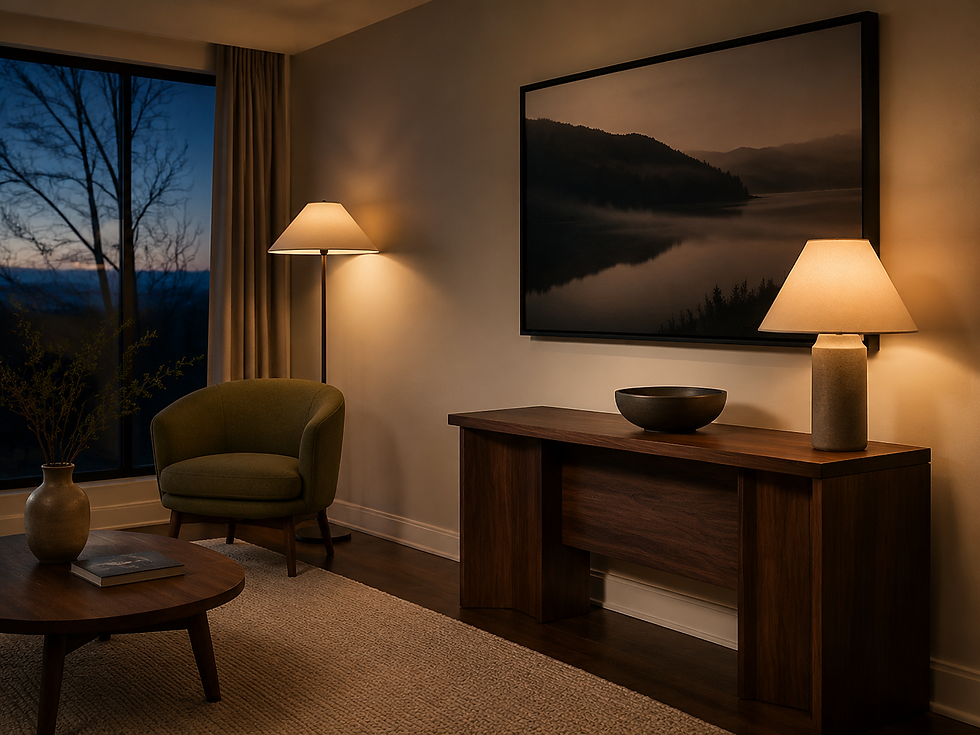
Layered lighting creates depth without adding partitions. A table lamp beside a sofa, a floor lamp near a reading chair, or a small wall light beside art gives the eye several destinations. Architectural Digest’s designers similarly warn against relying on the ceiling fixture as the primary source and recommend layered light for a more welcoming room.
Two or three light sources at different heights are usually enough:
General light for moving through the room
Task light for reading or working
A lower, warmer light that gives art and materials atmosphere
Light also makes texture legible. Wood grain grows richer. Plaster reveals its unevenness. Linen catches shadow. A painting changes as daylight fades and lamplight begins to touch the frame.
This is one reason a collected room often feels most complete in the evening. The relationships between objects are no longer held only by arrangement. They are held by light.
Leave breathing room around what matters
Collected does not mean every wall needs art and every surface needs objects. Empty space is part of the composition.
A clear strip of wall beside a painting can make the artwork feel larger. An uncluttered corner can make the adjacent chair feel more intentional. A coffee table with one ceramic bowl may reveal more character than the same table covered with decorative books and accessories.
Try this simple editing pass:
Remove everything from one surface.
Return the object with the strongest shape or meaning.
Add one companion object only if it changes the composition.
Stop before the surface begins explaining itself too loudly.
The same rule applies to color. A collected room can contain several hues, but one or two should lead while the others appear as echoes. Repeating a muted green from a painting in a cushion or ceramic piece is usually more convincing than matching the whole palette exactly.
Breathing room is not unused space.
It is the distance that allows one thing to be seen as itself.
Let art hold the emotional center
Artwork can change a small room without using a centimeter of usable floor area. Landscapes with open horizons, receding paths, distant hills, or water give the eye somewhere to travel beyond the physical boundary of the wall.
But art does something more important than create perceived depth. It prevents a compact interior from becoming purely functional.
Choose one piece you genuinely want to live with rather than several generic prints selected only to coordinate with the furniture. A painting with atmosphere, memory, or an unusual relationship of colors can become the room’s emotional center. Once that center exists, the rest of the styling can become simpler.
Printable art can be helpful here because the same work can be tested at different scales and framed for the architecture of the room. If the format is unfamiliar, this guide explains how digital wall art works, from download to printing and framing. The finish matters too: our comparison of matte paper, canvas, and fine art paper can help the image sit naturally beside the room’s existing textures.
The collected feeling is not created by filling the room.
It appears when the pieces seem to know one another.
A small room does not need to pretend it is large. It needs to feel complete at its own scale. Begin with one thing you love, then ask what would support it: a material repeated nearby, a better light source, a little more empty wall, or an artwork with enough presence to hold the room together.
Start there instead of adding five new things.
Research sources
Alex from Havenest Studio


Comments