
When a Flower Became a World: Georgia O’Keeffe and the Scale of Attention
Updated: Sep 8
A flower can be small enough to hold in one hand and large enough to reorganize an entire room. In Georgia O’Keeffe’s paintings, scale is never a neutral decision; it is a way of asking the eye to stay. Her enlarged petals and desert forms do not simply make nature decorative. They turn looking into an encounter—close, deliberate, and slightly disorienting. The familiar subject remains recognizable, but its proportions ask us to meet it again.
This is the central promise of O’Keeffe’s art: attention can change the size of the world. The Georgia O’Keeffe Museum’s account of her career places her flower paintings alongside New York skyscrapers and New Mexico landscapes, a range that makes her practice feel larger than any single motif. The museum’s biography records how she developed a personal language of abstraction before becoming known for both urban modernity and radical depictions of flowers.

Georgia O’Keeffe, Black Hollyhock Blue Larkspur, 1930. Image via the Georgia O’Keeffe Museum; rights reserved by the respective rights holder. View the museum record.
The First Act is a Change of Scale
O’Keeffe’s flower paintings begin with recognition. We know the subject is a flower, but the canvas refuses the distance at which a flower is usually seen. Petals push beyond the edges. Centers become chambers. A curve that might pass unnoticed outdoors becomes the governing architecture of the image.
The effect is physical before it is symbolic. We are brought close to contour, fold, shadow, and the slight instability of organic form. The eye does not survey a bouquet from across a room; it moves through a single structure, learning its temperature and rhythm.
The artist explained this impulse in a sentence that remains unusually direct: “When you take a flower in your hand and really look at it, it’s your world for the moment.” The Georgia O’Keeffe Museum preserves this statement alongside its account of her experiments with vibrant color, simplified shape, and unexpected perspectives.

Georgia O’Keeffe, Jack-in-the-Pulpit No. IV, 1930. Oil on canvas, National Gallery of Art, Washington. Image via the Georgia O’Keeffe Museum. View the museum record.
A Flower is Not a Symbol Before it is a Form
O’Keeffe’s flowers have often been asked to carry meanings that begin outside the paintings: femininity, sexuality, nature, interior life. Some of those readings belong to the history of their reception, especially the way critics looked at a woman artist’s work through the assumptions of a male-dominated art world.
But the paintings themselves are more disciplined than those interpretations suggest. Before a petal becomes a metaphor, it is a line that bends, a color that changes pressure, a dark interval held against a field of light. O’Keeffe’s achievement is not that she hides the subject’s associations; it is that she makes formal decisions strong enough to resist being reduced to them.
The museum’s exhibition account, Georgia O’Keeffe: Line, Color, Composition, emphasizes her drawing practice, dramatic palette, and the way forms can run beyond the edge of the canvas while the composition still holds together. That balance—expansion without collapse—is one of the quiet sources of her authority.

Georgia O’Keeffe, Bella Donna, 1939. Oil on canvas. Image via the Georgia O’Keeffe Museum; extended loan, private collection. View the museum record.
Line, Color, and Compositional Discipline
The paintings can look effortless because the decisions have been compressed. A petal may appear to glide into place, yet its contour determines the pace of the entire image. A saturated red or blue does not merely brighten the canvas; it changes how the neighboring tones breathe.
This is why O’Keeffe is better understood through structure than through adjectives. Her modernism is not simply bold, feminine, organic, or serene. It is built from a repeated negotiation between edge and field, concentration and openness, the recognizable object and the abstract shape it becomes when seen intensely.
Her long commitment to drawing mattered here. The museum notes that she kept sketchbooks for decades, using them to distill places and subjects into lines, contours, and compositions. The flower is therefore not an escape from design. It is a laboratory for it.
From New York Modernity to New Mexico
O’Keeffe’s career did not move from city to nature as if one world replaced the other. By the mid-1920s, she was known for paintings of skyscrapers as well as flowers—two subjects that share a surprising vertical confidence. Both can be isolated, enlarged, and made to carry the pressure of modern attention.
In 1929, she made the first of many trips to northern New Mexico. The region’s stark terrain, architecture, and cultural histories opened another field of forms: bones, crosses, mesas, doors, and distant horizons. The Georgia O’Keeffe Museum’s timeline records her recurring travels, her growing commitment to New Mexico, and her permanent move there in 1949.
The desert did not make her less abstract. It gave abstraction a different weight. A horizon could become a line of infinity; a hill could become a measured sequence of color; a bone could become both a found object and a shape with its own severe beauty.

Georgia O’Keeffe, Purple Hills Ghost Ranch–2 / Purple Hills No. II, 1934. Oil on canvas. Image via the Georgia O’Keeffe Museum. View the museum record.
The Edge of the Canvas is Part of the Subject
One of O’Keeffe’s most modern gestures is the way she lets the composition continue beyond the frame. The cropped flower feels close not because it is described in detail, but because the canvas cannot contain the whole encounter. We sense a larger form outside the image.
The Georgia O’Keeffe Museum connects this framing to the emergence of photography as an art form in the early twentieth century. The relationship is not imitation. It is a shared willingness to treat the edge as active: the picture does not end where the subject ends.
That idea also explains why her work can feel so contemporary in a home. A large floral painting does not have to behave like a polite botanical specimen. It can reorganize the wall around a single curve, interrupt a neutral room with concentrated color, or make a familiar corner feel briefly unfamiliar.
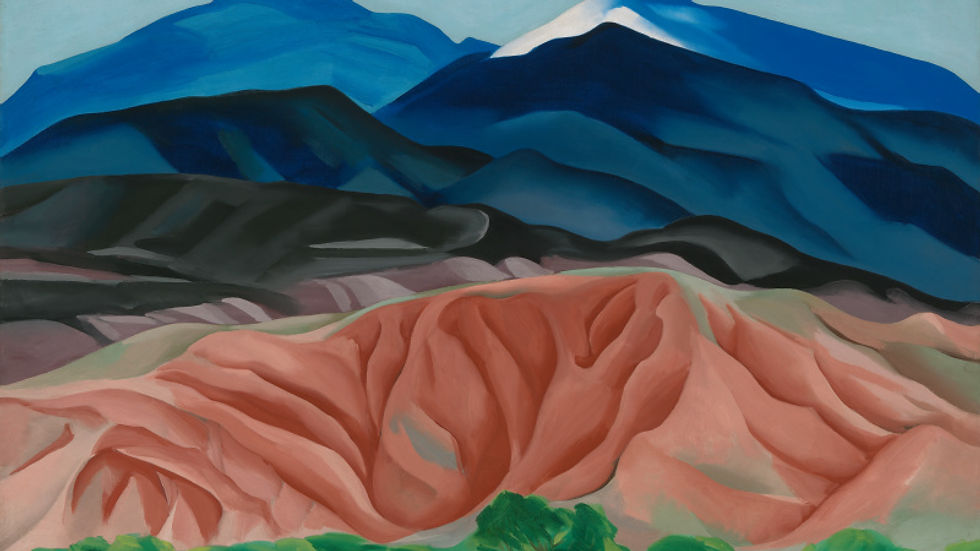
Georgia O’Keeffe, Black Mesa Landscape, New Mexico / Out Back of Marie’s II, 1930. Oil on canvas. Image via the Georgia O’Keeffe Museum. View the museum record.
Abstraction is a Way of Seeing
To call O’Keeffe an abstract artist does not require us to stop seeing flowers, hills, or bones. It asks us to notice what happens when the subject is held long enough for its ordinary category to loosen. A flower becomes a world because the painting refuses haste. Its scale slows the eye without making the image passive. We move from contour to color, from color to depth, from depth back to the question of what we thought we already knew.
The museum’s account of her work describes this as a process of selection, elimination, and emphasis. O’Keeffe does not copy the whole visible world. She chooses the part that can carry the feeling of looking. That is why her paintings can be both highly recognizable and formally open.

Georgia O’Keeffe, Ram’s Head, White Hollyhock–Hills, 1935. Oil on canvas, Brooklyn Museum. Image via the Georgia O’Keeffe Museum. View the museum record.
Living with O’Keeffe’s Scale
In a room, O’Keeffe’s lesson is less about matching a style than about deciding what deserves visual weight. A large flower can give a quiet wall a center of gravity. A desert horizon can extend the room’s sense of air. A close crop can bring energy to a reading corner without filling the space with objects.
The key is to let the artwork keep its edge. Give it enough wall around the frame to register as an intentional field, and allow nearby materials—wood, linen, plaster, ceramic—to support its concentration rather than compete with it.
For a wider history of artists who make stillness visible, continue with The Painters Who Made Stillness Visible. For a practical approach to choosing artwork in a lived-in space, read How to Choose Wall Art for a Calm Living Room.
O’Keeffe’s flowers remain powerful because they do not ask to be consumed at a glance. They ask the room—and the person inside it—to make space for looking again.
Alex, Holland, and Louis from Havenest Studio
Comments