The Storm: A Little Shelter, Carried Together
The cloth is already lifting. A gust has caught its loose edge, opening a golden fold above two people running along a woodland path. One hand holds each side overhead. Before we study their faces or ask where they are going, Pierre-Auguste Cot’s The Storm gives us the familiar problem of trying to keep something light under control in moving air.
It is a small, believable difficulty inside a very carefully arranged painting. The fabric offers shelter, though it also seems ready to pull away.
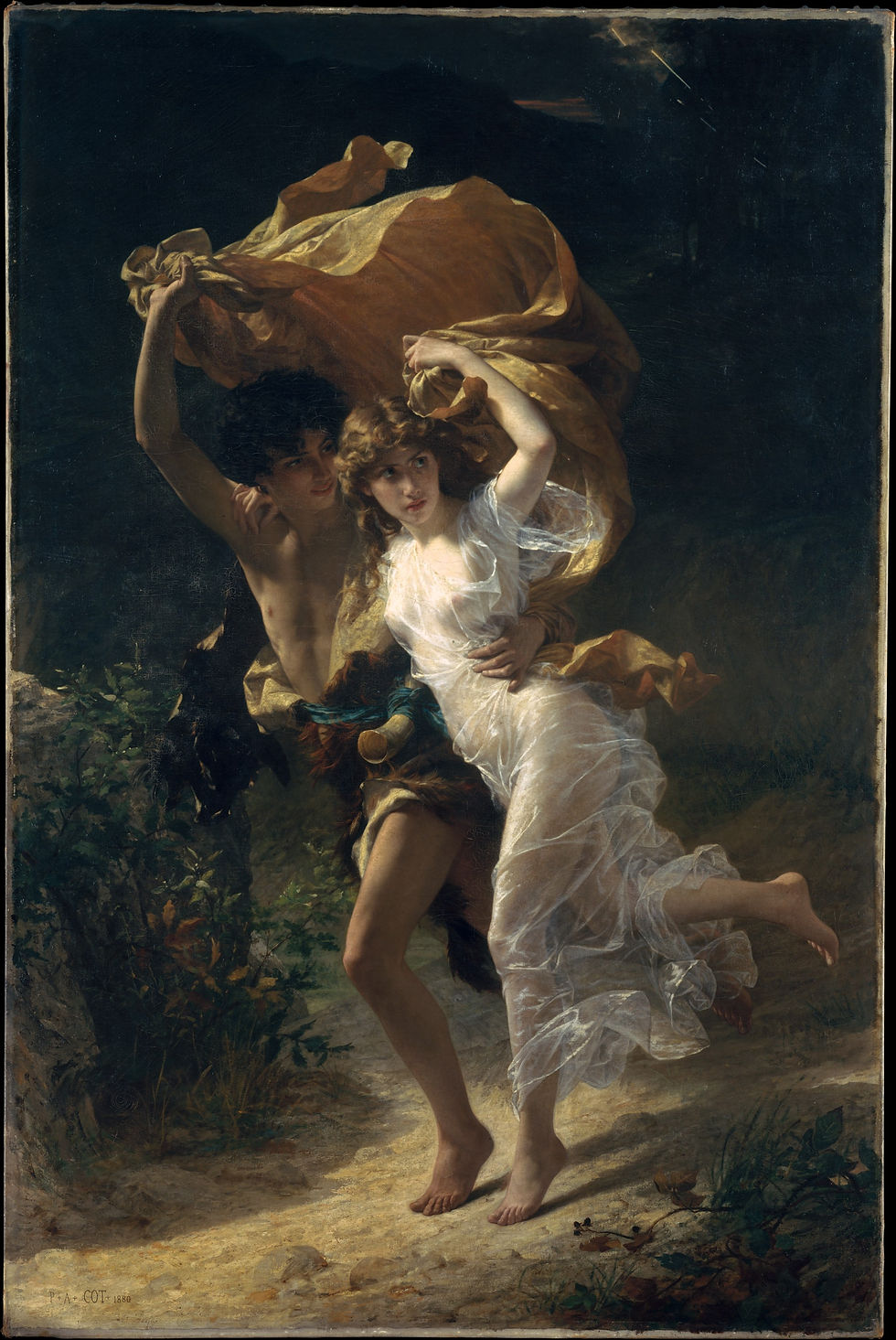
Pierre-Auguste Cot, The Storm, 1880. The Metropolitan Museum of Art, Catharine Lorillard Wolfe Collection, Bequest, 1887. Public domain.
In this essay
A painting with room around its story
Cot painted The Storm in 1880 for the collector Catharine Lorillard Wolfe. It appeared at the Paris Salon that year, and The Metropolitan Museum of Art records its later popularity and wide reproduction. The work followed the success of his earlier Springtime, another woodland scene centered on a youthful pair.
The exact literary identity of the figures remains uncertain. The museum notes that contemporary critics proposed different sources. We can leave that question open while looking closely at the scene Cot actually painted: two figures in motion, their clothing stirred, their faces turned, and a dark landscape beyond them.
An uncertain story does not leave the painting empty. It gives the visible decisions more weight. A hand, a lifted corner of cloth, or the placement of a foot can carry our attention before a name has entered the conversation.
Following the fabric
The overhead cloth is a landscape of its own. Light runs across one fold and stops at the next. The upper edge curls back, while the broader section behind the figures swells outward. Warm yellow-brown passages stand against woodland that is nearly black in places.
Look at how the hands interrupt that flow. Each grasp gathers the loose material into a smaller, firmer shape. Between them, the cloth expands again. The contrast makes its softness convincing: we sense where it can billow and where the pressure of a hand keeps it still.
The shelter feels temporary because its edges remain so active. No wall encloses the pair. Their cover has to travel with them, and both figures are involved in keeping it raised. To me, that shared task gives the scene much of its warmth.

Detail of The Storm: The lifted cloth and the hands holding it overhead. The Metropolitan Museum of Art, Catharine Lorillard Wolfe Collection, Bequest, 1887. Public domain.
Two people keeping pace
The raised arms create a loose arch above the faces. Lower down, bent knees and lifted feet send the eye along a different set of angles. Cot links the upper and lower movements without making every limb point the same way. The result feels coordinated, with just enough difference to suggest two bodies moving together.
One figure’s arm reaches around the other’s waist. Another hand rests near a shoulder. These contacts help us read the pair as a connected group even while the running movement stretches the composition outward.
They are beautiful, composed figures; the picture does not pretend to be an unplanned glimpse caught in passing. Yet the task within it is recognizable. Anyone sharing an umbrella, carrying something awkward with another person, or trying to match someone’s step knows the little adjustments involved. The painting gives those adjustments an unusually graceful form.

Detail of The Storm: The figures’ faces and their connected gestures. The Metropolitan Museum of Art, Catharine Lorillard Wolfe Collection, Bequest, 1887. Public domain.
Where the eyes go
The faces complicate the speed of the scene. The figure at the right turns her gaze upward and outward. Her companion looks toward her. Their attention follows different routes, even as their bodies travel along the same path.
We might read concern in that exchanged attention, or the exhilaration of being caught outside together. The expressions allow more than one emphasis. Nothing in the visible scene tells us exactly what either person is saying or how serious the danger will become.
That restraint is useful when looking at an image with such an emphatic title. The Storm invites us to expect drama. A close look at the faces gives us something more finely balanced: alertness, closeness, and a moment in which neither expression has fully settled.
The dark around them
The surrounding woodland makes the pale drapery and illuminated skin stand forward. Along the path, lighter earth gives the feet a place to arrive. Behind the figures, darkness compresses the space, leaving fewer details to compete with the movement.
The picture’s large shapes become especially clear if we step back. There is the warm cloth above, the pale figure at the right, the darker figure at the left, and the open stretch of path below. These areas hold together before we resolve individual folds or leaves.
Up close, the path introduces a rougher register. Stones, plants, and uneven ground sit beneath the smooth transitions of the figures. That difference brings the running back into contact with a place. Their feet have somewhere particular to land, however lightly the painting lets them pass over it.

Detail of The Storm: Feet, pale drapery and the uneven woodland path. The Metropolitan Museum of Art, Catharine Lorillard Wolfe Collection, Bequest, 1887. Public domain.
A little shelter, carried together
The more time I spend with the overhead cloth, the less it seems like a minor accessory. It sets a limit around the pair, but the limit keeps changing. Air presses against it. Arms maintain it. Their forward movement makes the arrangement possible for another instant.
There is an everyday tenderness in that, if we choose to read it there. Care can take the form of a small practical adjustment: raising an arm a little higher, moving closer so someone else fits underneath, keeping pace without announcing that we are doing it. The painting supplies the gestures; the association belongs to the viewer.
Cot’s scene remains idealized. Its flowing fabric and carefully placed bodies make the sudden weather look far more elegant than a real dash through rain is likely to feel. Acknowledging that artifice lets us enjoy how the picture works, including the gentleness it finds within its hurry.
The complete painting, revisited after the details. Pierre-Auguste Cot, The Storm, 1880. The Metropolitan Museum of Art, Catharine Lorillard Wolfe Collection, Bequest, 1887. Public domain.
Back at the full canvas, the cloth lifts again. The pair are still between one step and the next, sharing a cover too slight to become a roof. The painting leaves them there, occupied with the immediate business of getting through the weather together. For the length of our looking, the little shelter holds.
Continue looking at your own pace in the Havenest Journal, where we return to the gestures and details that make paintings worth lingering over.
Research sources
Alex from Havenest Studio

Comments