"The Young Lord of the Rose Window": A Portrait for Refined Interiors
A portrait can give a room presence faster than almost any other kind of wall art. It can also be difficult to choose. Will it feel compelling or overly formal? Will the colors work with the furniture? And can a historic-looking portrait live naturally in a contemporary home?
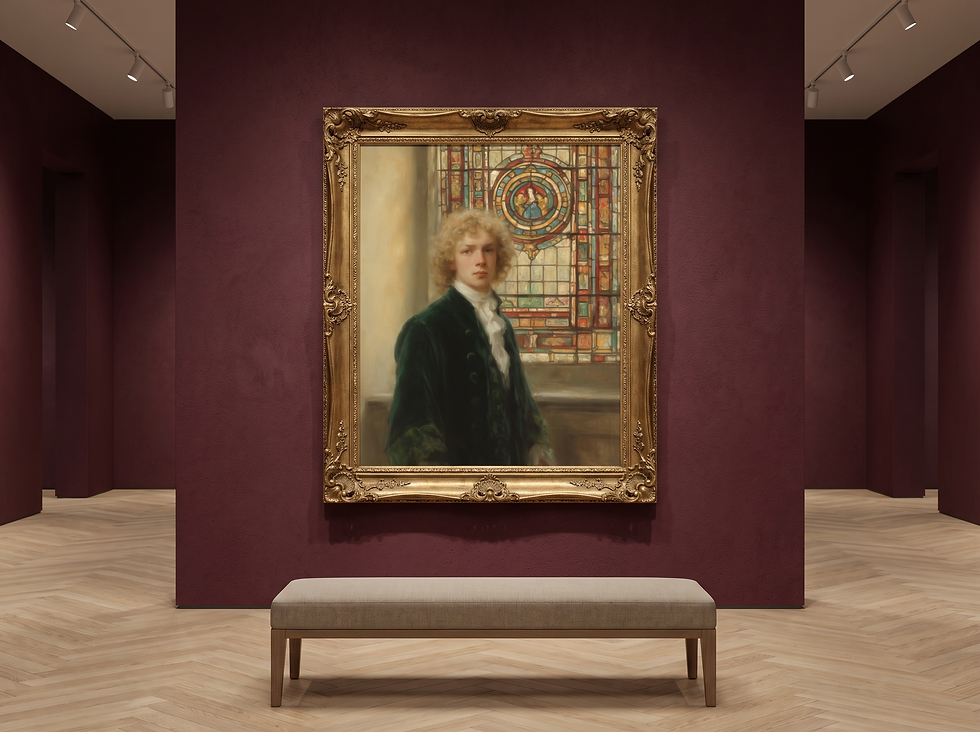
"The Young Lord of the Rose Window" offers a balanced answer. The young nobleman, dressed in deep green velvet and an ivory cravat, brings classical character to the wall, while the luminous stained-glass window behind him keeps the composition colorful, romantic, and visually alive.
Quick answer
"The Young Lord of the Rose Window" works best in a home library, reading corner, study, living room, hallway, or characterful bedroom.
Choose it when the room needs a strong vertical focal point, deeper color, or a sense of history. Pair it with walnut, dark wood, antique gold, or restrained black framing to keep the result collected rather than theatrical.
In this guide
What Makes This Young Nobleman Portrait Wall Art Distinctive?
The central figure is composed but not distant. His golden curls and youthful features soften the formality of his dark green coat, while his expression suggests a private life beyond the conventions of the portrait.
Behind him, the circular stained-glass window introduces ruby, amber, turquoise, and antique-gold notes. These colors prevent the dark clothing from becoming visually heavy and give the artwork several possible connections to a room’s existing palette.
The result is not simply an image of aristocracy. It is a portrait about the moment when youth begins to meet expectation: a young person standing inside an inherited world, perhaps wondering what part of it will truly become his own.
For buyers drawn to literary rooms, European-inspired interiors, romantic portraiture, or dark academia decor, that suggestion of an unfinished story is part of the appeal.
Which Rooms Suit "The Young Lord of the Rose Window" Best?
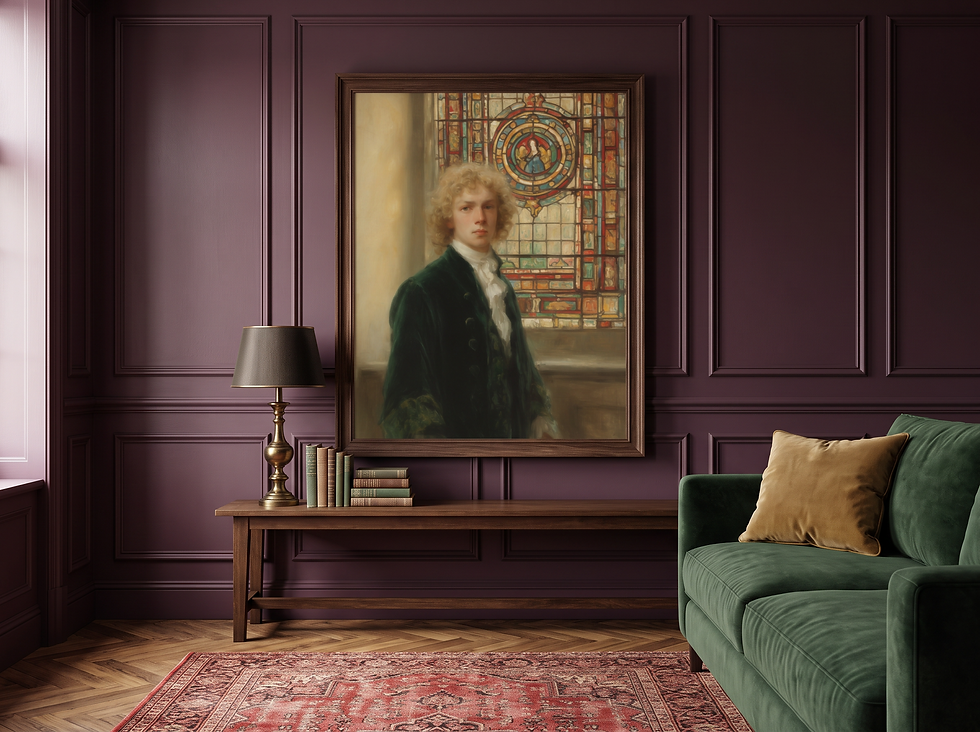
This artwork carries enough visual weight to become a focal point, but it does not need an elaborate period interior around it. In fact, the portrait often feels more convincing when surrounded by furniture that is simpler and more contemporary.
Use the following guide to decide where it belongs.
Room | Why it works | Frame direction | Placement idea |
|---|---|---|---|
Home library | The literary atmosphere and deep colors complement books and dark wood | Walnut or restrained antique gold | Between two bookcases or above a reading chair |
Living room | The portrait gives a neutral room a clear focal point | Dark wood or slim black | Above a console or on a narrow wall beside the sofa |
Study | Its composed mood supports a focused, reflective space | Walnut | Opposite the desk or above a low cabinet |
Bedroom | The romantic palette creates intimacy without relying on floral decor | Warm wood or muted gold | Above a dresser rather than directly above the bed |
Entryway | The vertical composition adds height and immediate character | Dark wood | Above a half-moon console with minimal styling |
Gallery wall | The portrait can serve as the visual anchor among landscapes and studies | Match one frame finish elsewhere in the arrangement | Place it slightly off-center and give it visual breathing room |
If you are building a mixed gallery wall, allow this portrait to lead. Surround it with smaller landscapes, botanical studies, architectural drawings, or handwritten documents rather than several competing faces.
For more guidance on combining portraits with other subjects, see Havenest’s vintage art styling guide.
Product Recommendation
Best for: Home libraries, studies, entryways, romantic bedrooms, traditional living rooms, and European-inspired interiors.
Artwork: "The Young Lord of the Rose Window"
Why it works: The deep green coat gives the composition visual authority, while the stained-glass window introduces enough color and light to prevent the portrait from appearing severe.
Buyer fit: Choose this piece if you prefer narrative portraiture, old-world details, and artwork that invites questions. If your room is extremely pale, minimal, and without any darker accents, introduce one or two supporting elements—such as a walnut frame, dark book, or aged-brass lamp—to help the portrait feel connected.
How Should You Frame and Print It?
The listing includes high-resolution JPG files organized into five ratio groups:
2:3
3:4
4:5
5:7
11:14
This gives you flexibility to choose a file that matches your intended frame instead of cropping one image into every possible shape. Because each ratio requires a slightly different crop, review the complete file before deciding which composition you prefer.
For the most painterly presentation, canvas is a natural choice. Its woven surface complements the oil-painting-inspired brushwork and reduces the flat appearance that can occur with glossy poster paper.
Smooth or lightly textured fine-art paper is better when you want the facial features, cravat, and architectural details of the stained glass to remain especially crisp. Matte paper offers an accessible framed option with less reflection than a glossy surface.
Havenest’s guide to the best paper for printable wall art explains the practical differences between matte paper, fine-art paper, and canvas.
Before ordering a large print, check the printer’s preview for cropping, orientation, and edge wrapping. This is especially important for canvas, where part of the composition may extend around the stretcher bars.

Will This Portrait Make the Room Feel Too Formal?
Not necessarily. Formality usually comes from the entire arrangement, not from one artwork.
A gilded frame, symmetrical furniture, heavy drapery, and several ornate accessories will amplify the portrait’s aristocratic character. That may be perfect for a dramatic library or traditional interior.
For a more relaxed result, use a walnut or narrow black frame, leave space around the artwork, and place only one or two useful objects beneath it. A ceramic lamp, a small stack of books, or a simple branch is enough.
The contrast between historical imagery and clean contemporary furniture can make the portrait feel intentional rather than costume-like. The room gains a past without becoming trapped inside it.
You can also explore the Havenest Art Curation journal for more examples of placing narrative artwork in present-day interiors.
Before-You-Buy Checklist
You understand that this is a digital download, not a physical framed print.
You have selected the ratio that matches your intended frame or canvas.
You have reviewed how the composition changes between ratio files.
Your chosen printer accepts high-resolution JPG files.
You have checked the print preview for cropping and orientation.
You have chosen paper or canvas based on the amount of detail you want to preserve.
You understand that screen and print colors may vary according to the printer, ink, and material.
The artwork will be used according to the listing’s personal-use license.
Frequently Asked Questions
Is "The Young Lord of the Rose Window" a physical print?
No. The listing is for a digital download. No frame, canvas, or physical print is shipped.
What files are included?
The purchase provides access through a PDF containing a Google Drive link. The artwork files are supplied as high-resolution JPGs in five ratio folders.
Can I print "The Young Lord of the Rose Window" at a large size?
The listing includes files prepared for large-format printing. Always confirm the selected file and final dimensions with your printer, particularly for oversized canvas or fine-art output.
Which surface is best for this artwork?
Canvas supports the painterly character, while smooth or lightly textured fine-art paper preserves more of the portrait and stained-glass detail. Matte paper is a practical option for standard framing.
Which frame color works best?
Walnut is the most versatile choice. Antique gold increases the classical character, while a narrow black frame creates a cleaner transition into a contemporary room.
Can the artwork be given as a gift?
The personal-use license permits printing the artwork as a personal gift. The digital files or download link should not be redistributed.
Bring a Story to the Wall
"The Young Lord of the Rose Window" is for the room that needs more than coordinated color. It introduces a face, a history, and a question that remains unanswered each time someone passes it.
Printed at an intimate size, it can become a private presence beside a reading chair. Printed larger, it can anchor a library, entryway, or living room with the gravity of an inherited portrait—without requiring the inheritance.
Words and visual direction by Havenest.
Comments