When a Tree Becomes a Landmark: Hiroshige and Japan's Ancient Pines
Some landscapes are remembered by their mountains. Others are remembered by a bridge, a shoreline, or a road. In Hiroshige's Japan, a single tree can carry the same weight. It can tell us where we are, what season has arrived, how weather is moving through the scene, and how many generations have looked at the same horizon.
The ancient pine is never merely decoration in these prints. It is a temporal anchor: a living landmark that holds sacred memory, human care, and the changing scale of everyday life. When Hiroshige enlarges a tree until its branches enter the viewer's space, he changes the way landscape is read. The tree becomes a presence before it becomes a view.
This essay follows that presence through Karasaki, Miho, and other Japanese landscapes, asking how an old tree can transform a picture from scenery into a place with memory. It continues the visual questions explored in our related essay Japan at Sunset: Hiroshige and the Art of Vanishing Light. There, light makes place feel temporary. Here, the tree gives that temporary world a deeper duration.
The Tree That Refuses to Be Background
A tree in a landscape is often treated as a framing device. It fills an edge, balances a distant mountain, or gives the eye a measure of scale. Hiroshige certainly understood all of these functions, but he also gave trees a kind of agency. They interrupt the view. They lean into the picture. They occupy the foreground with the confidence of something that was there before the traveler arrived and will remain after the traveler has gone.
That feeling is especially strong in the vertical compositions of the nineteenth-century woodblock print. A trunk may rise beyond the upper edge, while the middle distance opens toward water, hills, or a settlement. The viewer is not placed outside the landscape like a spectator looking through a window. Instead, the viewer stands close to the tree, almost beneath it, sharing the weather and looking outward from its shelter.
The result is psychologically subtle. The landscape feels larger because the tree is close, but it also feels more intimate. The old pine becomes a companion to looking - a quiet figure that makes human beings appear brief without making them insignificant.
Karasaki: When a Pine Becomes a Sacred Place
Hiroshige's Pine Tree at Karasaki belongs to the celebrated Eight Views of Omi, a group of scenic locations around Lake Biwa. The Met identifies Karasaki as a site famous for an ancient pine that was revered as sacred. That context matters: the tree is not simply an attractive specimen. It is the reason the place has entered cultural memory.
In the print, the pine spreads horizontally with extraordinary force. Its branches are supported and extended across the composition, while the lake and distant shore recede beneath it. The tree does not frame the scene so much as absorb it. Water, sky, and faraway land become the world held inside its reach.

Utagawa Hiroshige, Night Rain at Karasaki, from the series Eight Views of Omi - View source
This is one reason the image feels less like a view than an encounter. We do not approach Karasaki as a neutral location. We approach the tree as an accumulated fact - a living landmark whose fame is already present before the image begins. The print records a place, but it also records the act of recognizing a place.
Rain as a Test of Endurance
The Karasaki pine becomes even more compelling when Hiroshige places it under rain. In Night Rain at Karasaki, fine vertical lines fall across the large tree and the open landscape. The weather reduces clarity, but it does not reduce the tree's authority. If anything, the rain makes its endurance more visible.
Rain changes the rhythm of looking. It turns distant forms into suggestions and brings the foreground into sharper emotional focus. The pine is not heroic in the theatrical sense; it does not conquer the storm. It simply remains present within it. The branches, the supports, and the dense mass of needles become evidence of a life that has learned to hold its shape through changing conditions.
The British Museum notes that Hiroshige often paired pine trees with symbols of long life. That association helps explain the quiet gravity of these images, but the print does not need to be reduced to a single symbol. The pine is at once longevity, landmark, shelter, weather, and living structure. Its meanings accumulate rather than replace one another.
The Tree Is Also a Structure
One of the most moving details in the Karasaki images is the visible support given to the pine's heavy boughs. Stakes and braces hold the branches above the ground. The tree is old, but it is not imagined as untouched by human care. Its longevity depends partly on a relationship between natural growth and deliberate maintenance.
That detail complicates the usual fantasy of the ancient tree as pure wilderness. This is a cultural landscape, not an untouched one. People have recognized the tree's age and importance, and they have built around its needs. The supports are almost architectural: a quiet armature that allows the tree to continue being itself.
Hiroshige's sensitivity lies in making that care visible without turning the picture into an explanation. The viewer notices the braces as part of the composition, then slowly understands them as part of the tree's biography. Age here is not only a number. It is a history of adaptation, protection, and continued presence.
Miho: Pine Grove, Sea, and the Long Horizon
At Miho no Matsubara, the ancient-tree idea expands from one famous pine to an entire coastal grove. Hiroshige repeatedly returned to Miho in different series, placing its pines alongside the sea and Mount Fuji. The grove creates a horizontal threshold: land becomes shore, shore becomes water, and water opens toward a mountain that seems almost outside ordinary time.

Utagawa Hiroshige, Suruga Province, Miho Pine Grove, 1853 - View source
Here the tree is less a single protagonist than a chorus. The repeated trunks establish a rhythm, while the distant Fuji provides a calm counterweight. The eye moves between the near and the far: rough bark and dark needles in the foreground, then the delicate geometry of the mountain beyond.
That movement gives Miho a different emotional temperature from Karasaki. Karasaki feels like an encounter with one revered body. Miho feels like a landscape of continuity, where the grove, the sea, and the mountain participate in a longer cultural story. In the tradition surrounding Miho, the pine grove is also associated with the Hagoromo legend, which adds another layer of memory to the view.
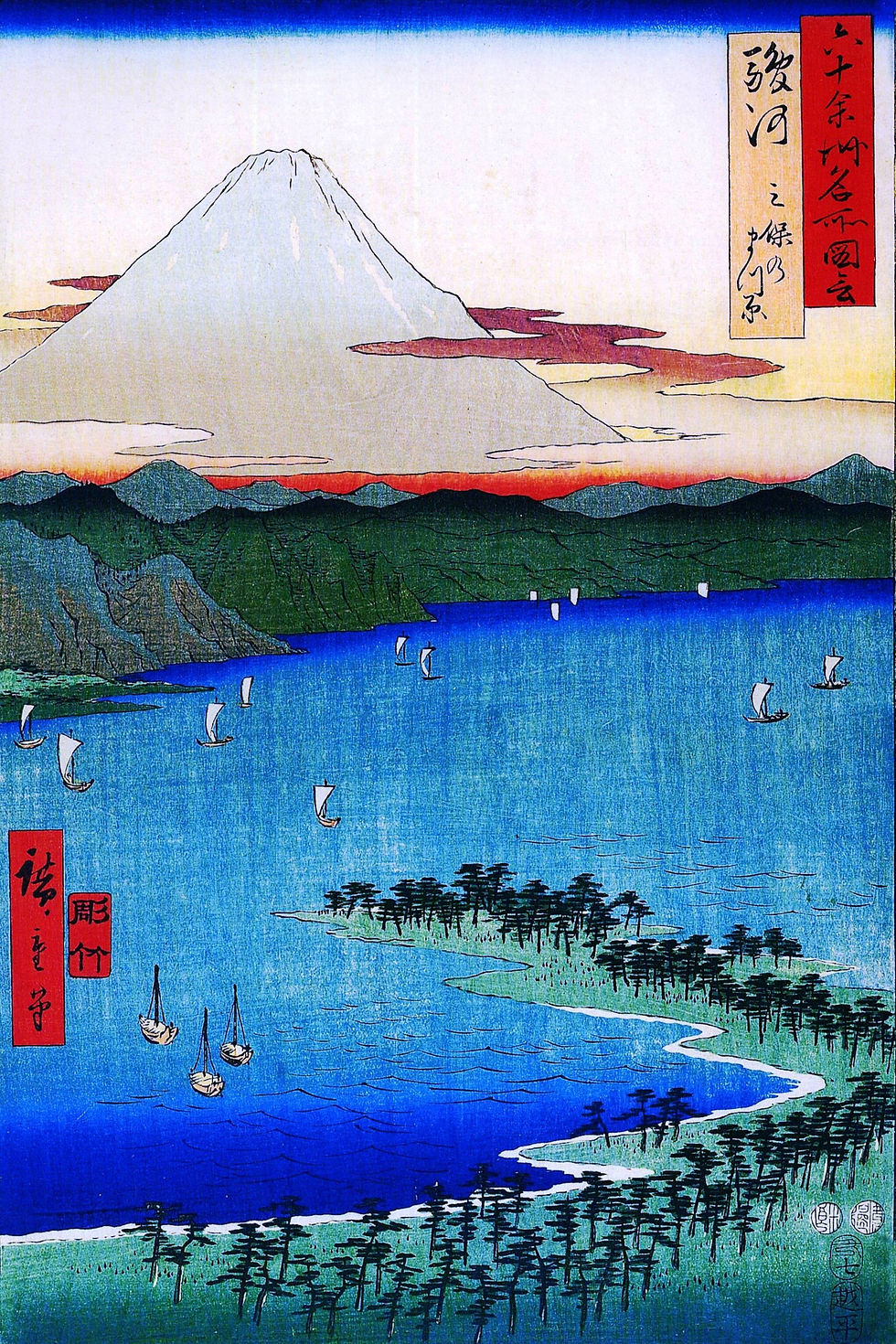
Utagawa Hiroshige, The Pine Grove at Mio in Suruga Province, circa 1856 - View source
A Tree Carries More Than One Calendar
Japanese landscape imagery is closely tied to seasonal change. The Met's discussion of seasonal imagery in Japanese art describes a visual culture in which weather, plants, and recurring natural events could carry poetic and religious associations. A pine therefore does not belong to one season in the same way that cherry blossoms belong to spring or autumn grasses belong to fall.
Its significance comes partly from its ability to remain legible across seasons. Snow may make the branches architectural. Rain may make them atmospheric. Sunset may turn them into silhouettes. The tree gathers different kinds of time without losing its identity. It gives the viewer a way to imagine duration not as a straight line, but as return.
This is where Hiroshige's old trees meet the wider emotional logic of his landscapes. His prints are full of passing moments - a shower, a moonrise, a final band of light, a traveler crossing a bridge. The ancient tree answers those moments with a slower register. It does not stop change. It makes change visible against something that has lasted.

Utagawa Hiroshige, Ejiri, Miho no ura, origin of the Hagoromo pine, circa 1845 - View source
From Landmark to Image
Hiroshige's trees also belong to the history of ukiyo-e as a reproducible art form. As the Met explains, landscape prints brought famous places, travel routes, and scenic views to a broad audience. A location could be encountered through a paper image before it was ever reached in person.
That circulation changed the meaning of a landmark. The pine at Karasaki was rooted in one place, but its image could travel into an Edo home. A viewer might know the site from a journey, from poetry, from another print, or only from the reputation carried by the series. The tree became both a physical presence and a portable memory.
This does not make the image less specific. It makes specificity shareable. Hiroshige's art preserves the particular curve of a branch, the direction of rain, the relation between grove and mountain, while allowing the emotional experience of standing before an old tree to move from one viewer to another.

Utagawa Hiroshige, Sunset at Seta, from the Eight Views of Omi - View source
Why Ancient Trees Still Speak to Us
The modern attraction of these prints is not only their color, line, or compositional daring. It is their understanding of visual grounding. An old tree gives a room, a picture, or a memory a point of weight. It reminds us that beauty does not always depend on novelty. Sometimes it depends on the feeling that something has continued to exist while we were elsewhere.
Hiroshige also offers a gentler idea of scale. Human figures remain small, but they are not mocked by the landscape. They walk, pause, travel, wait, and look. The tree makes their lives feel temporary, yet it also gives those lives a setting worthy of attention. Deep time does not cancel the everyday; it holds it.
That may be the lasting power of the ancient pine in Japanese art. It is not an escape from history or weather. It is a way of seeing both at once: the rain that will pass, the traveler who will leave, the light that will fade, and the living form that continues to stand within the view.
Comments