Banquet Still Life Wall Art for a Dining Room That Welcomes Company

The Table of Temptations supplies concentrated detail above a substantial sideboard. Havenest room visualization; framing and furnishings are shown for styling inspiration.
A dining room can feel most inviting just before anyone sits down. Glasses catch the light, a serving dish waits near the table, and the chairs still hold the promise of conversation. There is a little anticipation in the arrangement, even when dinner itself is simple.
A banquet still life can bring a related sense of occasion to the wall. Its abundance gives the eye somewhere to travel, moving among fruit, vessels, and folded fabric. The room around it does not need to reproduce that abundance. In fact, the picture may be most useful when it carries the detail that the furniture and tabletop leave open.
Havenest's The Table of Temptations brings grapes, gold-toned objects, and small discoveries into one composition. Looking closely at how those elements work together is the best starting point for deciding where the artwork belongs.
In this article
Follow the grapes through the composition
The grape clusters form a substantial middle ground in the illustrated work. Pale green fruit catches attention near the center, while darker purple grapes extend the arrangement toward the right. The change in color gives the cluster variety without breaking it into separate subjects. From a distance, the grapes read as a broad, connected mass; closer in, the individual forms become available.
Other objects set up a different rhythm around them. A cut pomegranate and an orange sit to the left. Oysters occupy a plate on the right. A tall clear glass and a gold-toned goblet rise above the fruit, while patterned olive-colored fabric spreads beneath. Your eye can move across the tabletop and then upward, rather than stopping at one isolated object.

Fruit, vessels, insects, and patterned cloth offer several routes through the composition.
The scene suggests hospitality and plenty through its arrangement. The glass and goblet introduce a sense of ceremony, while the fruit keeps the subject recognizable and immediate. In a dining room, that balance can be enough: a picture that makes an ordinary wall feel connected to the activity of gathering and eating.
Leave room for the small discoveries
After the broad arrangement comes the pleasure of detail. A butterfly appears near the right side of the composition, and a dragonfly occupies the space to the left. Their smaller forms interrupt the weight of the fruit and vessels. They give the eye another route through an image that might otherwise feel entirely grounded on the table.
The clear glass also asks for a different kind of attention from the gold-toned goblet beside it. One depends on visible edges and reflections; the other has a more solid presence. The fabric introduces another layer through its folds and decorative pattern. These contrasts make the picture more than a single block of rich color.
Choose a position where at least some of those details can be enjoyed. A wall seen only from the far end of a large room may reduce the work to its overall palette. That can still be attractive, but it gives up part of the image's interest. A dining area with a nearby seated view offers a chance to notice something different on successive occasions.
Give abundance a clear boundary
A detailed still life benefits from a setting that makes its edges easy to find. This does not require an empty or austere room. It asks for a clear relationship between the picture and its immediate neighbors. If a patterned curtain, a display shelf, and several smaller frames all meet around it, the main composition can lose its shape.
Begin with the section of wall directly surrounding the frame. Allow the work to register as one complete rectangle before the eye reaches another assertive element. A sideboard beneath it can provide a useful visual base, especially if the surface has a few larger objects rather than many unrelated small ones.

A pale surrounding wall gives the detailed composition a clear boundary.
Havenest's broader guide to dining room wall art considers how artwork relates to the room as a whole. For this particular piece, the question is more specific: where can a concentrated, detailed image lead comfortably? Establish that role first, and the decisions about accessories and adjacent pictures become less arbitrary.
Borrow one color relationship from the picture
The artwork offers several possible connections to an interior: olive and gold, dark grape and cream, or warm wood beside the brighter fruit. You do not need to use all of them. Choose the relationship that already has some support in the room, then let the remaining colors stay within the picture.
For example, dark furniture may connect naturally to the deeper areas of the composition, while a pale wall gives the gold-toned objects room to register. In a lighter dining room, a restrained olive textile could form a subtler bridge. Those are starting points for comparison, not prescriptions for a complete new scheme.

An alternative setting shows the picture beside large areas of pale fabric and dark wood.
Look at finish as well as color. A matte cloth and a reflective vessel behave differently even when their hues are related. The same distinction can make a real room more interesting. Our article on linen, wood, and soft art explains how materials can have separate roles. Here, let the picture supply the richest concentration of detail while the surrounding materials offer larger, simpler surfaces.
Keep the real table available for dinner
A banquet image can tempt you to build an elaborate tabletop beneath it. The room rarely needs such a literal response. The picture already contains fruit, glass, metal, and patterned cloth. The real table can remain available for plates, serving dishes, and the people who will move them around.
Start with the requirements of the meal. Leave enough space to set down a shared dish and to see the person opposite. If you add flowers or a decorative object, judge its position from a seated view. Something that looks attractive from the doorway can become an obstacle during conversation.
The artwork can carry a sense of occasion on days when the table is almost bare. That is one reason a dining room picture need not depend on seasonal decoration or a perfectly laid setting. A bowl of fruit may be present one week and absent the next. The image should still belong. Let it enrich the room's everyday use, rather than turning the room into a permanent display that has to be dismantled whenever company arrives.
Frame for detail and distance
A frame can either give a complex composition a firm boundary or add another layer of ornament. A narrow wood profile may connect easily to dining furniture. A gold-toned inner edge can pick up the metallic objects in the image. A decorative frame can work too, provided its pattern does not make the whole arrangement difficult to read.
Compare those options against the entire picture. Looking only at the goblet may lead you toward too much gold; looking only at the dark fabric may produce a heavier result than you intended. Step back to the distance from which the artwork will usually be seen and consider the image and frame as one object.
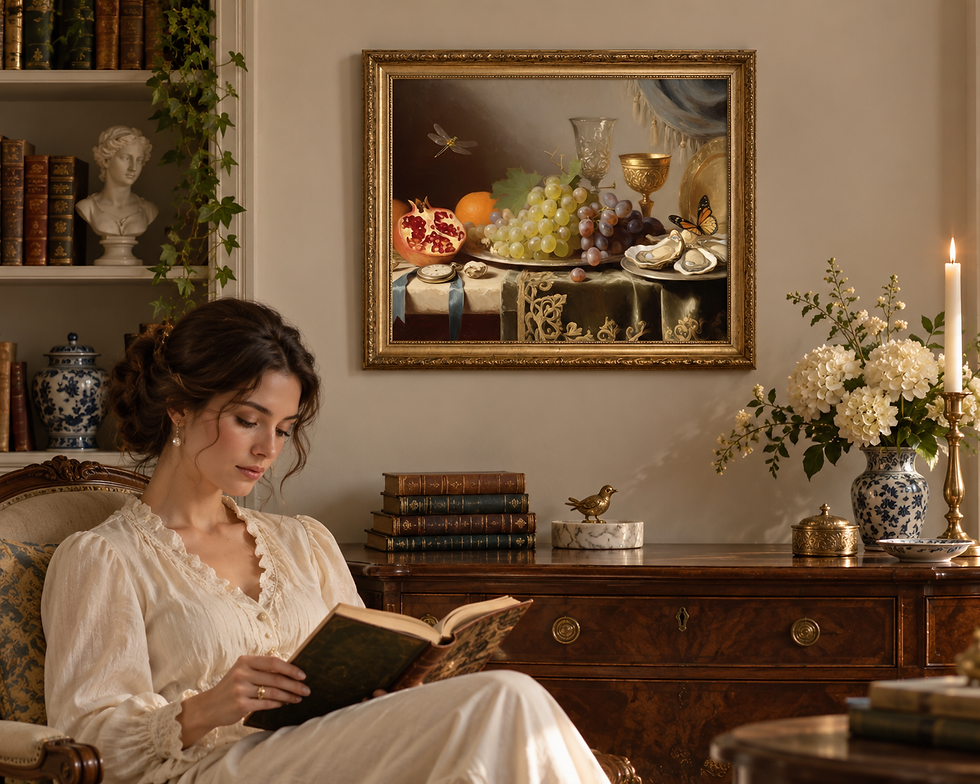
The frame and image need to work together from an ordinary seated view.
Measure that complete object before committing to a position above a sideboard. Our guide to hanging wall art above furniture offers useful placement questions. Then test a paper outline in your own room, allowing for any lamps or serving pieces below. Confirm the purchase format and framing requirements from the current listing and your chosen service rather than assuming that a room mockup specifies the finished dimensions.
Check the room after the lights come on
A dining room artwork may be seen most often in the evening, so daylight alone is not the final test. Switch on the lights you normally use for meals and check the proposed wall from several chairs. Look for reflections that interrupt the fruit or obscure the smaller details. Moving the picture or changing the direction of a nearby light may improve the view.
Notice how the composition holds together after dark. The distinction between the lighter grapes and deeper surrounding areas should remain enjoyable, even when you are not studying every detail. A room does not need theatrical illumination to support a substantial artwork; it needs a view that stays legible and comfortable during its ordinary use.

Assess the wall in the light you use for dinner, as well as during the day.
Then bring the decision back to the room's purpose. Does the picture make the dining area feel more like a place where you want to sit? Does it work when the table is clear, when dinner is underway, and when a chair has been moved out of line? A convincing setting makes room for all three. The artwork supplies the feast of details; the household supplies the actual company.
If the composition suits the room you have in mind, explore Havenest's banquet still life on Etsy. Review the current listing for the purchase details and available imagery, then choose a framing and placement plan that fits your own space.
A welcoming dining room does not have to remain formally arranged. Sometimes a single picture can hold the richness on the wall, leaving the table free for whatever the evening brings.
Written by Max · Havenest Content Team
Comments